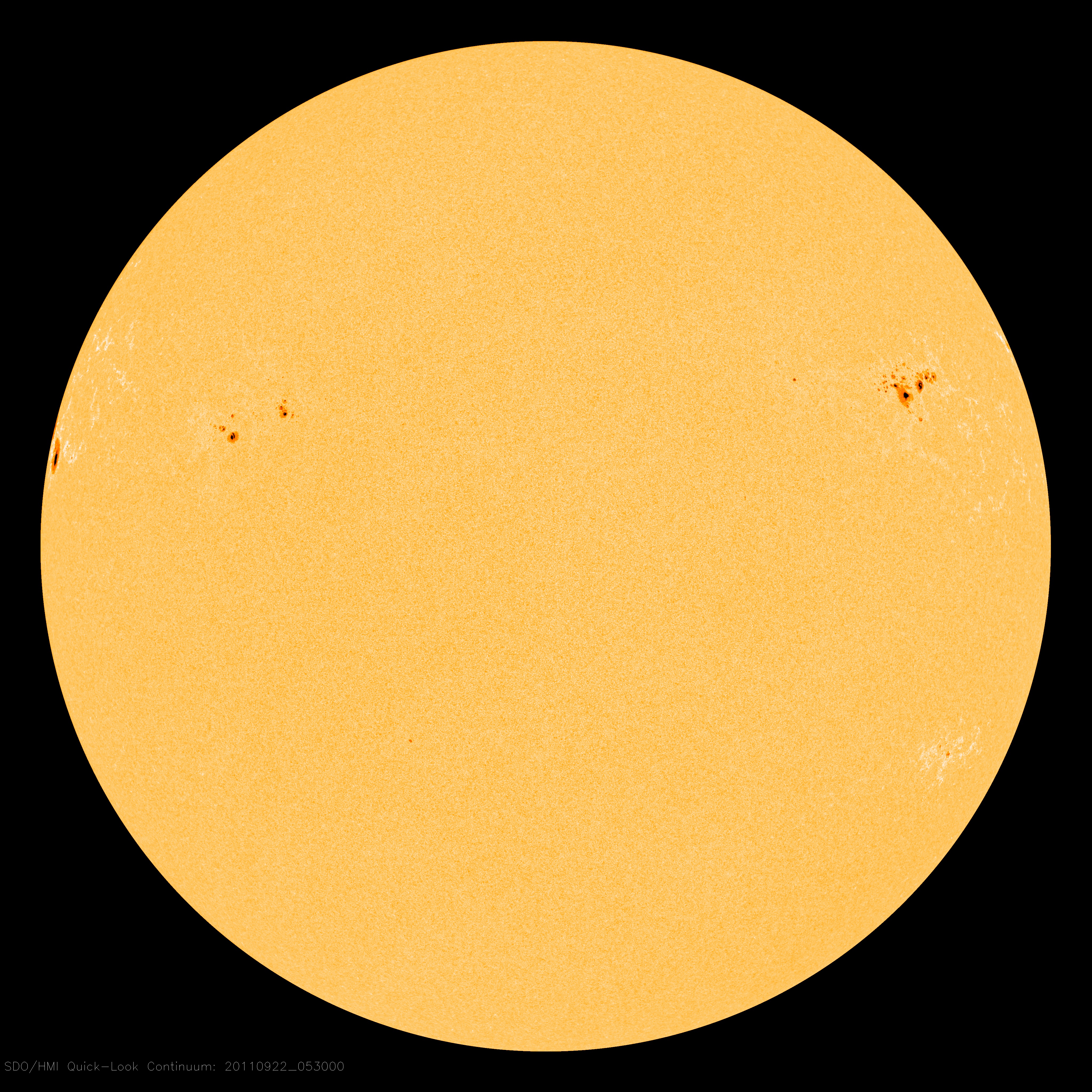
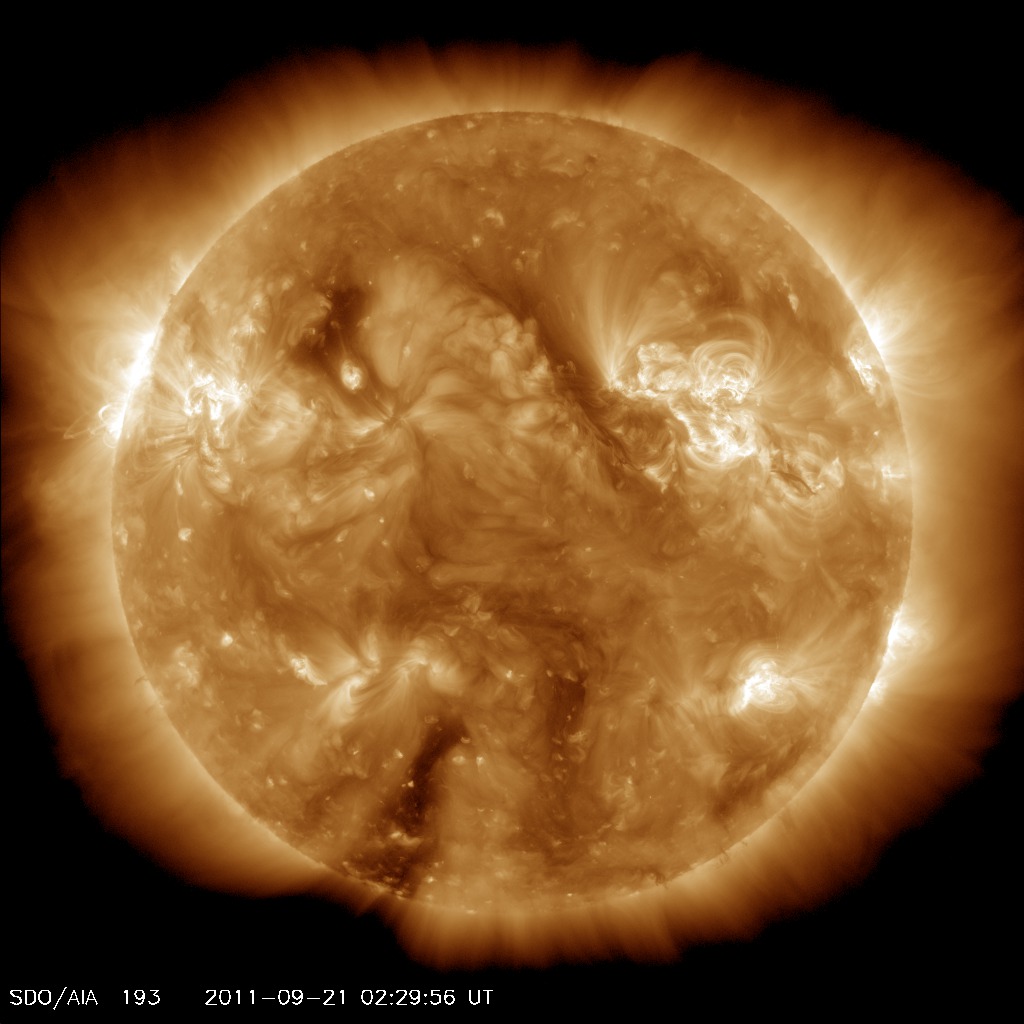
Metallic photos of the sun by renowned photographer Greg Piepol bring together the best of art and science. Buy one or a whole set. They make a stellar gift. | | |
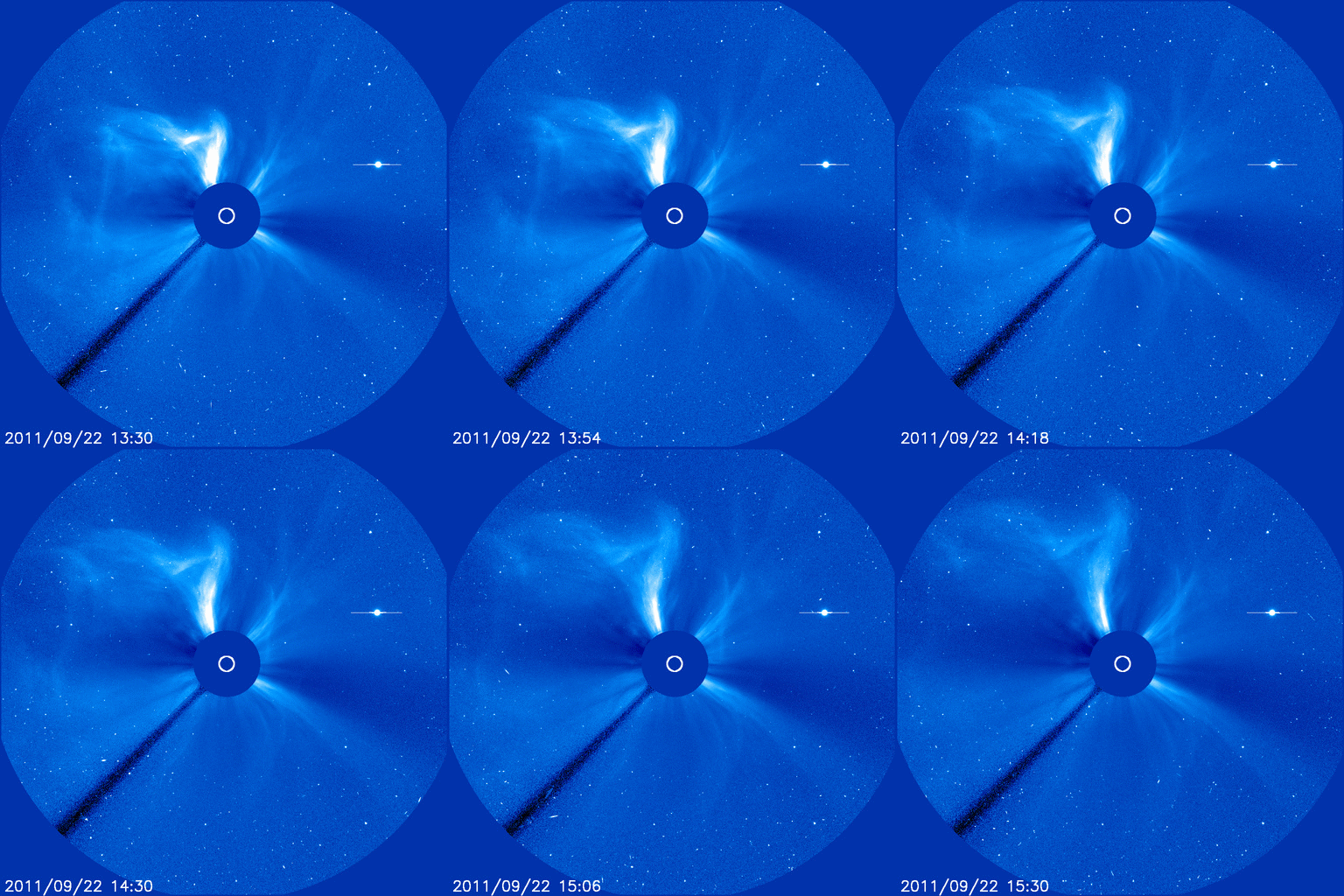
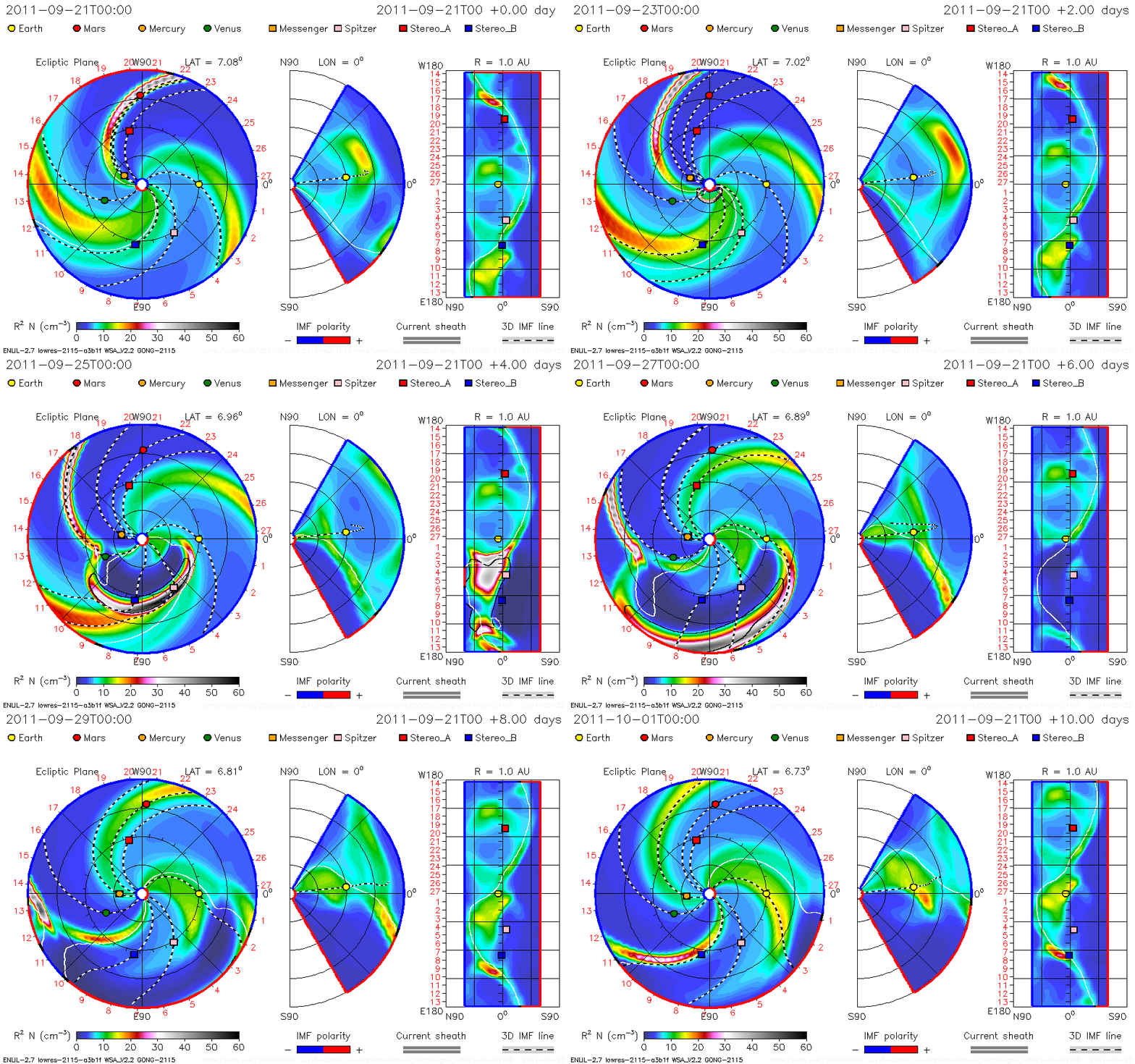
MAJOR X-FLARE + CME UPDATE: Earth-orbiting satellites have detected a long-duration X1.4-class solar flare coming from a new sunspot on the sun's eastern limb. The blast, which peaked at 1100 UT, produced a significant coronal mass ejection (CME). Using data from the SOHO-STEREO fleet of spacecraft, analysts at the Goddard Space Weather Lab have modeled the trajectory of the CME and concluded that the body of the cloud will not hit Earth. A minor glancing encounter with the outskirts of the CME is, however, possible on Sept. 25th. [CME: movie, forecast track]
AURORAS UNDERFOOT: Solar activity is picking up, and no one has a better view of its effect on Earth than the crew of the International Space Station. During a geomagnetic storm on Sept. 17th, astronauts recorded a must-see movie of auroras dancing underfoot:
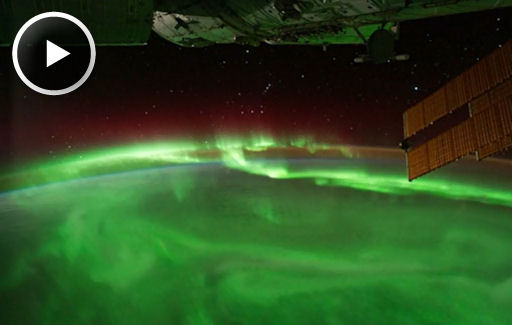
Taken over the southern Indian Ocean, the movie spans a 23-min period from 17:22:27 to 17:45:12 GMT on Sept. 17.
Note how the underbelly of the space station glows green from the reflected light of the auroras below. Also, in the distance, Sirius the dog star and Orion the Hunter can be seen rising feet-first into the night sky.
The storm, which registered a moderate 6 on the 0-to-9 K-index scale of geomagnetic disturbances, was caused by a coronal mass ejection (CME) hitting Earth's magnetic field. It was just a glancing blow, but with CMEs that is often enough to spark bright auroras over both ends of Earth. The space station was flying over the southern hemisphere at the time of the display. Observers in the northern hemisphere saw it too.
A similar storm could be in the offing this week. Another CME is heading toward Earth, and it appears likely to deliver a glancing blow on Sept. 22nd around 23:00 UT. Sky watchers above and below should be alert for auroras. Aurora alerts: text, voice.
September 2011 Aurora Gallery
[previous Septembers: 2010, 2009, 2008, 2007, 2006, 2005, 2004]
RE-ENTRY ALERT: NASA's UARS satellite is making its final orbits around Earth, tumbling and flashing brightly as it descends toward a Sept. 23rd re-entry. Amateur astronomer Jim Saueressig II caught the bus-sized satellite flying over Burlington, Kansas, on Sept. 20th (image). "It was easily visible in spite of the moonlight and the twilight of the sunrise. The tumble and associated flares were very apparent," he says.
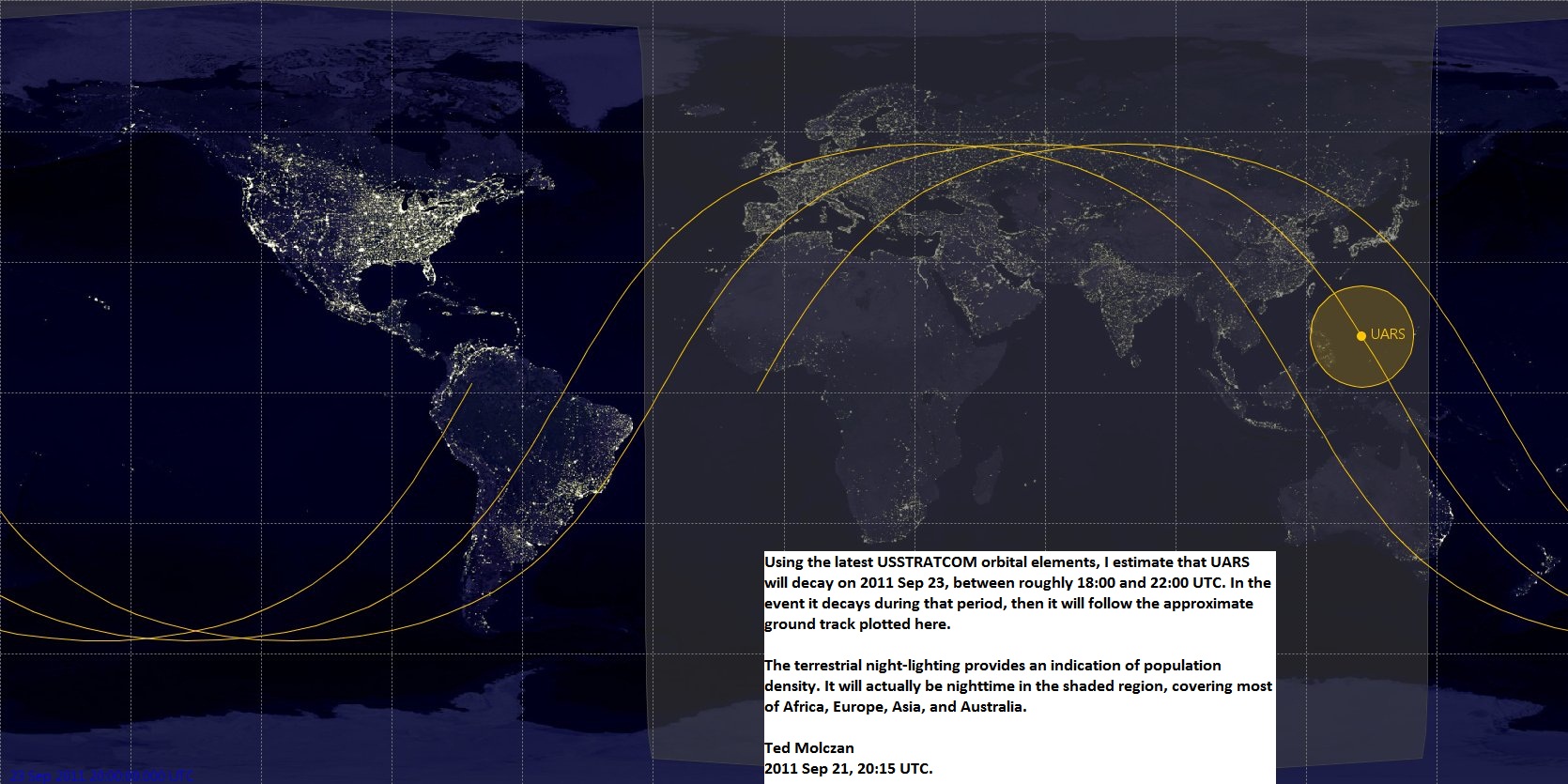
Satellite tracking expert Ted Molczan has used USSTRATCOM's orbital elements of UARS to predict a decay time "late on Sep 23, roughly between 18:00 and 22:00 UTC." Click on the map to view ground tracks corresponding to this interval:
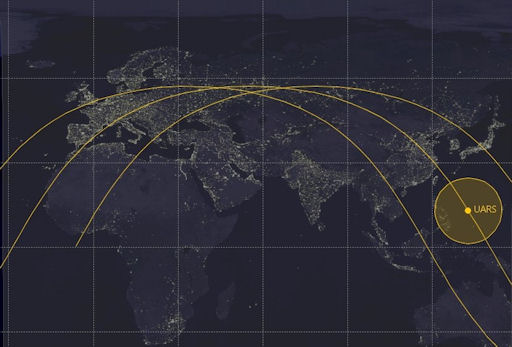
"There is still potential for the estimated time of decay to shift somewhat before it begins to narrow down," cautions Molczan.
The disintegration of UARS is expected to produce a fireball that could be visible even in broad daylight. Not all of the spacecraft will burn up in the atmosphere, however; according to a NASA risk assessment, as many as 26 potentially hazardous pieces of debris could be scattered along a ground track some 500 miles long. The same report puts the odds of a human casualty at 1 in 3200.
For last-chance sightings of this brightly flashing satellite, please check the Simple Satellite Tracker or download the Satellite Flybys app for your smartphone.
more images: from Theirry Legault of Dunkerque, France; from Oscar Martín Mesonero of Madrid, Spain;