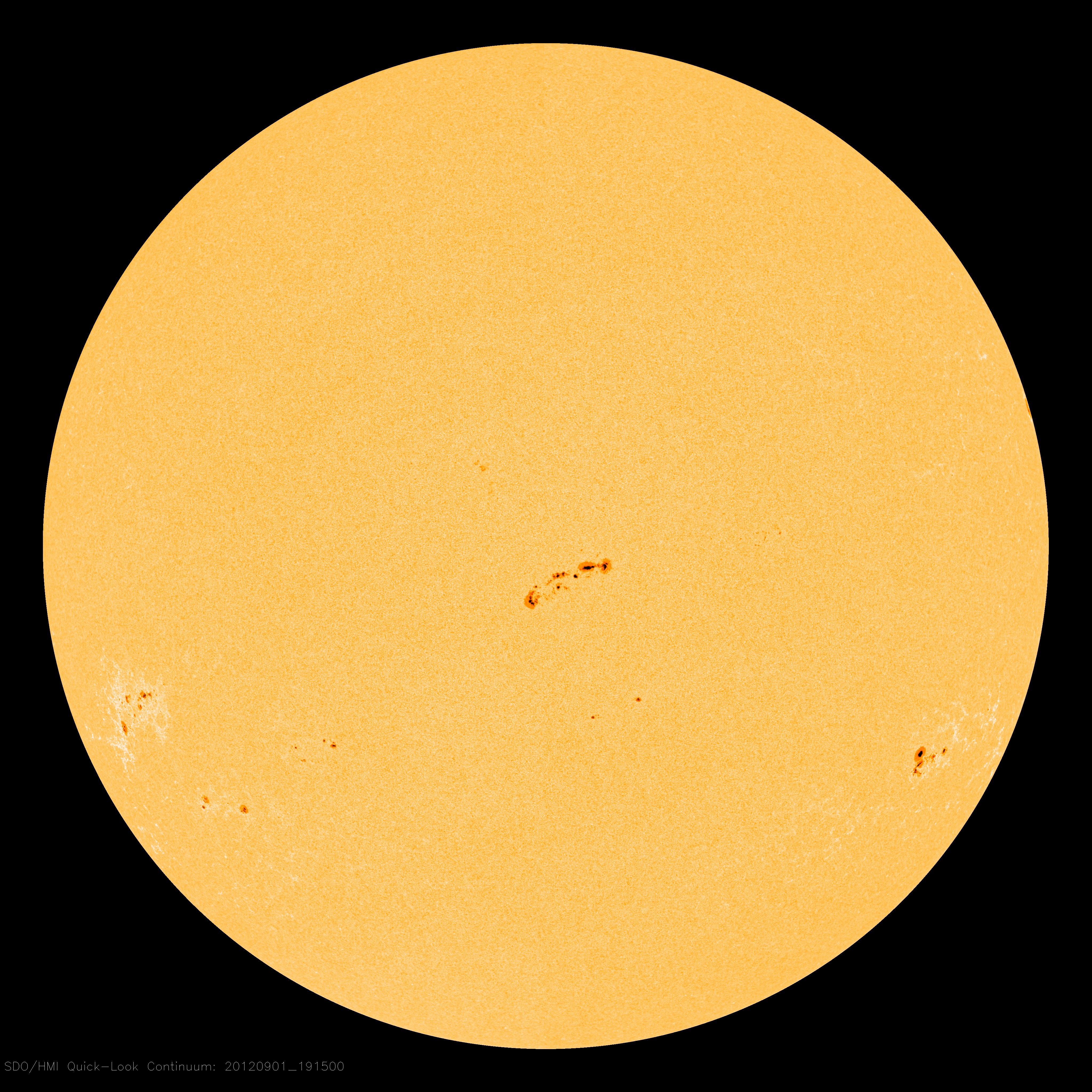
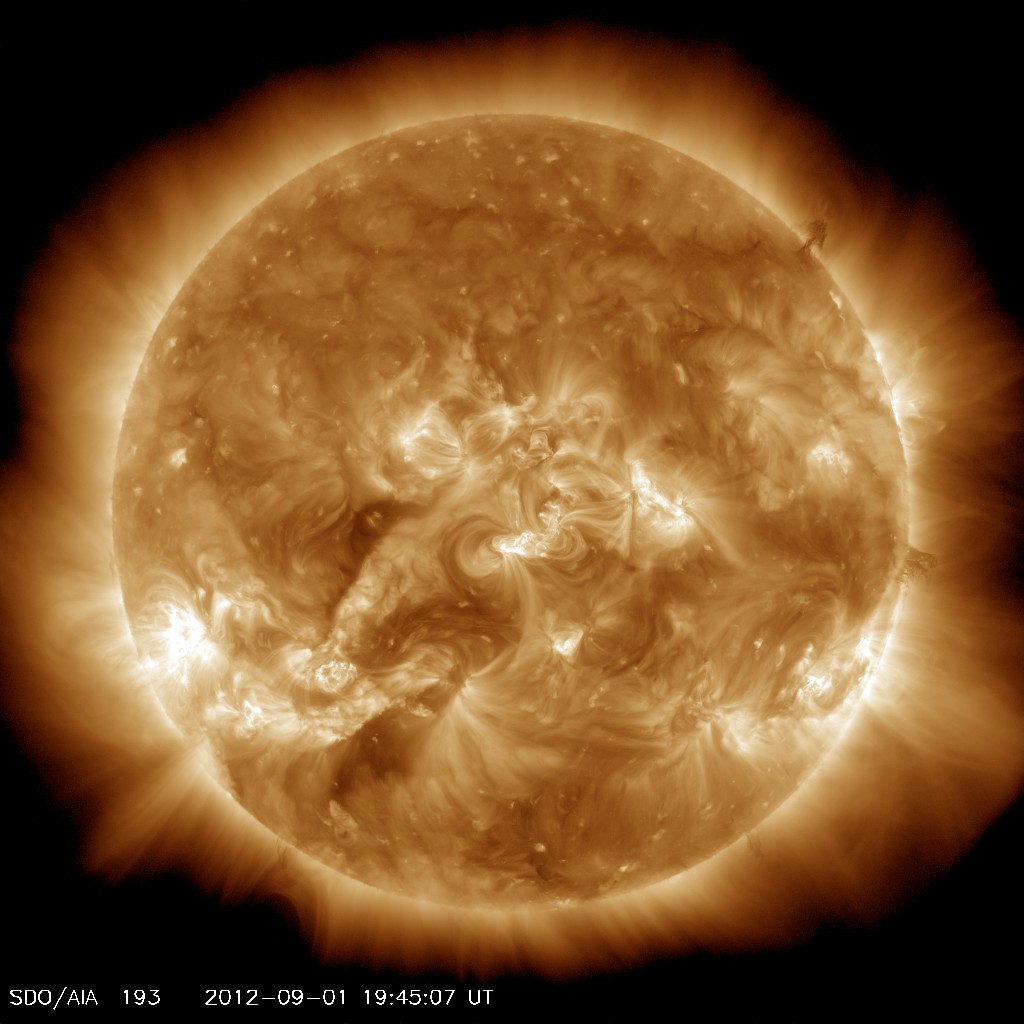
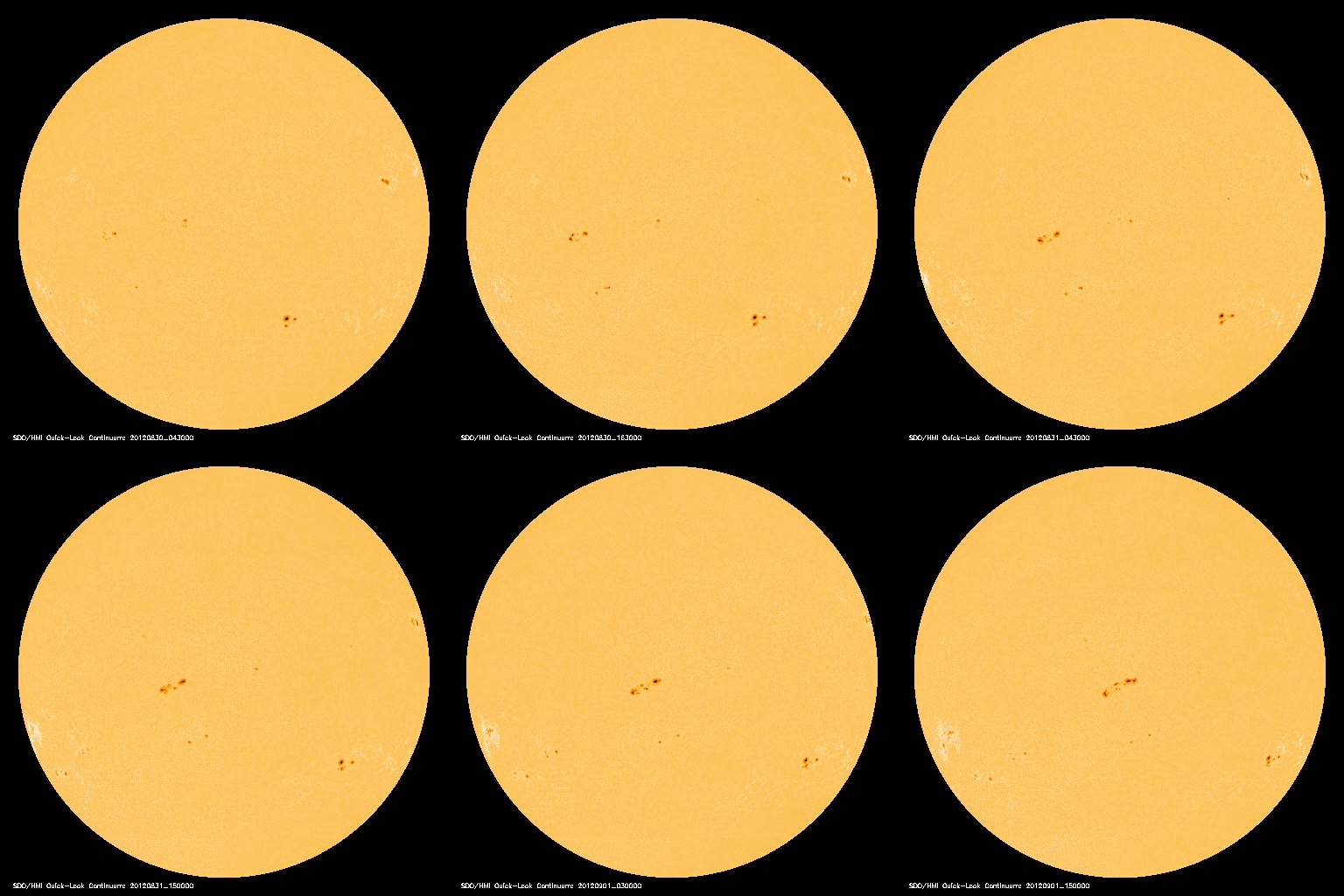
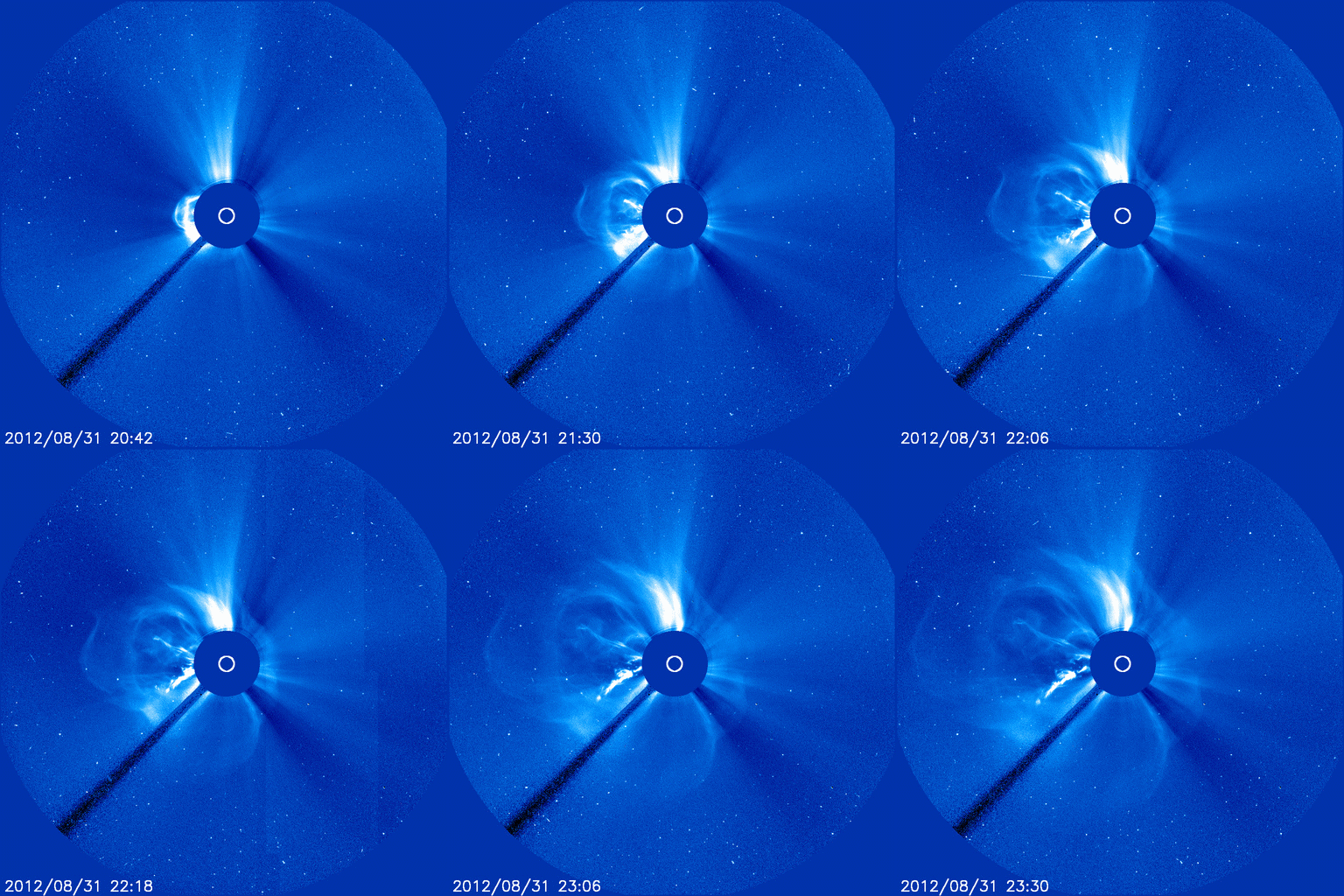
Thirty-five new items have just been added to our Meteorite Jewelry collection. Browse the Space Weather Store for something out of this world. | | | CHANCE OF FLARES: Sunspot AR1560 has more than quadrupled in size since August 30th, and now the fast growing active region is directly facing our planet: movie. NOAA forecasters estimate a 40% chance of M-class solar fares during the next 48 hours. Solar Flare alerts: text, phone. MAGNIFICENT ERUPTION: A filament of magnetism curling around the sun's southeastern limb erupted on August 31st, producing a coronal mass ejection (CME), a C8-class solar flare, and one of the most beautiful movies ever recorded by NASA's Solar Dynamics Observatory: 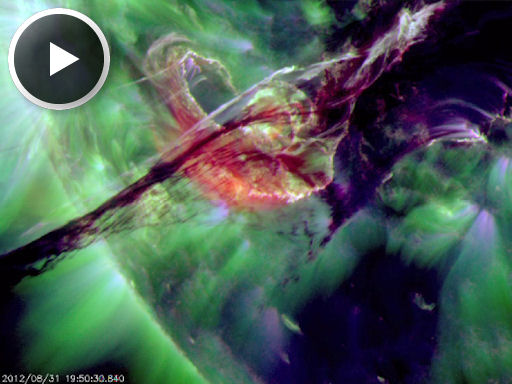
The explosion hurled a CME away from the sun traveling faster than 500 km/s (1.1 million mph). The cloud, shown here, is not heading directly toward Earth, but it could deliver a glancing blow to our planet's magnetic field on or about September 3rd. This date is preliminary and may be changed in response to more data from coronagraphs on the Solar and Heliospheric Observatory (SOHO). Stay tuned. Realtime Space Weather Photo Gallery
Realtime Aurora Photo Gallery
Realtime Noctilucent Cloud Photo Gallery
[previous years: 2003, 2004, 2005, 2006, 2007, 2008, 2009, 2011] Potentially Hazardous Asteroids ( PHAs) are space rocks larger than approximately 100m that can come closer to Earth than 0.05 AU. None of the known PHAs is on a collision course with our planet, although astronomers are finding new ones all the time. On September 1, 2012 there were 1330 potentially hazardous asteroids. Notes: LD means "Lunar Distance." 1 LD = 384,401 km, the distance between Earth and the Moon. 1 LD also equals 0.00256 AU. MAG is the visual magnitude of the asteroid on the date of closest approach. | | The official U.S. government space weather bureau | | | The first place to look for information about sundogs, pillars, rainbows and related phenomena. | | | Researchers call it a "Hubble for the sun." SDO is the most advanced solar observatory ever. | | | 3D views of the sun from NASA's Solar and Terrestrial Relations Observatory | | | Realtime and archival images of the Sun from SOHO. | | | from the NOAA Space Environment Center | | | the underlying science of space weather | |