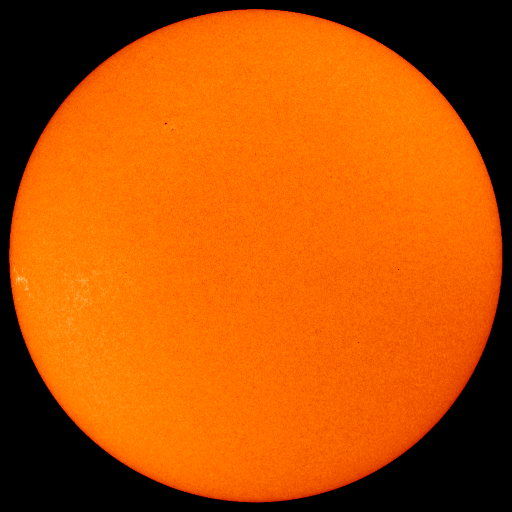
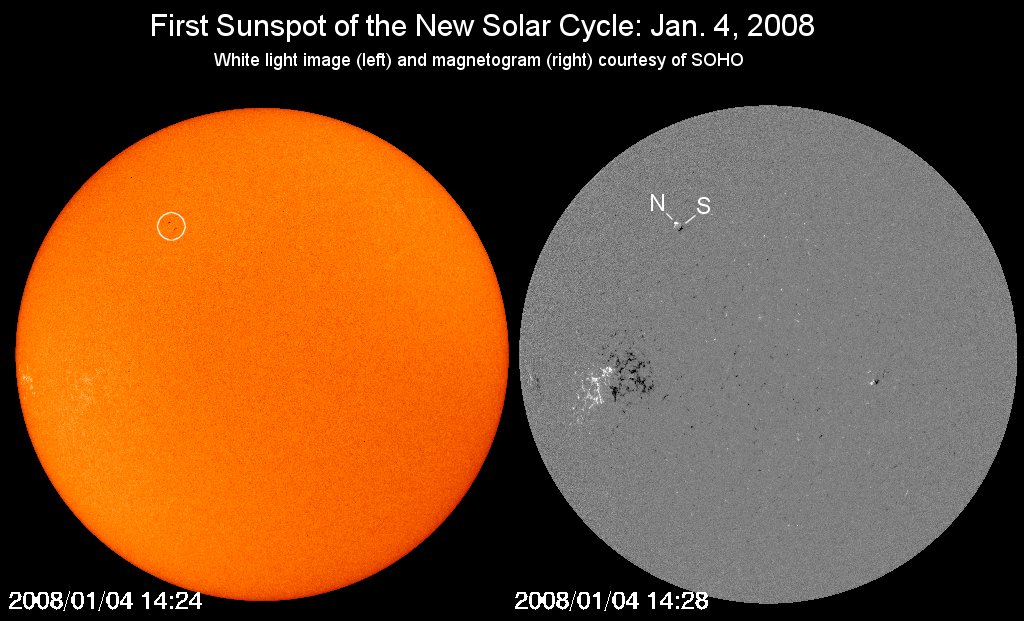
 Where's Saturn? Is that a UFO--or the ISS? What's the name of that star? Get the answers from mySKY--a fun new astronomy helper from Meade. Where's Saturn? Is that a UFO--or the ISS? What's the name of that star? Get the answers from mySKY--a fun new astronomy helper from Meade. SOLAR CYCLE 24: Solar physicists have been waiting for the appearance of a reversed-polarity sunspot to signal the start of the next solar cycle. The wait is over. A magnetically reversed, high-latitude sunspot emerged today: image. If you have a solar telescope, take a look at this important new active region. It marks the beginning of Solar Cycle 24 and the sun's slow ascent back to Solar Maximum. QUADRANTID METEORS: The 2008 Quadrantid meteor shower peaked around 0200 UTC on Friday, Jan. 4th. That is the initial report from astronomers who flew a research airplane north of the Arctic Circle for an uninterrupted view of the shower. The team, led by Peter Jenniskens of the SETI Institute, witnessed many bright Quadrantids among an "amazing display" of aurora borealis; this is a typical view through the plane's starboard window: 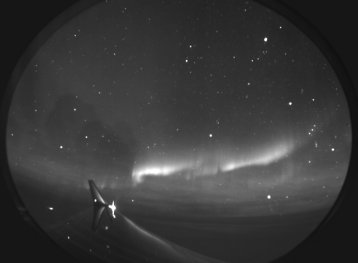
More photos from the Arctic Quadrantid MAC flight
The timing of the peak suggests that Quadrantid debris comes from the breakup of a comet circa 1490 AD. The largest known remaining fragment of the comet is now catalogued as 2003 EH1, a near-Earth asteroid. more images: from Brian Emfinger of Ozark, Arkansas; from Jeffrey Berkes of West Chester, PA; from Radek Grochowski near Swidnica, Poland TIME BOMB: Tick-tock, tick-tock. It's been 71 days since Comet 17P/Holmes exploded on Oct. 24, 2007, brightening almost a million-fold to naked-eye visibility. This means it could be time for another explosion. To understand why 71 days is significant, we turn back the clock to the year 1892. (continued below) 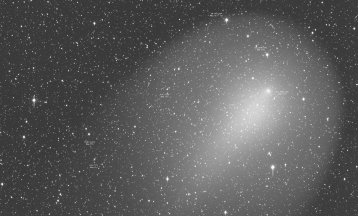
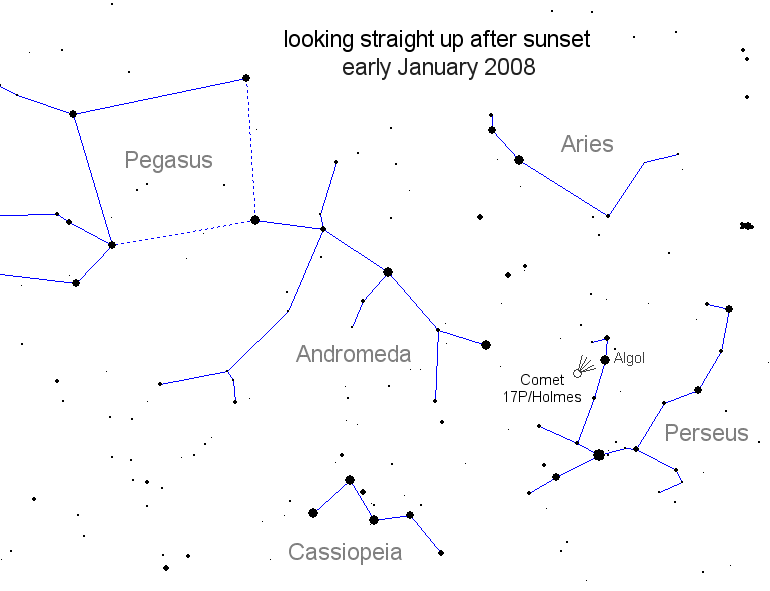
Above: Comet 17P/Holmes on Jan. 3, 2008. Photo credit: Mike Holloway of Van Buren, Arkansas: gallery. Comet Holmes was discovered on Nov. 6, 1892, by astronomer Edwin Holmes while he was making observations of the Andromeda Galaxy. He noticed the comet not far from Andromeda when it "exploded"--a brightening akin to that of Oct. 2007. It was quite a sensation as observers around the world suddenly were able to see the comet with the naked eye. Interest faded as the comet expanded and dimmed, but then, 71 days later on Jan. 16, 1893, Holmes exploded again! Deja vu? No one knows why Holmes occasionally explodes. Theories range from tiny moonlets crashing into the comet's icy surface to great comet-caverns collapsing under the stress of sunlight. The interval 71 days may have no significance at all. But on this anniversary of a double explosion, it reminds us to keep an eye on Comet 17P/Holmes. Finding the comet is easy. Tonight, after sunset, take your binoculars outside and scan the northern constellation Perseus: sky map. Holmes is readily visible as a big pale fuzzball near the variable star Algol. On January 21-23, the comet will pass directly in front of Algol; the view through a backyard telescope should be dynamite! Comet 17P/Holmes Photo Gallery
[World Map of Comet Sightings]
[sky map] [ephemeris] [orbit] [comet binoculars] |