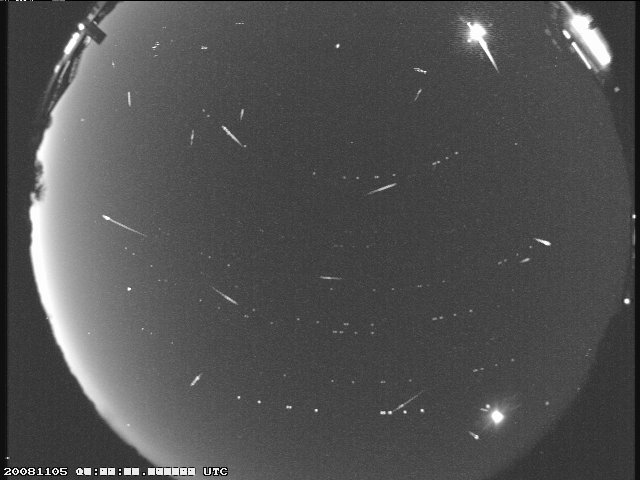
| WAKE UP! Did you sleep through the auroras of October? Next time get a wake-up call: Spaceweather PHONE. | | | AURORA ALERT: High-latitude sky watchers should be alert for Northern Lights tonight. Earth is entering a high-speed solar wind stream and this is sparking auroras around the Arctic Circle: gallery. TAURID FIREBALLS: During the night of November 4th-5th, astronomers at the Marshall Space Flight Center video-recorded six explosions on the Moon. The blasts were caused by Taurid meteoroids hitting the lunar surface. "The Moon is experiencing a good meteor shower," says Bill Cooke of the NASA Meteoroid Environment Office. So is Earth. A NASA all-sky monitoring station in Walker County, Georgia, recorded more than a dozen bright meteors and fireballs on same night the Moon was getting hit. This 9-hour composite image shows the activity at a glance: 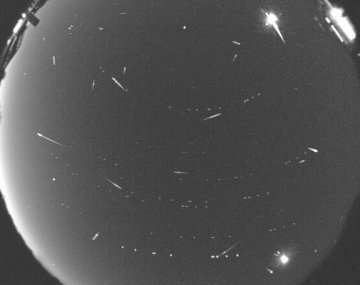
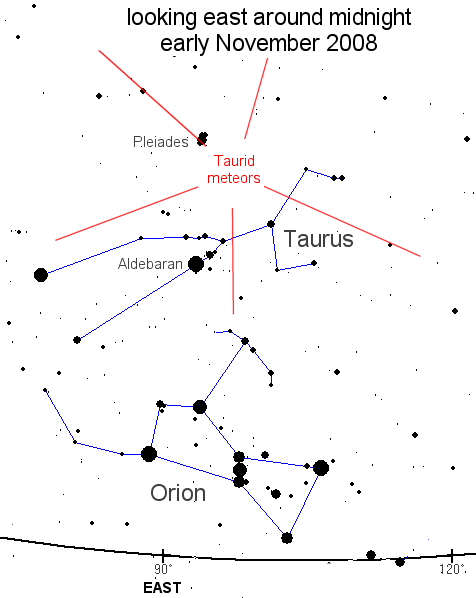
The best Taurid of the evening was a centimeter-sized nugget that self-destructed in flight. It's the magnitude -5 flash in the upper right corner of the composite image: 5MB movie. The show's not over. Between Nov. 5th and 12th, the Earth-Moon system will be passing through a swarm of gritty debris from parent comet 2P/Encke. When the same thing happened in 2005, sky watchers observed a slow drizzle of midnight fireballs for nearly two weeks. So be alert for Taurids! The best time to look is anytime after dark. The constellation Taurus (where Taurids appear) rises at sunset and stays up all night long: sky map. 2008 Taurid Fireball Gallery
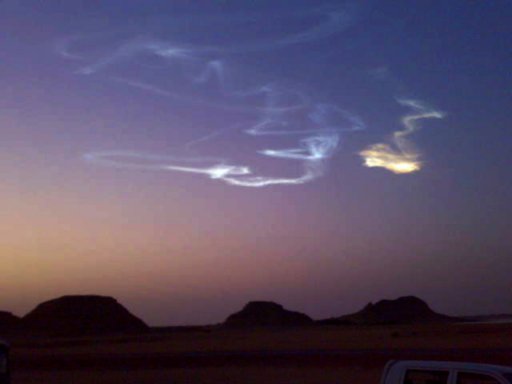
[2005 Taurids: on Earth, on the Moon] DISINTEGRATED ASTEROID: Asteroid 2008 TC3 was discovered on Oct. 6, 2008, and a day later it hit Earth. The 3 meter-wide space rock disintegrated in the atmosphere, producing a fireball about as bright as a full Moon. Although the time and location of impact were predicted with some precision, few people saw it because it happened over a remote area of northern Sudan. Now, for the first time, a ground-based photo has come to light: 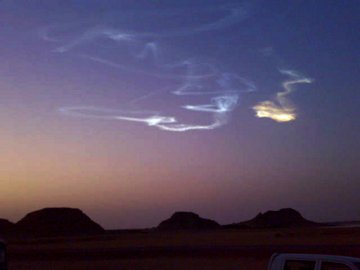
This is a single frame from a video taken by Mr. Mohamed Elhassan Abdelatif Mahir and communicated by Dr. Muawia H. Shaddad of the University of Karthoum. It shows the fireball's aftermath--a smoky trail of debris twisted by high-altitude winds and illuminated by the rising sun. Researchers hope publication of this photo will encourage other photographers to come forward and submit their images of the debris or, better yet, the fireball itself. Readers, were you in Sudan on Oct. 7th? Send your fireball reports and photos to meteor expert Peter Jenniskens of the SETI Institute. Your data could improve the chances of recovering meteorites.
UPDATED: Nov. 2008 Aurora Gallery
[Previous Novembers: 2007, 2006, 2004, 2003, 2001, 2000] |