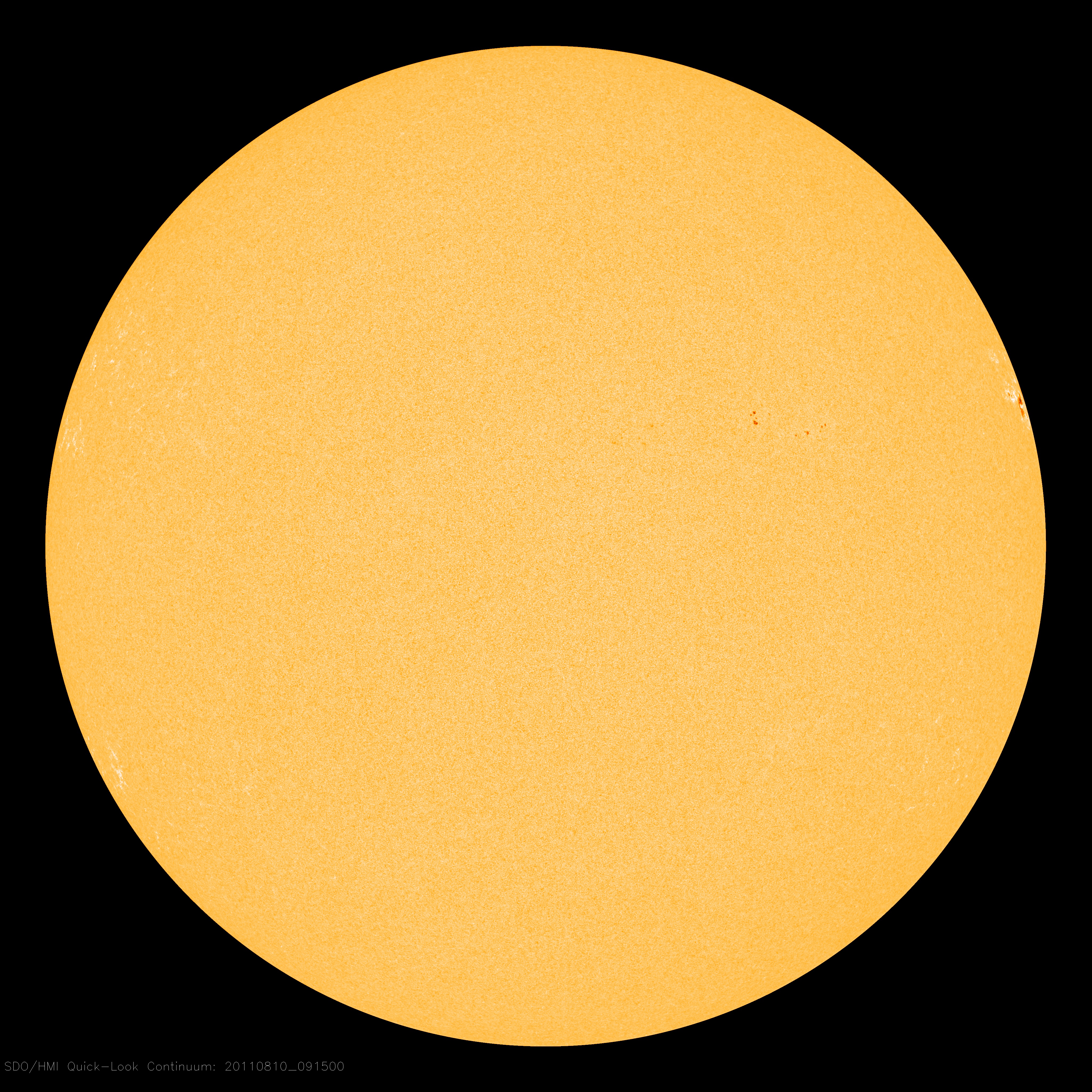
Metallic photos of the sun by renowned photographer Greg Piepol bring together the best of art and science. Buy one or a whole set. They make a stellar gift. | | |
PERSEID METEOR SHOWER: Earth is entering a stream of debris from Comet Swift-Tuttle, source of the annual Perseid meteor shower. International observers are now reporting more than a dozen Perseids per hour, a number that will increase as the shower reaches its peak on August 12-13. Full moonlight will reduce visibility on peak night, but not enough to completely spoil the show. The best time to look is Saturday morning, Aug. 13, just before dawn when the Moon is low, the shower is peaking, and the ISS is flying overhead. Also, be sure to tune into Space Weather Radio to hear the ghostly pings of Perseids disintegrating over the US Air Force's Space Surveillance Radar.
What was that? Dawn is a great time to see satellites. There are hundreds in Earth orbit, and you're sure to see some of them while you're watching the Perseids. This app for Android phones can tell you what you're seeing.
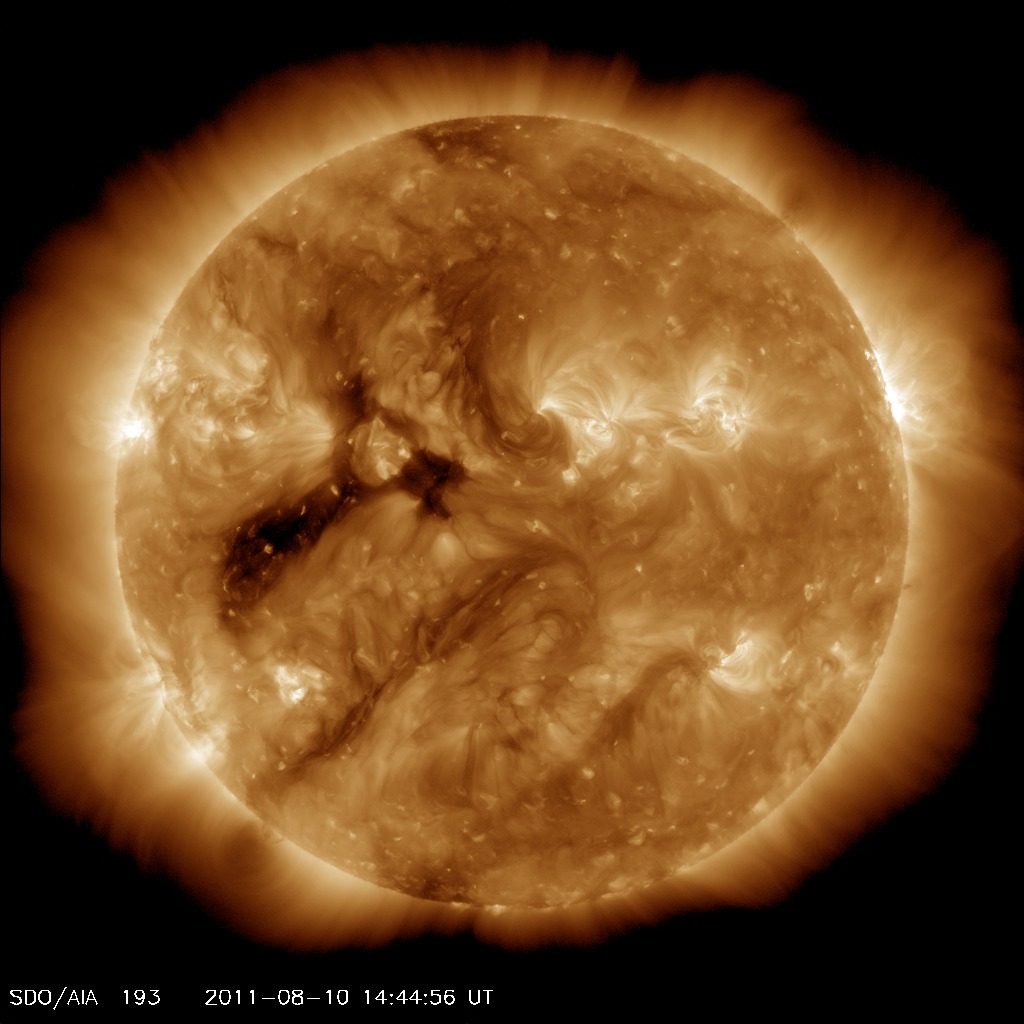
MAJOR FLARE, NOT EARTH-DIRECTED: On August 9th at 0805 UT, sunspot 1263 produced an X7-class solar flare--only the third X-flare of new Solar Cycle 24 and the most powerful so far. NASA's Solar Dynamics Observatory captured the explosion's extreme ultraviolet flash:
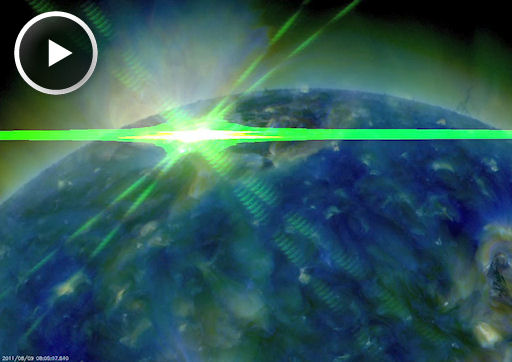
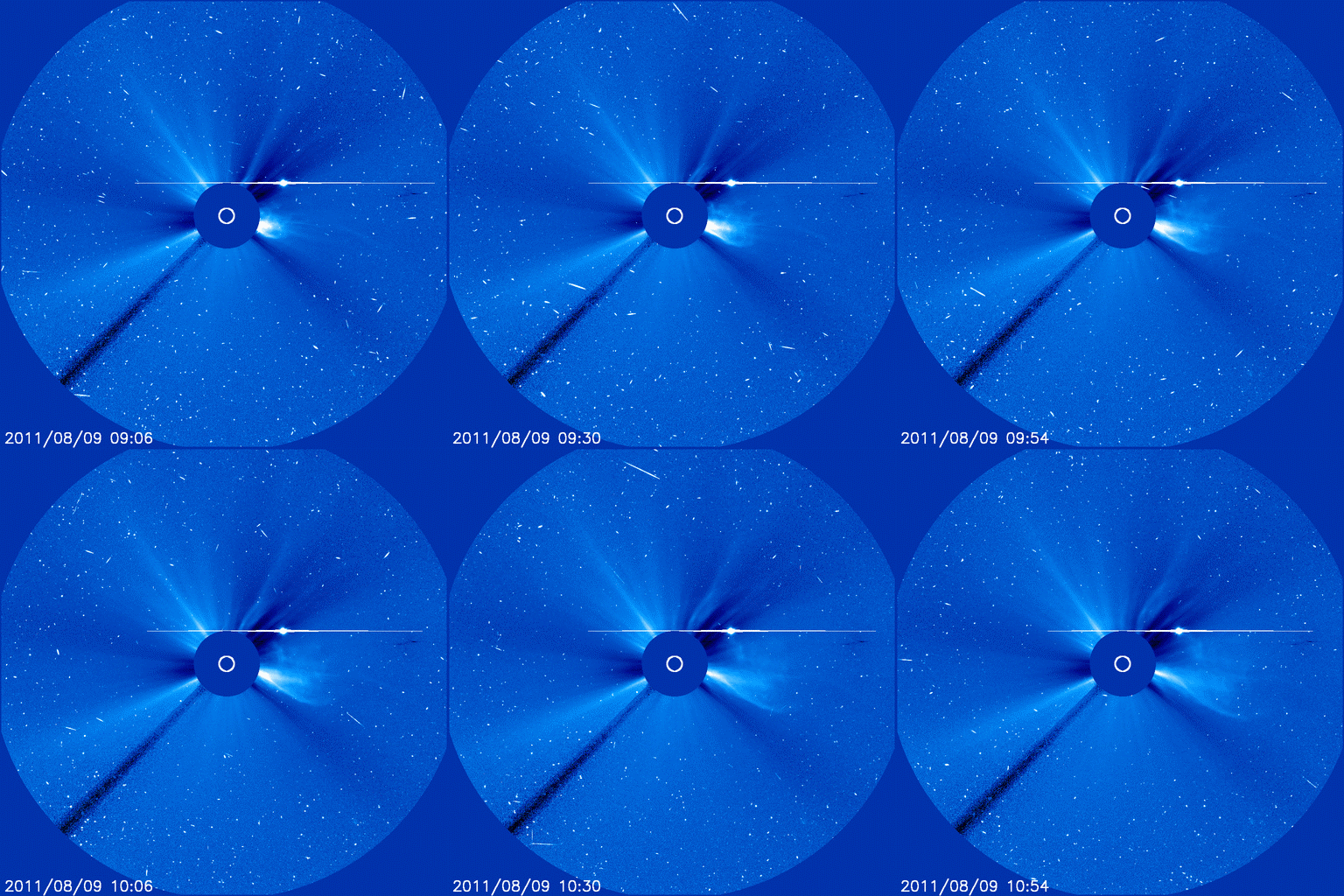
The brunt of the explosion was not Earth directed. Nevertheless, radiation from the flare created waves of ionization in Earth's upper atmosphere, briefly disrupting communications at some VLF and HF radio frequencies. The blast also accelerated a mild torrent of protons toward Earth; they can be seen speckling the images in this SOHO movie of a CME emerging from the blast site. The CME will probably miss Earth. At this time, however, we cannot rule out a glancing blow from the flank of the cloud on August 11th or 12th. Stay tuned for additional analysis. Solar flare alerts: text, voice.
X-flares of Solar Cycle 24: Feb. 15, 2011 (X2), March 9, 2011 (X1), Aug. 9, 2011 (X7). Before these three, the previous X-flare occured on Dec.14, 2006, (X1) during old Solar Cycle 23.
WEEKEND AURORAS: A widespread display of auroras erupted late Friday, Aug. 5th, when a double-CME hit Earth's magnetic field and sparked a G4-category geomagnetic storm. Click on the image to view a time lapse video of the event recorded by Michael Ericsson on the shores of Tibbitt Lake in the Northwest Territories of Canada:
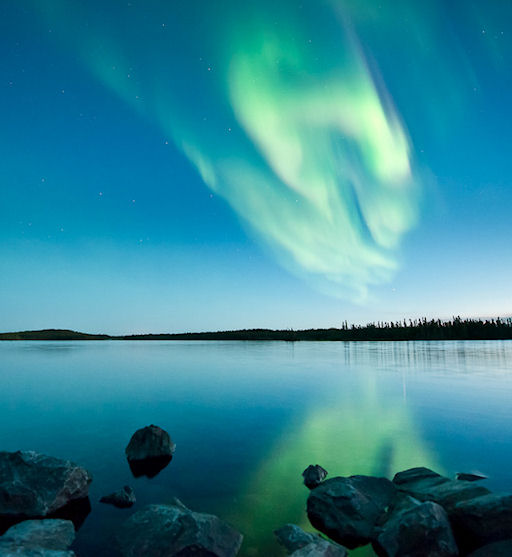
"Although not the most intense auroras I've ever seen, this one is definitely up there on my favorites list," he says.
The show was not restricted to Canada. Northern Lights spilled across the border into the United States as far south as Oregon, Utah, Colorado, and Nebraska. (Note: The faint red lights photographed in Nebraska are typical of low-latitude auroras during major geomagnetic storms.) Observers in Europe as far south as England, Germany and Poland also witnessed a fine display. Browse the gallery for more examples.
Did you miss the show? Don't let that happen again. Sign up for geomagnetic storm alerts: text, voice.
August 2011 Aurora Gallery
[previous Augusts: 2010, 2009, 2008, 2007, 2006, 2005, 2004, 2003, 2002]
2011 Noctilucent Cloud Gallery
[previous years: 2003, 2004, 2005, 2006, 2007, 2008, 2009]