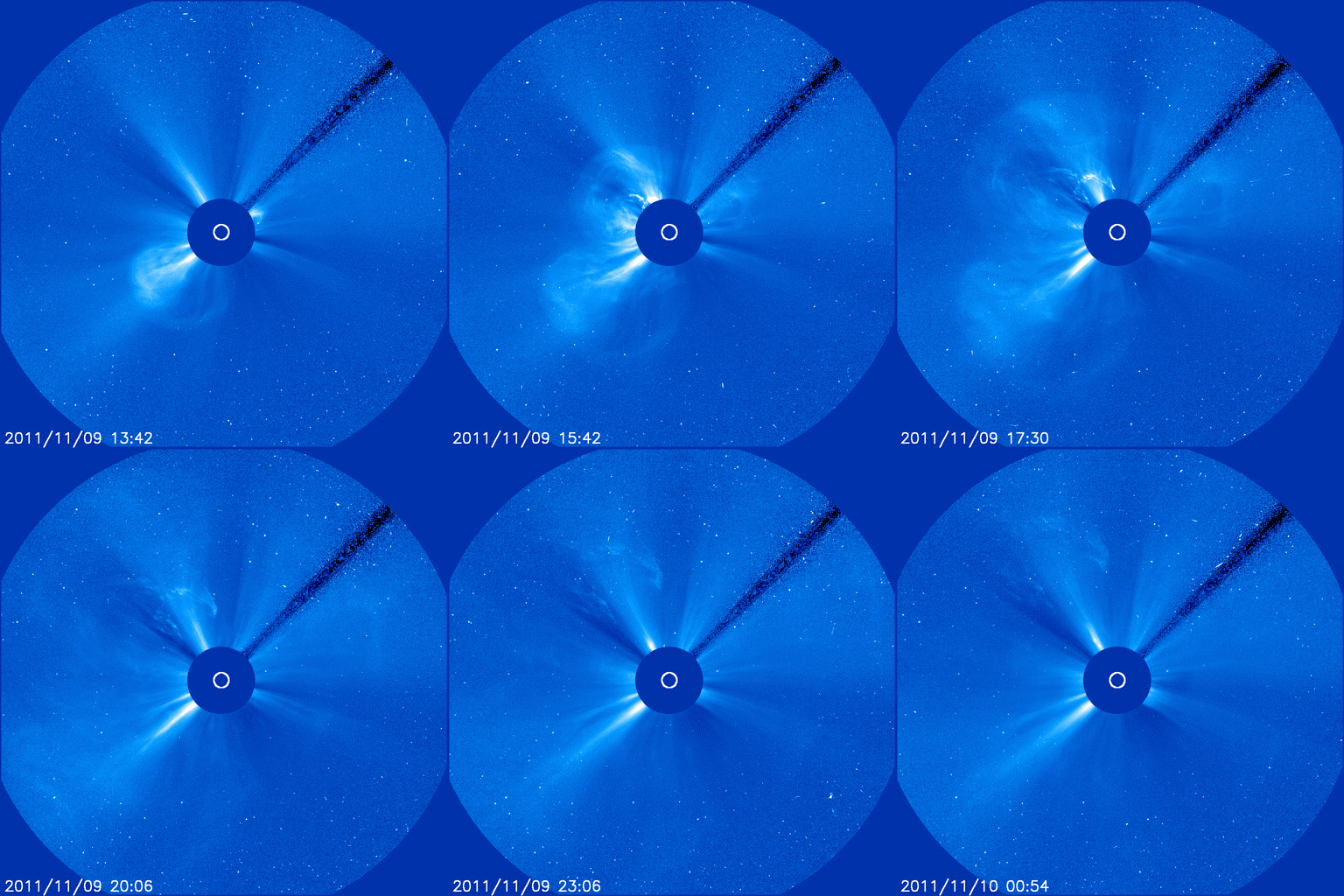
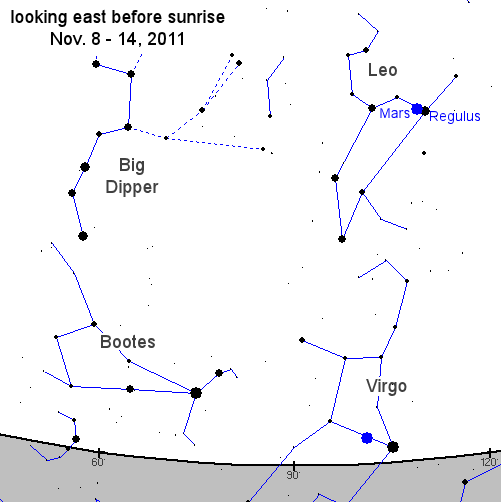
Turn your cell phone into a field-tested satellite tracker. Works for Android and iPhone. | | | COLORFUL CONJUNCTION : The red planet Mars and the blue star Regulus have gathered together in the pre-dawn sky for a close conjunction that will be at its best on the morning of Friday, Nov. 11th. Wake up early, look east, and behold the colors. INCOMING CME? Yesterday, Nov. 9th around 1330 UT, a magnetic filament in the vicinity of sunspot complex 1342-1343 erupted, producing a M1-class solar flare and hurling a CME into space. The Solar and Heliospheric Observatory (SOHO) recorded the progress of the expanding plasma cloud: 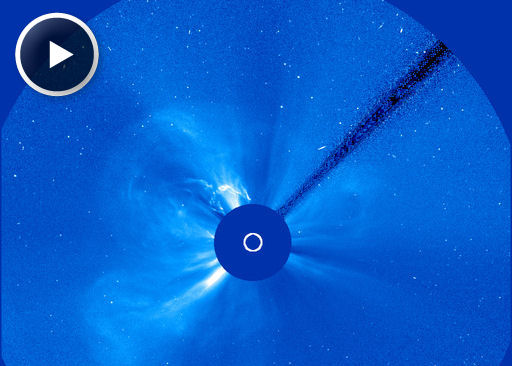
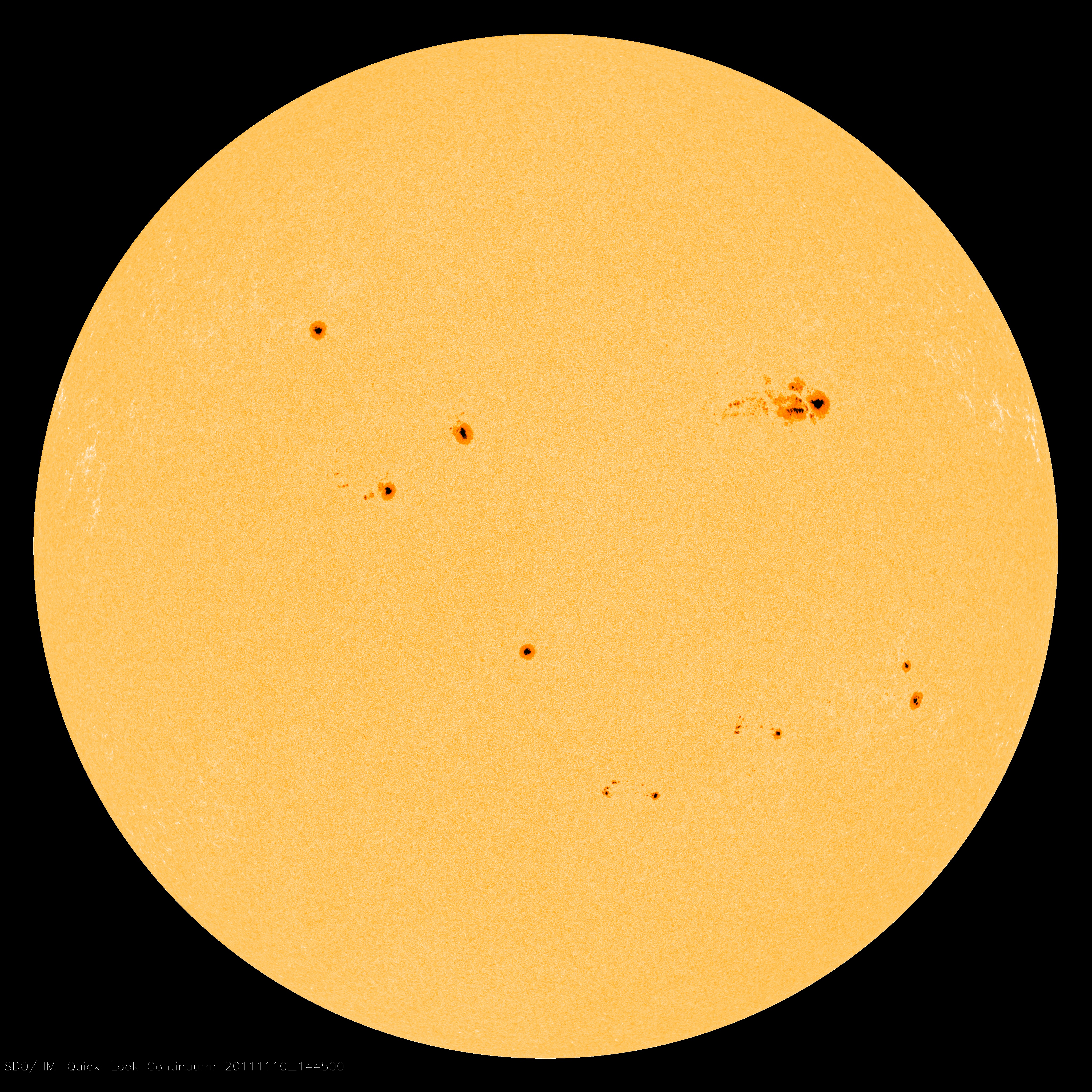
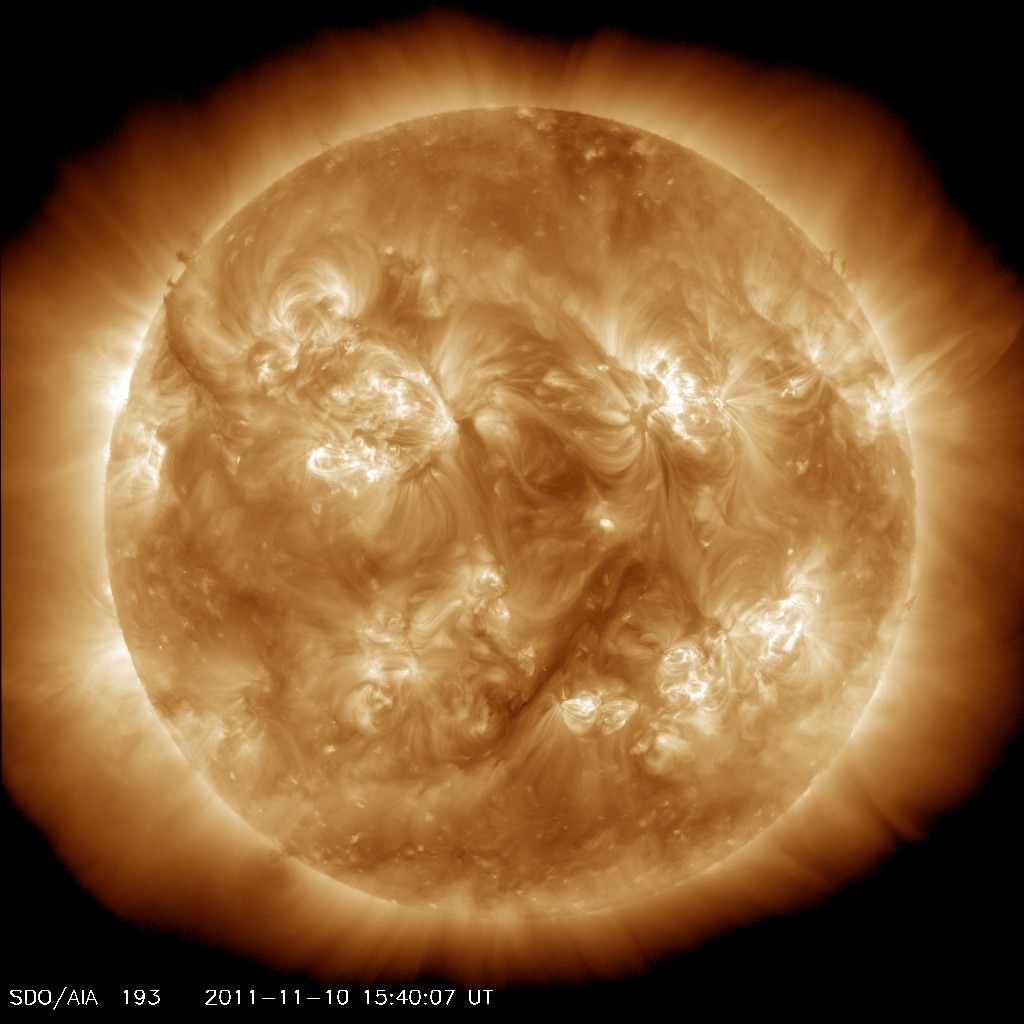
Although the eruption was not squarely aimed at Earth, the CME is likely to deliver a glancing blow to our planet's magnetic field on Nov. 11th or 12th. This could add to the impact of another CME already en route. The earlier cloud was propelled by a filament eruption (movie) on Nov. 7th and is also expected to deliver a glancing blow on Nov. 11th. Analyses of these events are still preliminary, and the forecast may change. For now it is safe to say that high-latitude sky watchers should be alert for auroras on Nov. 11-12. Aurora alerts: text, voice. SPOTTED SUNRISE: Solar Cycle 24 is gaining steam with more sunspots, solar flares, and CMEs than we've seen in years. This development is having a visible effect on the solar disk; it's not blank anymore. Today's snapshot from Jett Aguilar of Quezon City, the Philippines, reveals a distinctly spotty sunrise: 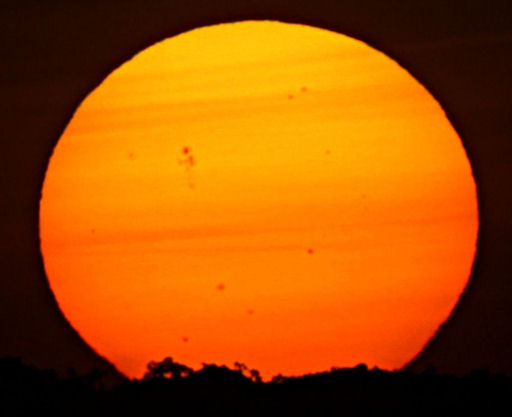
"At sunrise this morning, I was finally able to capture the active sun with its face stippled with sunspots," says Aguilar. "Giant sunspot AR1339 was particulary visible." To take the picture, he used an off-the-shelf Canon 50D digital camera with a Canon EF 100-400 mm lens. Other readers who wish to try this should be careful. Never look at the sun through unfiltered optics even when the solar disk is dimmed by clouds and haze. Focused sunlight can permanently damage your eyes. Instead, point your camera using the LCD screen or, better yet, buy a safe solar telescope. The view is dynamite and it is only going to improve as Solar Cycle 24 approaches maximum in 2012-2013. Potentially Hazardous Asteroids ( PHAs) are space rocks larger than approximately 100m that can come closer to Earth than 0.05 AU. None of the known PHAs is on a collision course with our planet, although astronomers are finding new ones all the time. On November 10, 2011 there were 1256 potentially hazardous asteroids. Recent & Upcoming Earth-asteroid encounters: | Asteroid | Date(UT) | Miss Distance | Mag. | Size | | 2011 FZ2 | Nov 7 | 75.9 LD | -- | 1.6 km | | 2005 YU55 | Nov 8 | 0.8 LD | 11.2 | 400 m | | 2011 UT91 | Nov 15 | 9.9 LD | -- | 109 m | | 1994 CK1 | Nov 16 | 68.8 LD | -- | 1.5 km | | 1996 FG3 | Nov 23 | 39.5 LD | -- | 1.1 km | | 2003 WM7 | Dec 9 | 47.6 LD | -- | 1.6 km | | 1999 XP35 | Dec 20 | 77.5 LD | -- | 1.0 km | | 2000 YA | Dec 26 | 2.9 LD | -- | 80 m | | 2011 SL102 | Dec 28 | 75.9 LD | -- | 1.1 km | Notes: LD means "Lunar Distance." 1 LD = 384,401 km, the distance between Earth and the Moon. 1 LD also equals 0.00256 AU. MAG is the visual magnitude of the asteroid on the date of closest approach. | | The official U.S. government space weather bureau | | | The first place to look for information about sundogs, pillars, rainbows and related phenomena. | | | Researchers call it a "Hubble for the sun." SDO is the most advanced solar observatory ever. | | | 3D views of the sun from NASA's Solar and Terrestrial Relations Observatory | | | Realtime and archival images of the Sun from SOHO. | | | from the NOAA Space Environment Center | | | the underlying science of space weather | |