They came from outer space--and you can have one! Genuine meteorites are now on sale in the Space Weather Store. | | |
LYRID METEOR SHOWER: Earth is approaching the debris field of ancient Comet Thatcher, source of the annual Lyrid meteor shower. Forecasters expect the shower to peak on April 21-22; a nearly-new moon on those dates will provide perfect dark-sky conditions for meteor watching. Usually the shower is mild (10-20 meteors per hour) but unmapped filaments of dust in the comet's tail sometimes trigger outbursts 10 times stronger. [video] [Lyrid chat]
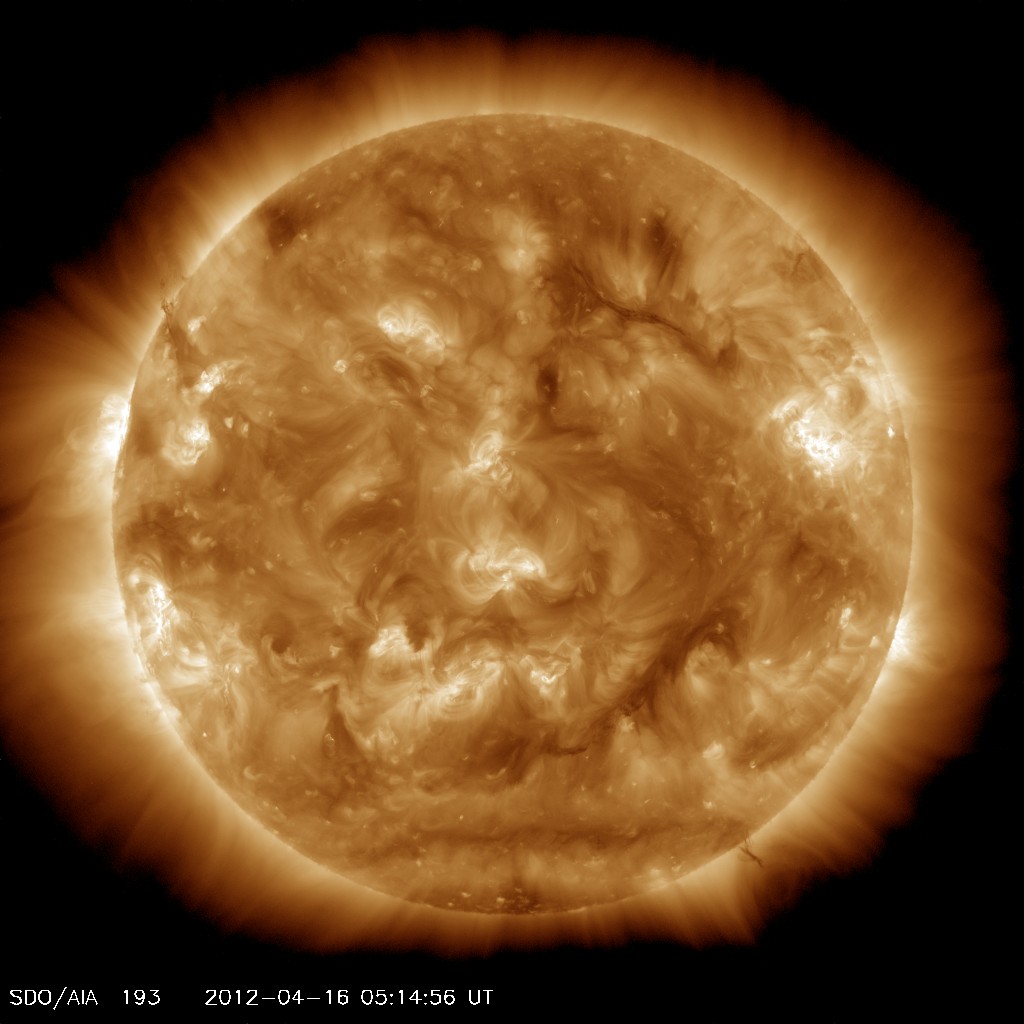
SPECTACULAR EXPLOSION: Magnetic fields on the sun's northeastern limb erupted around 17:45 UT on April 16th, producing one of the most visually-spectacular explosions in years. NASA's Solar Dynamics Observatory recorded the blast at extreme ultraviolet wavelengths:

The explosion, which registered M1.7 on the Richter Scale of solar flares, was not Earth-directed. A CME produced by the blast is likely to hit NASA's STEREO-B spacecraft, but probably no planets.
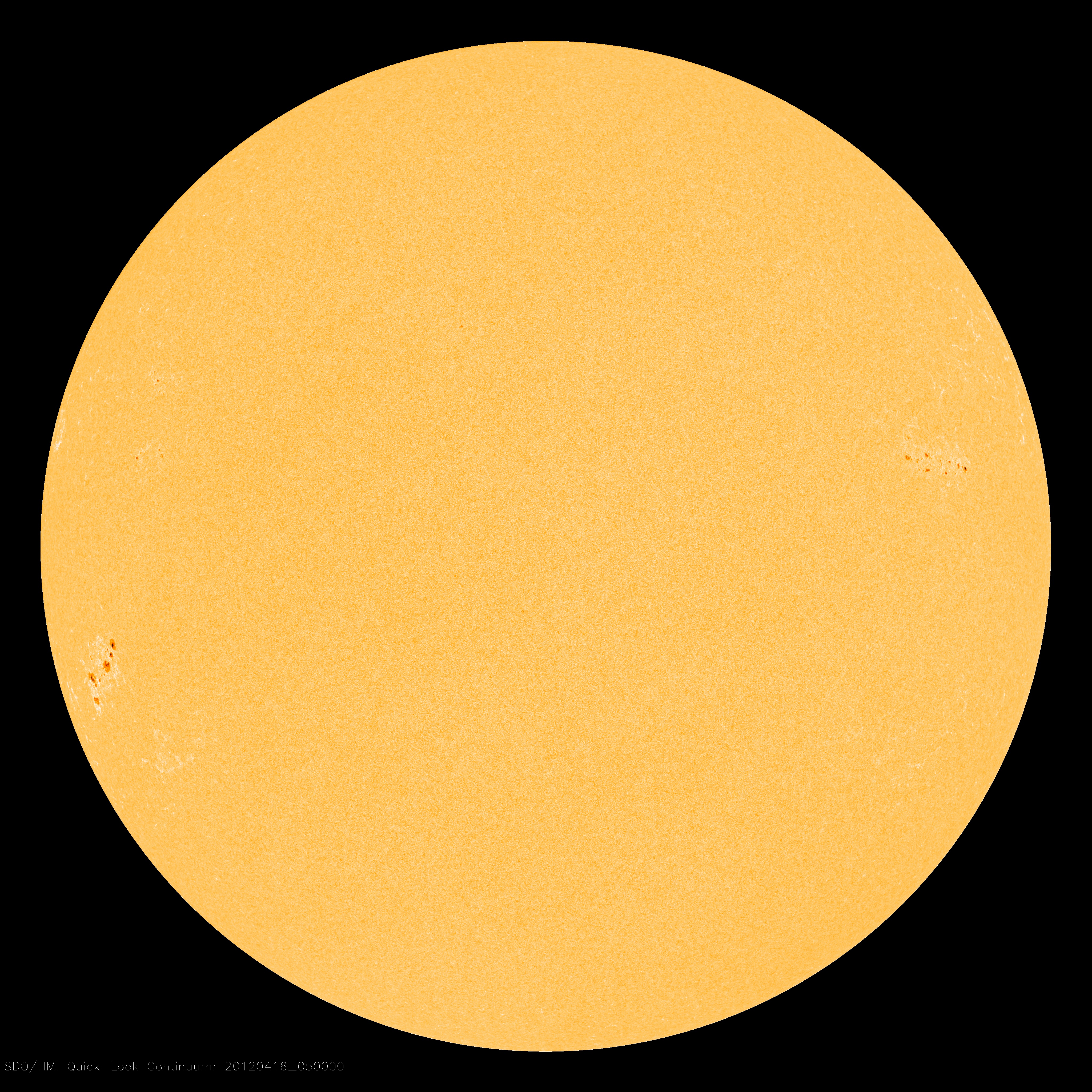
This event confirms suspicions that an active region of significance is rotating onto the Earth-facing side of the sun. Stay tuned for updates. Solar flare alerts: text, phone.
UPDATE: Using data from SDO, Steele Hill of NASA's Goddard Space Flight Center has assembled a must-see movie of the event. The movie shows the explosion unfolding at 304 Angstroms, a wavelength which traces plasma with a temperature around 80,000 K.
SATURN'S RINGS AT THEIR BEST: This week Saturn is at opposition--directly opposite the sun in the skies of Earth. The ringed planet rises at sunset and soars high in the sky at midnight, up all night long. Opposition is the time when Saturn's rings are at their best. From the point of view of Earth, shadows in the ring plane almost completely disappear (just as your own shadow tries to hide beneath your feet at noon) and sunlight is directly backscattered by icy ring particles toward our planet.
Amateur astronomer Christopher Go photographed the brightening rings on April 12th:
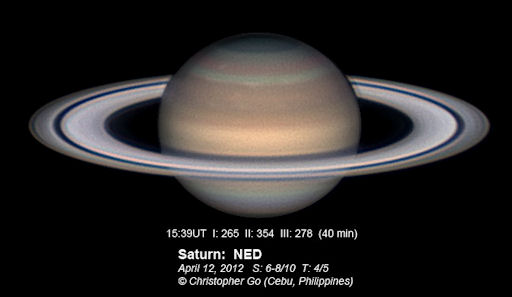
"Saturn is close to opposition and the rings are brightening. This is the Seeliger Effect," says Go. "Also a Northern Electrostatic Disturbance, which was detected by Cassini a few days ago, can be seen as a white patch north of the green belt."
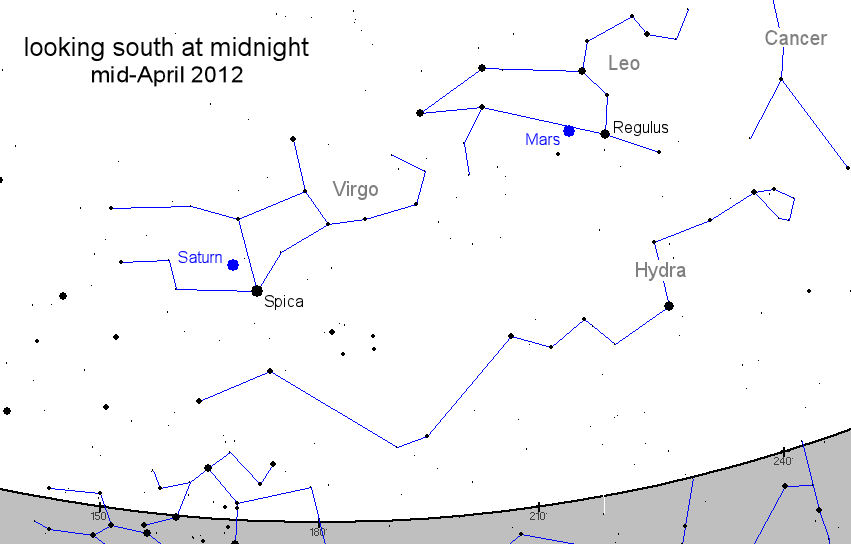
Saturn is easy to find. Look south at midnight. The ringed planet forms a "double star" with Spica. [sky map]
more images: from Efrain Morales Rivera of Aguadilla, Puerto Rico
Potentially Hazardous Asteroids (
PHAs) are space rocks larger than approximately 100m that can come closer to Earth than 0.05 AU. None of the known PHAs is on a collision course with our planet, although astronomers are finding
new ones all the time.
On April 16, 2012 there were 1287 potentially hazardous asteroids.
Notes: LD means "Lunar Distance." 1 LD = 384,401 km, the distance between Earth and the Moon. 1 LD also equals 0.00256 AU. MAG is the visual magnitude of the asteroid on the date of closest approach. | | The official U.S. government space weather bureau |
| | The first place to look for information about sundogs, pillars, rainbows and related phenomena. |
| | Researchers call it a "Hubble for the sun." SDO is the most advanced solar observatory ever. |
| | 3D views of the sun from NASA's Solar and Terrestrial Relations Observatory |
| | Realtime and archival images of the Sun from SOHO. |
| | from the NOAA Space Environment Center |
| | the underlying science of space weather |