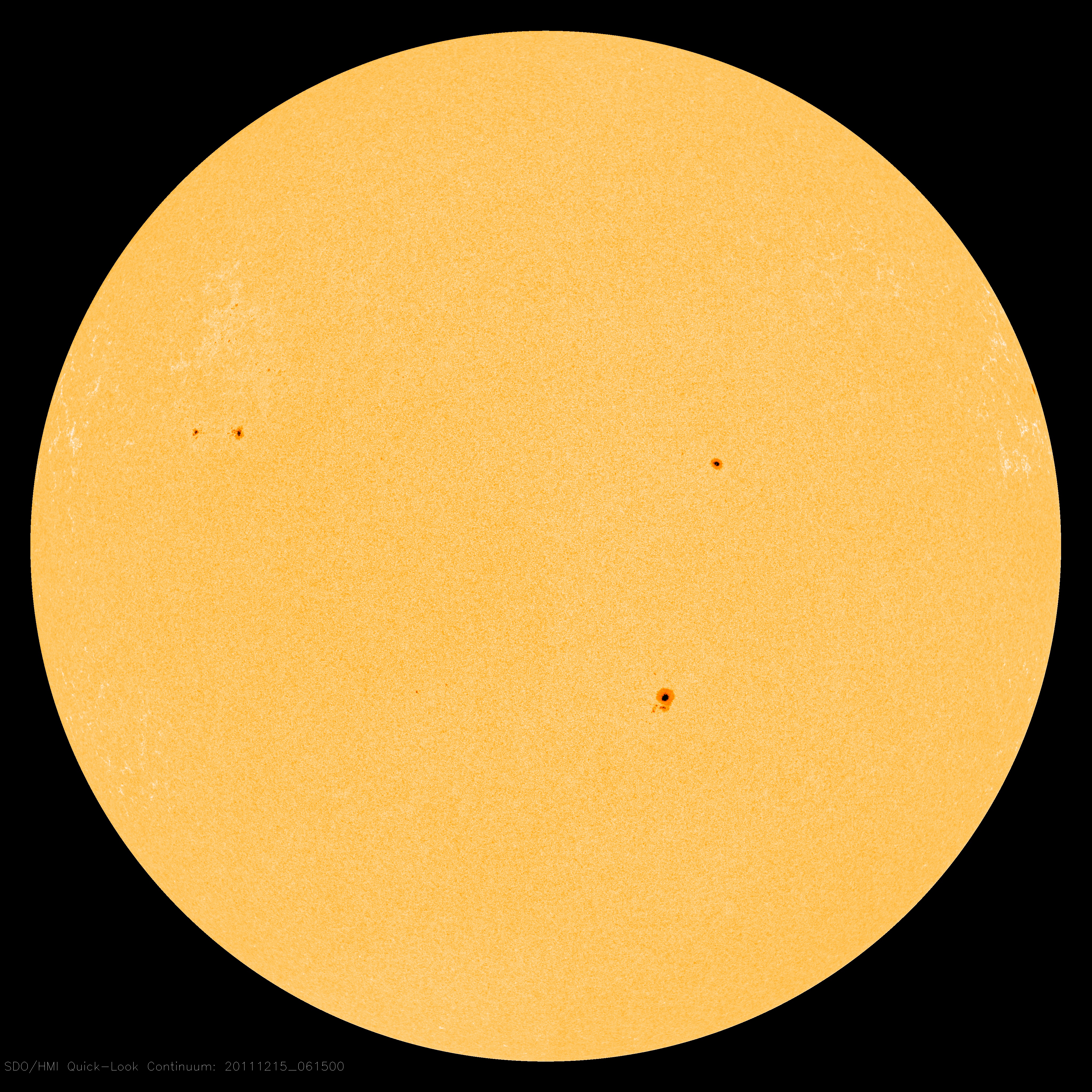
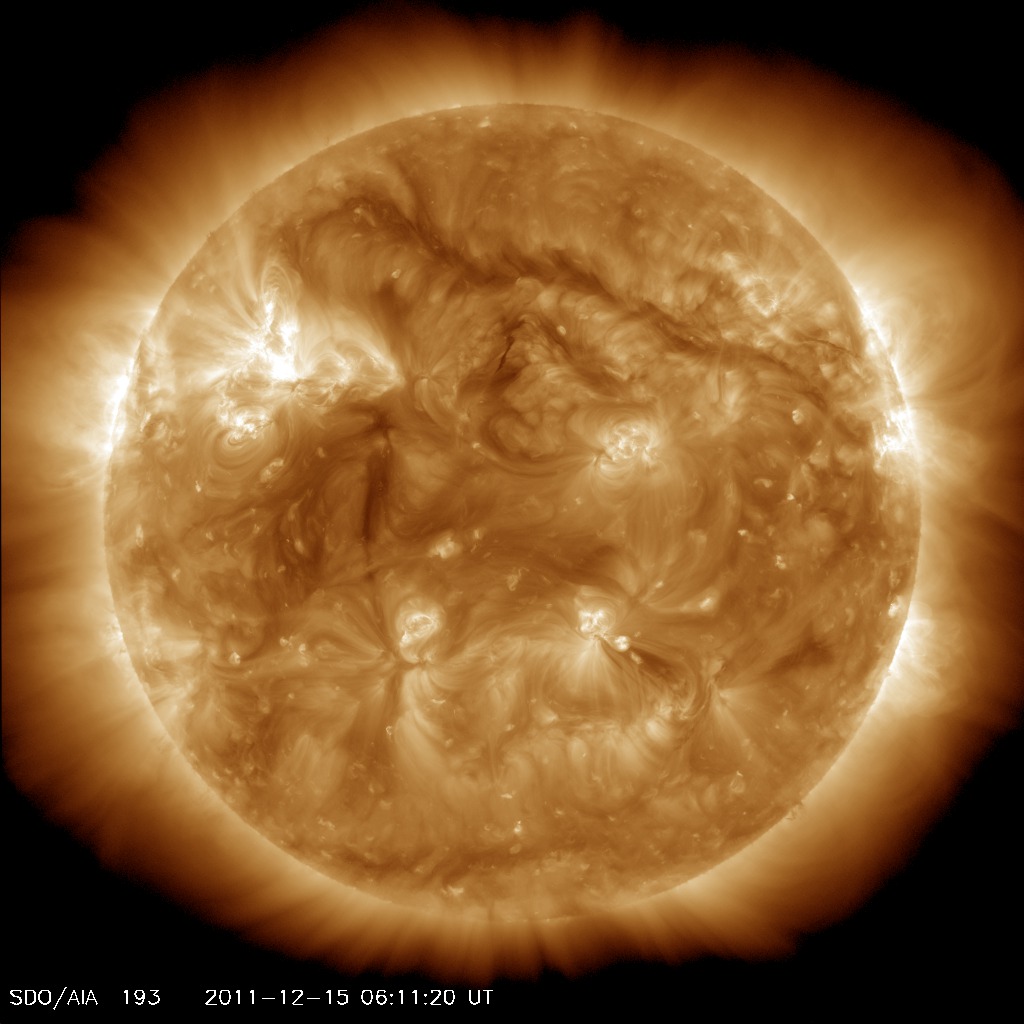
Turn your cell phone into a field-tested satellite tracker. Works for Android and iPhone. | | | COMET LOVEJOY SURVIVES: Incredibly, sungrazing Comet Lovejoy has survived its close encounter with the sun. Lovejoy flew only 140,000 km over the stellar surface during the early hours of Dec. 16th. Experts expected the icy sundiver to be destroyed. Instead, NASA's Solar Dynamics Observatory caught the comet emerging from perihelion (closest approach) apparently intact: 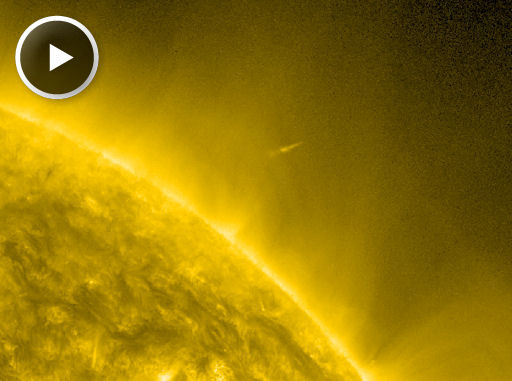
Movie formats: 25 MB Quicktime, 0.8 MB m4v
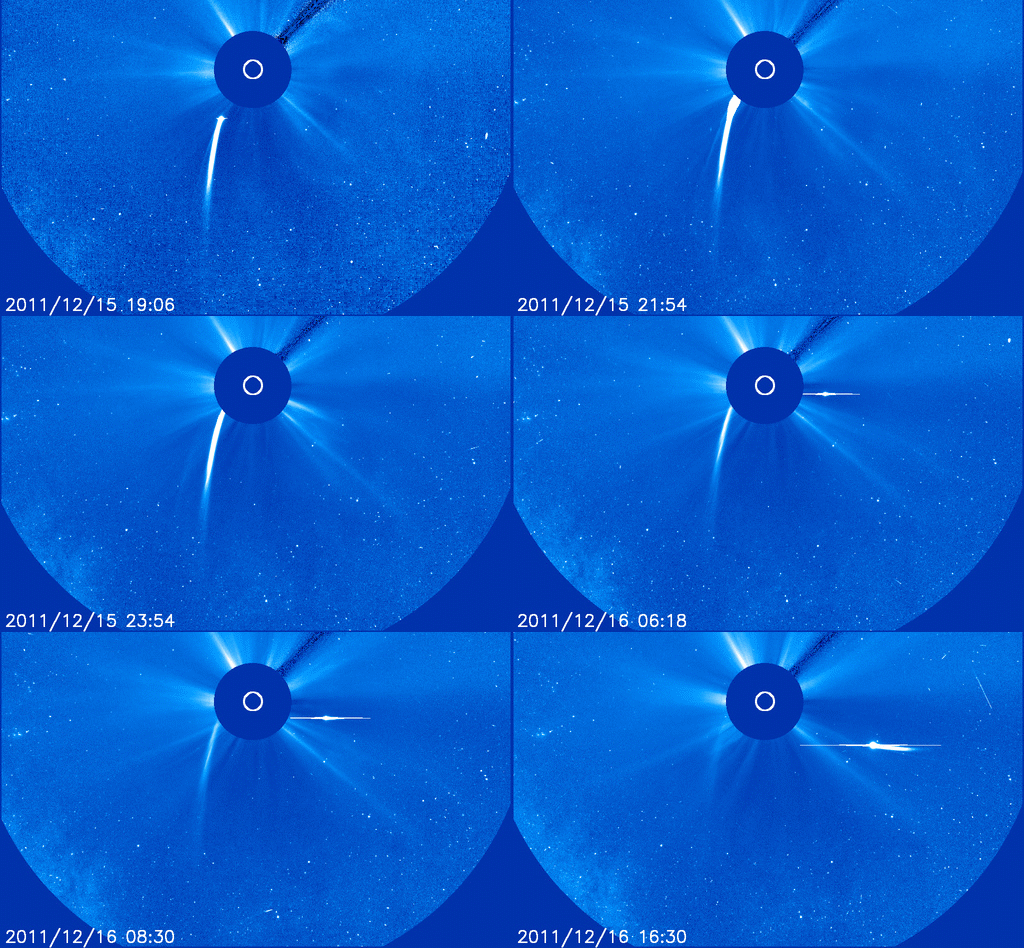
SDO also recorded Comet Lovejoy's entry into the sun's atmosphere: movie. Comet Lovejoy began the week as a chunk of dusty, rocky ice more than 200 meters in diameter. No one can say how much of the comet's core remains intact or how long it will hang together after the searing heat of perihelion. "There is still a possibility that Comet Lovejoy will start to fragment," says researcher Karl Battams in a NASA news release. "It’s been through a tremendously traumatic event; structurally, it could be extremely weak." New images received on Dec. 16th from the Solar and Heliospheric Observatory confirm that Comet Lovejoy survived perihelion and show the comet receding from the sun: 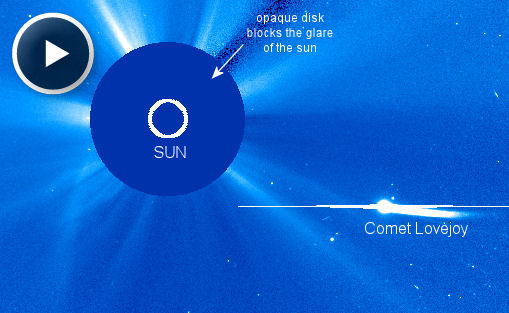
At first the emerging comet was missing its tail. This might have been a trick of geometry: The comet's tail was pointing away from Earth, temporarily invisible due to foreshortening. On the other hand, the absence might have been genuine. The comet's store of surface volatile materials could have been "baked-out" by the fiery transit, leaving the nucleus unable to mount substantial jets of gas and dust. Newly-arriving SOHO images show the tail is reforming. There could be more surprises in store for this unpredictable comet. Stay tuned for updates. More data: Europe's Proba2 microsatellite recorded Comet Lovejoy's entrance and exit from the sun: movie. The darkening in the middle of the movie is a solar eclipse: "Proba2's orbit briefly carried it behind the earth with respect to the sun," explains Dan Seaton of the Royal Observatory of Belgium. "The timing of the eclipse was perfect. It happened while the comet was out of sight behind the sun." CURIOSITY AND THE SOLAR STORM: Last month, a massive solar storm launched itself toward Mars just as NASA's new rover, Curiosity, was blasting off from Cape Canaveral in the same direction. Researchers say it was a welcome coincidence. For the first time in Mars-rover history, Curiosity is equipped to study solar storms, and it will be monitoring space weather all the way to the Red Planet. [full story]
Dec. 10th Total Lunar Eclipse Gallery Potentially Hazardous Asteroids ( PHAs) are space rocks larger than approximately 100m that can come closer to Earth than 0.05 AU. None of the known PHAs is on a collision course with our planet, although astronomers are finding new ones all the time. On December 16, 2011 there were 1272 potentially hazardous asteroids. Recent & Upcoming Earth-asteroid encounters: | Asteroid | Date(UT) | Miss Distance | Mag. | Size | | 2000 YA | Dec 26 | 2.9 LD | -- | 80 m | | 2011 SL102 | Dec 28 | 75.9 LD | -- | 1.0 km | | 2011 WS95 | Dec 28 | 7.2 LD | -- | 49 m | | 1991 VK | Jan 25 | 25.3 LD | -- | 1.9 km | | 433 Eros | Jan 31 | 69.5 LD | -- | 8.5 km | | 2009 AV | Feb 16 | 44.9 LD | -- | 1.2 km | | 2000 ET70 | Feb 19 | 17.7 LD | -- | 1.0 km | | 2011 CP4 | Feb 23 | 9.1 LD | -- | 255 m | | 2008 EJ85 | Mar 6 | 9.1 LD | -- | 44 m | | 1999 RD32 | Mar 14 | 57.9 LD | -- | 2.3 km | Notes: LD means "Lunar Distance." 1 LD = 384,401 km, the distance between Earth and the Moon. 1 LD also equals 0.00256 AU. MAG is the visual magnitude of the asteroid on the date of closest approach. | | The official U.S. government space weather bureau | | | The first place to look for information about sundogs, pillars, rainbows and related phenomena. | | | Researchers call it a "Hubble for the sun." SDO is the most advanced solar observatory ever. | | | 3D views of the sun from NASA's Solar and Terrestrial Relations Observatory | | | Realtime and archival images of the Sun from SOHO. | | | from the NOAA Space Environment Center | | | the underlying science of space weather | |