They came from outer space--and you can have one! Genuine meteorites are now on sale in the Space Weather Store. | | |
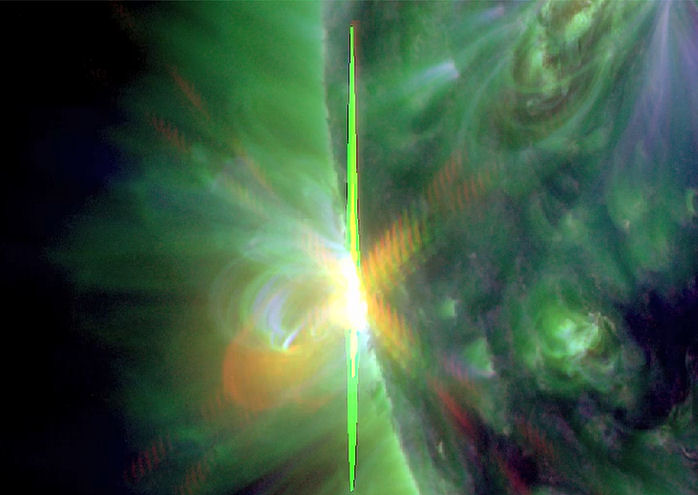
ALMOST-X FLARE: Today at 1814 UT, Earth-orbiting satellites detected an impulsive M9-class solar flare. The source was an active region just behind the sun's southeastern limb. NASA's Solar Dynamics Observatory recorded the extreme ultraviolet flash: image. Radio blackouts and ionization waves in the upper atmosphere are possible on the dayside of Earth as a result of this event. Stay tuned for updates.
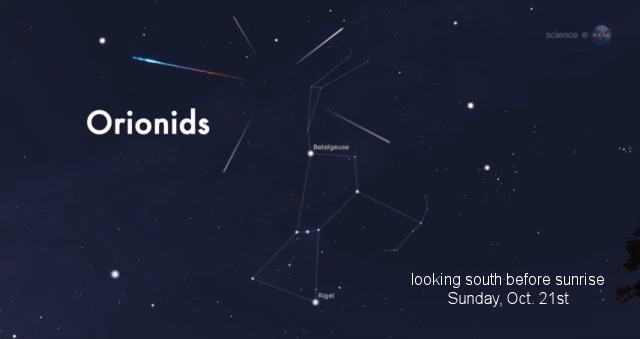
ORIONID METEOR SHOWER--TODAY! Earth is passing through a stream of debris from Halley's Comet, source of the annual Orionid meteor shower. Forecasters expect ~25 meteors per hour when the shower peaks on Oct. 21st. No matter where you live, the best time to look is during the dark hours before sunrise on Sunday morning. Observers in both hemispheres can see this shower. [video] [full story] [NASA Chat] [meteor radar] [sky map]
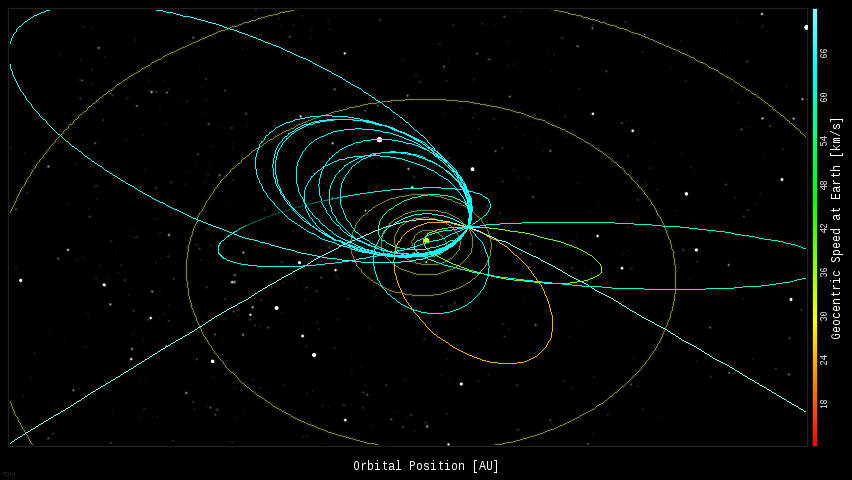
On Oct. 19th, as Earth was making first contact with the debris stream, NASA's All-sky Fireball Network recorded 10 Orionid fireballs over the southern USA. Their orbits are color-coded baby blue in the diagram below:

The location of Earth, where all the orbits intersect, is denoted by the red 'splat.'
Not every orbit in the diagram is an Orionid. The orange and green ellipses correspond to random meteors not associated with Halley's debris stream. If you watch the sky for a few hours on Sunday morning, you are likely to see a few of these 'sporadic meteors' among the dozens of Orionids. Happy meteor watching!
Realtime Meteor Photo Gallery
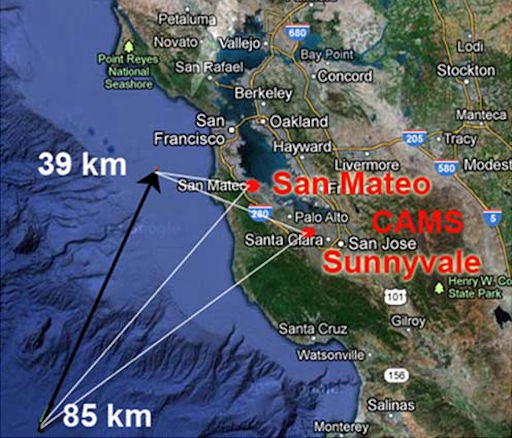
METEOR MAKES LANDFALL: A small asteroid that exploded over the San Francisco Bay Area on Oct. 17th, shaking houses with its sonic boom, might have scattered pieces of itself on the ground. That's the conclusion of Peter Jenniskens of the NASA Ames Research Center. He triangulated data from a pair of meteor surveillance cameras to determine the fireball's trajectory, denoted by the black arrow in the map below:
"The asteroid entered at a [relatively slow] speed of 14 km/s. There's a good chance that a fairly large fraction of this rock survived and fell somewhere around the North Bay," says Jenniskens. "Much more accurate results will follow from a comprehensive study of the video records. Now, we hope that someone recovers a meteorite on the ground."
In the map, red dots represent the surveillance cameras Jenniskens used to calculate the trajectory. The black arrow traces the asteroid's path; 85 km and 39 km are the altitudes of the asteroid at the two ends of the arrow. Jenniskens adds that "39 km is not the end point, but the final bit captured by the San Mateo video camera." The disintegrating asteroid continued beyond the tip of the arrow for a possible landfall somewhere north of San Francisco. Stay tuned for updates on the meteorite hunt.
Note: This was not an Orionid.
Realtime Space Weather Photo Gallery
Realtime Aurora Photo Gallery
Realtime Noctilucent Cloud Photo Gallery
[previous years: 2003, 2004, 2005, 2006, 2007, 2008, 2009, 2011]