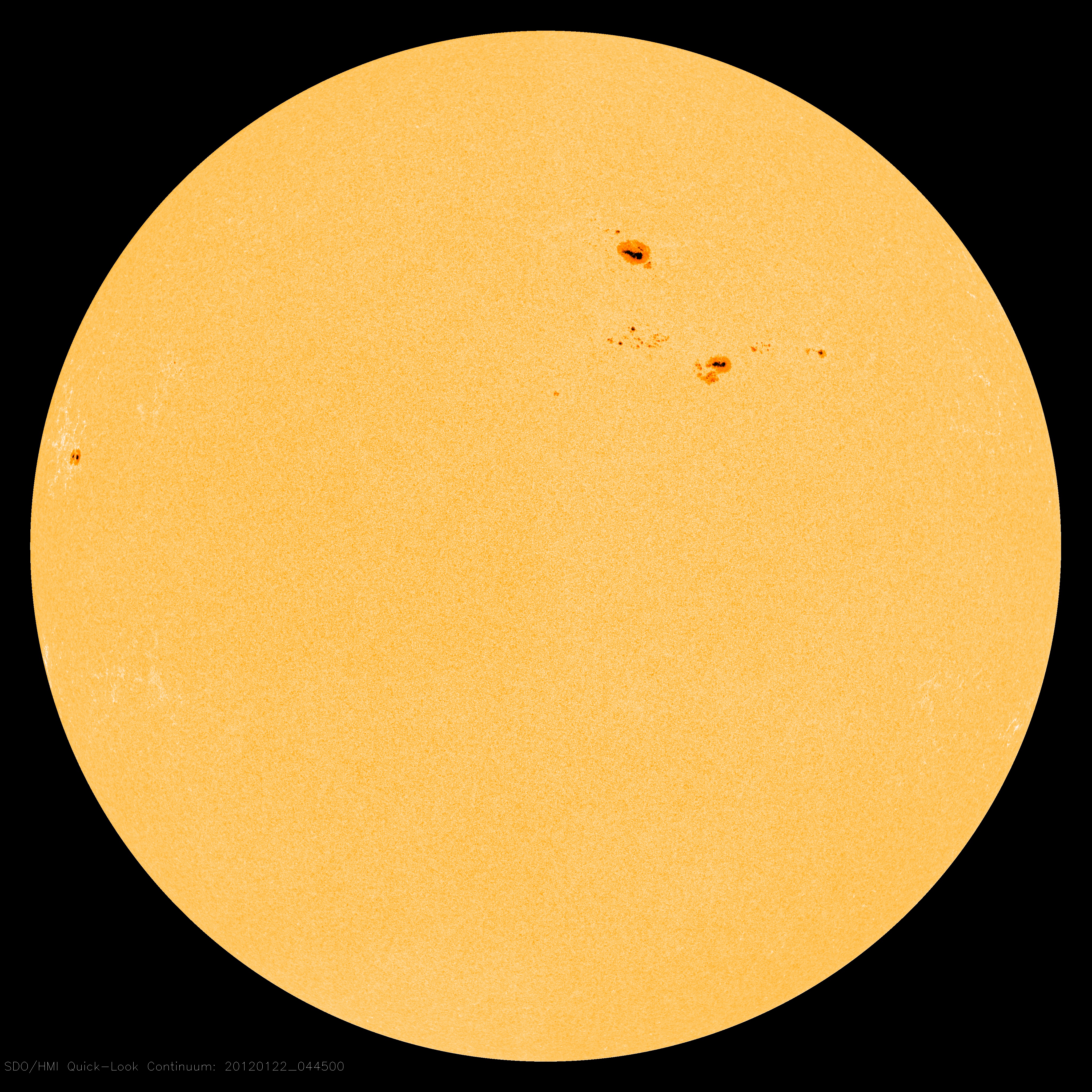
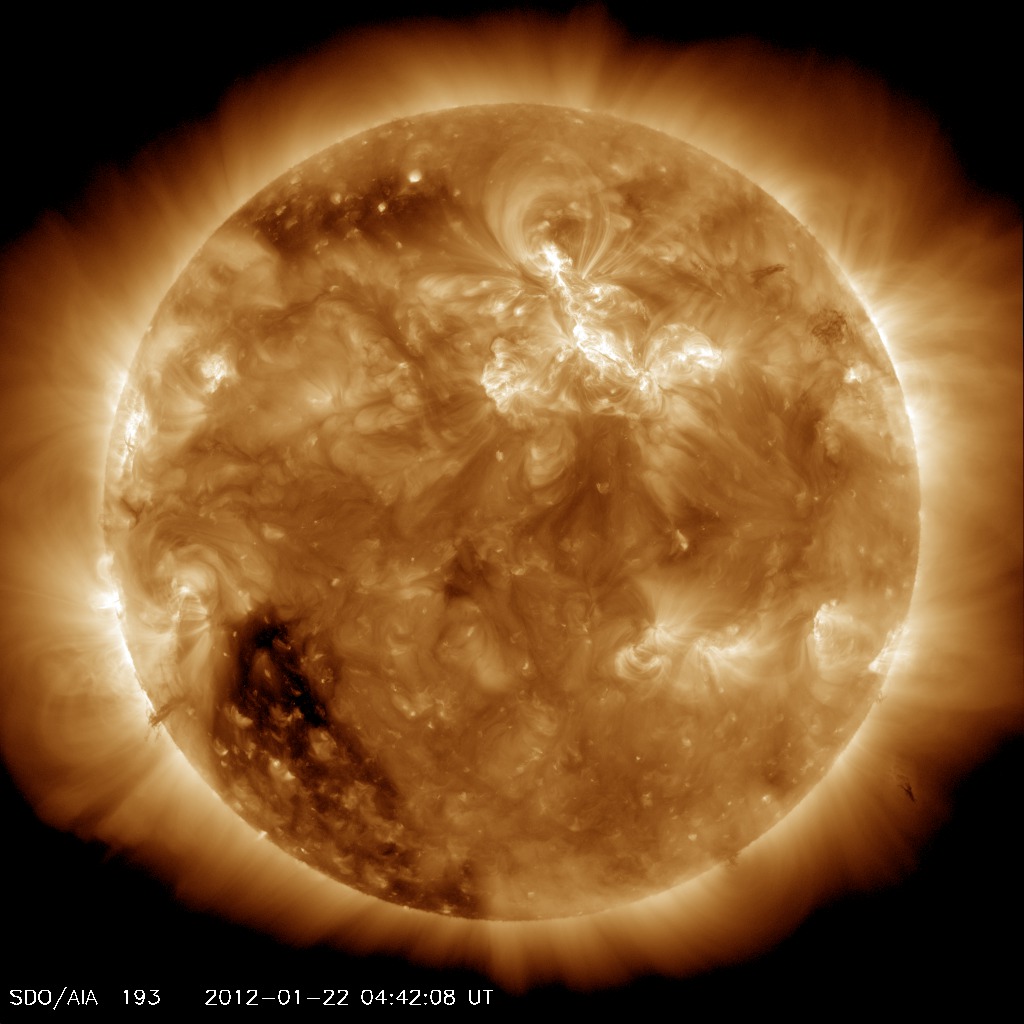
Metallic photos of the sun by renowned photographer Greg Piepol bring together the best of art and science. Buy one or a whole set. They make a stellar gift. | | |
HIGH-LATITUDE AURORAS: The Arctic Circle is alight with auroras following this morning's CME impact. Incoming reports from Russia, Denmark, Scotland, England, and Norway confirm a bright apparition underway now. Aurora alerts: text, voice.
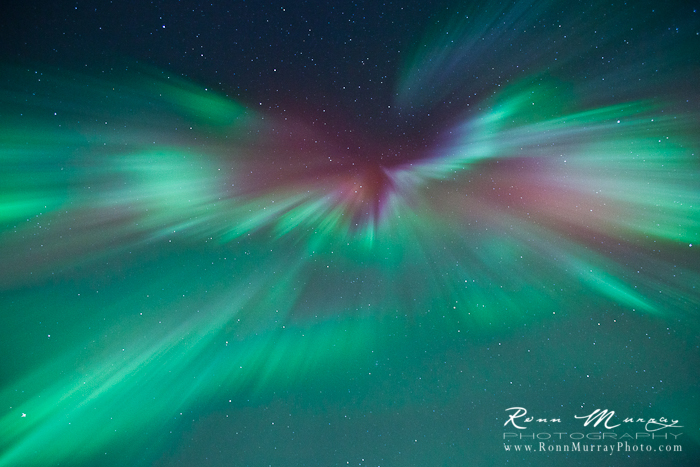
CME IMPACT: Arriving a little later than expected, a coronal mass ejection (CME) hit Earth's magnetic field at 0617 UT on Jan. 22nd. According to analysts at the Goddard Space Weather Lab, the impact strongly compressed Earth's magnetic field and briefly exposed satellites in geosynchronous orbit to solar wind plasma. Shifting lines of magnetic force induced strong ground currents in Norway and sparked bright auroras over the upper reaches of North America. This colorful corona appeared over Chatanika, Alaska:
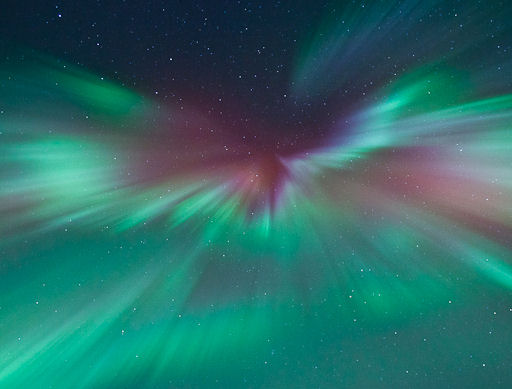
"We enjoyed some amazing displays as the late arriving CME made its presence felt," says photographer Ronn Murray.
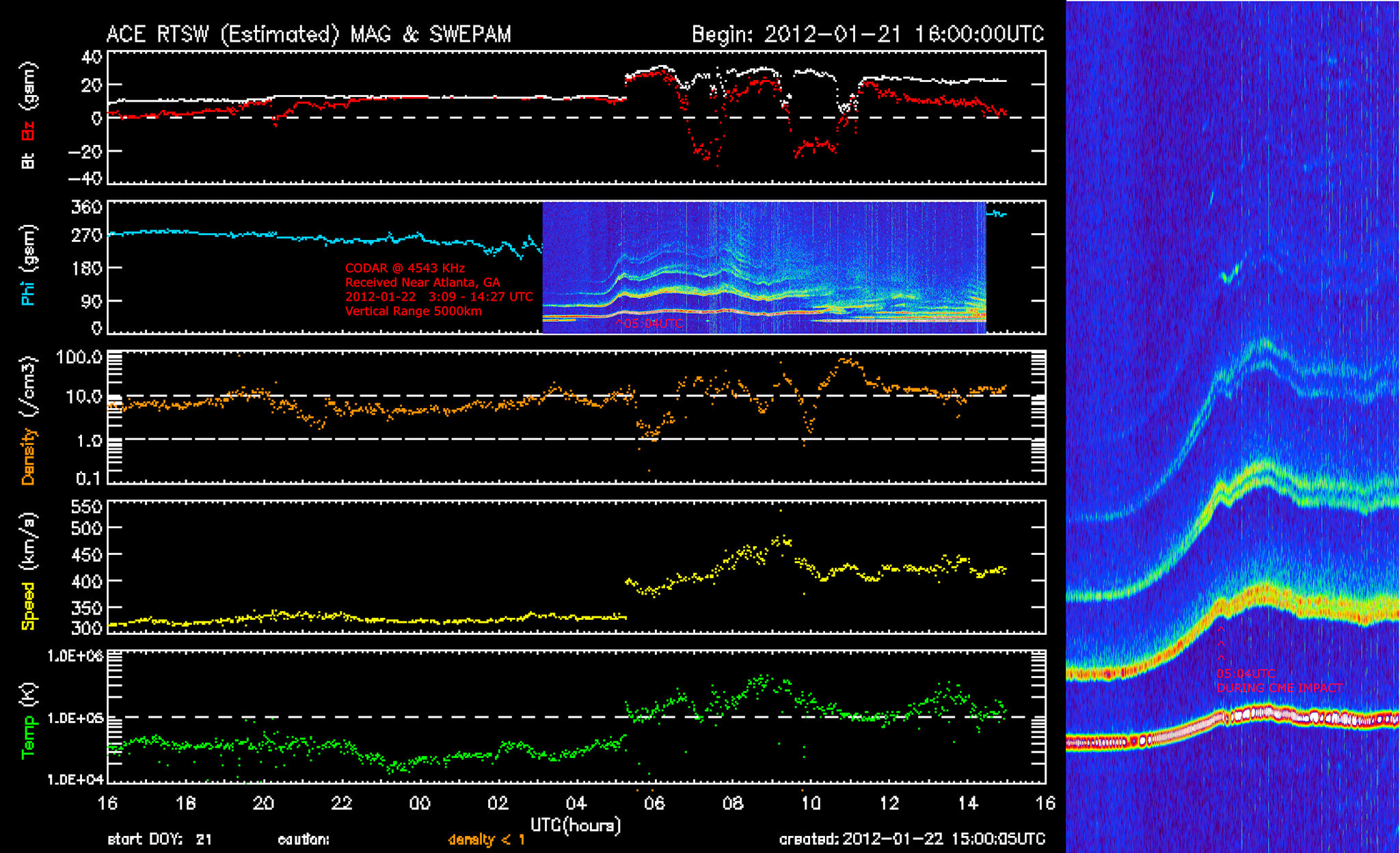
The impact also disturbed Earth's ionosphere. In Atlanta, Georgia, radio engineer Pieter Ibelings monitored a 4.5 MHz CODAR (coastal radar) signal as it bounced off layers of ionization along the US east coast. "The moment of impact can be clearly seen on the CODAR radar plot," he points out:
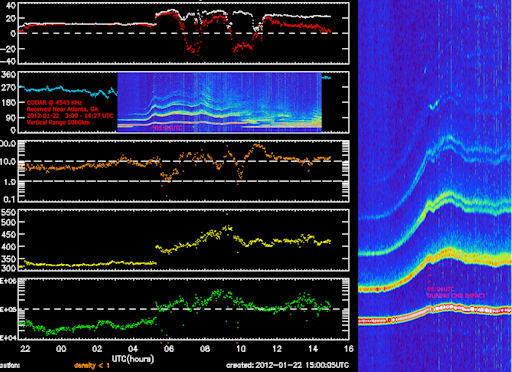
"The CODAR transmitters are located all around the coast and are used for mapping the ocean currents to a distance of about 200 miles," Ibelings explains. "These signals also propagate through the ionosphere so they can be picked up all around the world. The signals are almost perfect for ionospheric sounding since they are linear chirps. I capture the chirp with a receiver locked to GPS both in frequency and time. I then de-chirp the waveform so I can extract the time of arrival information at my location."
The CODAR echoes show ionization layers shifting vertical position by some hundreds of kilometers, changes that surely affected the propagation of HF radio signals in the aftermath of the impact. More information about Ibelings' observations may be found here.
more aurora images: from Lance Parrish of Skiland, Alaska; from Coby Brock of North Pole, Alaska; from Phil Hart of Lake Laberge, Yukon, Canada; from Jason Ahrns of Chatanika, Alaska; from John Dean of Nome, Alaska; from Sam Tsai of Grande Prairie, Alberta, Canada; from Chad Blakley of Aurora Sky Station, Abisko National Park, Sweden; from Andrei Penescu of Kangerlussuaq, Greenland; from Marketa Stanczykova of Chatanika, Alaska; from Kimberly S Mietzah Damkoehler of Houston, Alaska;
January 2012 Aurora Gallery
[previous Januaries: 2010, 2009, 2008, 2007, 2005, 2004]
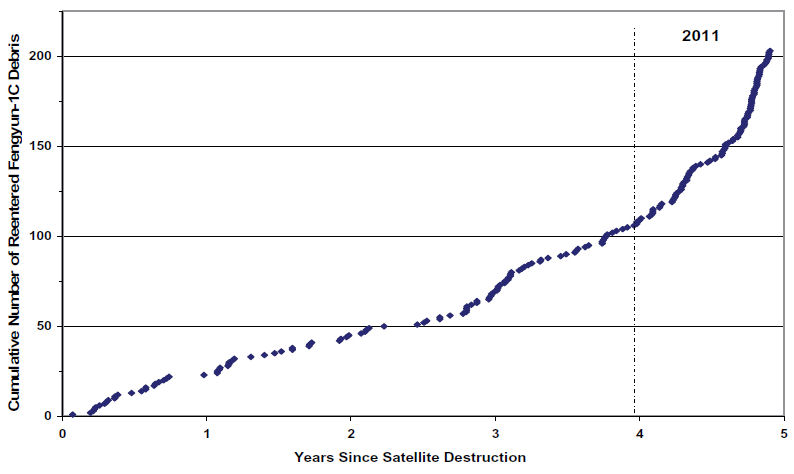
INCREASING SOLAR ACTIVITY CLEANS UP SAT-DEBRIS: Earth's atmosphere has been puffing up in response to increasing levels of UV radiation from sunspots. This is good news for satellite operators, because a puffed up atmosphere helps clean up low-Earth orbit. "The number of cataloged debris in Earth orbit actually decreased during 2011," reports Nick Johnson in NASA's Orbital Debris Quarterly newsletter. "[The figure below] illustrates how the rate of debris reentries from the Fengyun-1C anti-satellite test of January 2007 increased during the past year."
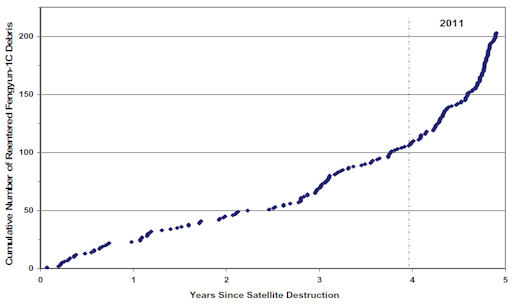
"Even though only 6% of the total 3218 cataloged debris from the ill-advised engagement had reentered by the end of 2011, half of these debris fell out of orbit in the past 12 months," he points out. "Likewise, many debris from the 2009 accidental collision of Cosmos 2251 and Iridium 33 are accelerating their departure from Earth orbit. In the absence of a new major satellite breakup, the overall orbital debris population should continue to decrease during 2012 and 2013."
Comet Lovejoy Gallery
[previous comets: McNaught, Holmes, Lulin, Tuttle, Ikeya-Zhang]