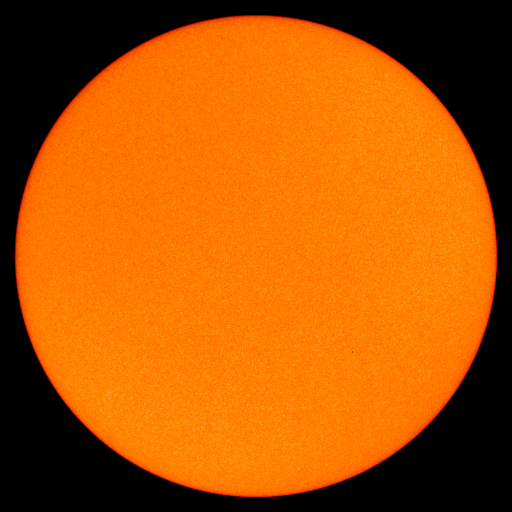
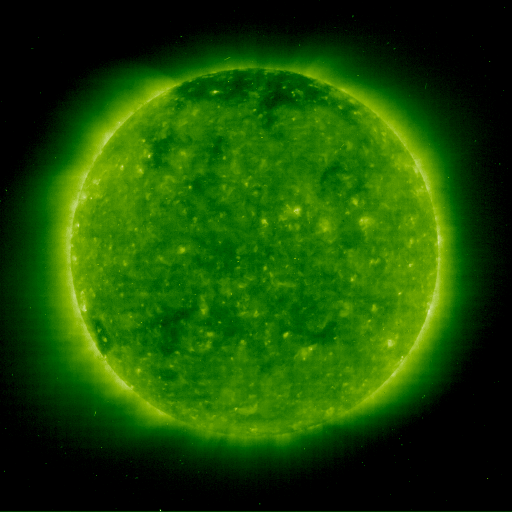
| QUIET SUN: Today marks the 44th consecutive day without spots on the sun--one of the longest quiet spells of the current solar minimum. In early July, sunspot 1024 seemed to herald the long-awaited onset of Solar Cycle 24, but shortly after that apparition, sunspot production turned off again. Deep solar minimum continues... ARE SUNSPOTS DISAPPEARING? Sunspots are made of magnetism. The "firmament" of a sunspot is not matter but rather a strong magnetic field that appears dark because it blocks the upflow of heat from the sun's fiery depths. Without magnetism, there would be no sunspots. That's what makes the following graph a little troubling: 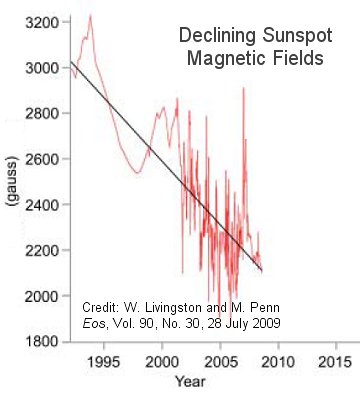
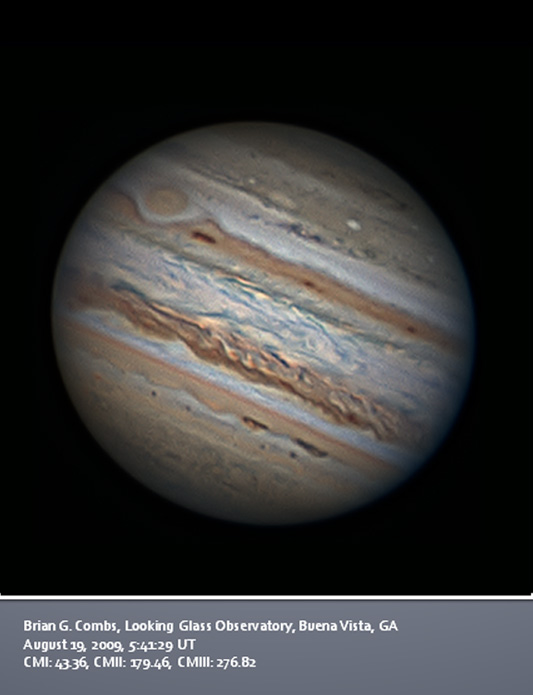
According to Bill Livingston and Matt Penn of the National Solar Observatory in Tucson, Arizona, sunspot magnetic fields are waning. The two respected solar astronomers have been measuring solar magnetism since 1992. Their technique is based on Zeeman splitting of infrared spectral lines emitted by iron atoms in the vicinity of sunspots. Extrapolating their data into the future suggests that sunspots could completely disappear within decades. That would be a bummer for Spaceweather.com. Don't count out sunspots just yet, however. While the data of Livingston and Penn are widely thought to be correct, far-reaching extrapolations may be premature. This type of measurement is relatively new, and the data reaches back less than 17 years. "Whether this is an omen of long-term sunspot decline, analogous to the Maunder Minimum, remains to be seen," they caution in a recent EOS article. One thing is certain. Solar Minimum is a lot more interesting than it sounds: more. JUPITER UPDATE: A little more than a month after a mystery-object crashed into Jupiter, the debris cloud is still visible in backyard telescopes. Amateur astronomer Brian Combs of Buena Vista, Georgia, took this picture on August 19th: 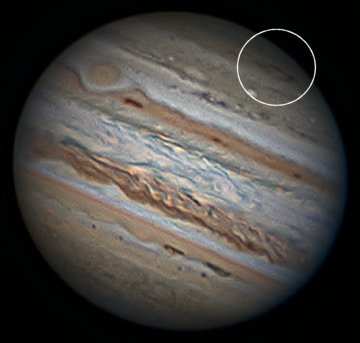
When Australian astrophotographer Anthony Wesley discovered the debris cloud on July 19th, it was about the size of many other small storms dotting Jupiter's upper atmosphere. Since then, the compact black mark has expanded into an enormous swirl rivaling the girth of the Great Red Spot itself. Unfortunately, as the cloud has expanded it has also faded, and its pale markings could soon disappear altogether. Continued monitoring is encouraged. more images: from Abe Megahed of Madison, Wisconsin; from Ralf Vandebergh of the Netherlands
August 2009 Aurora Gallery
[previous Augusts: 2008, 2007, 2006, 2005, 2004, 2003, 2002, 2001]
2009 Perseid Photo Gallery
[Science@NASA: The Perseids are Coming, Horse Flies and Meteors]
Explore the Sunspot Cycle |