Turn your cell phone into a field-tested satellite tracker. Works for Android and iPhone. | | |
UARS RE-ENTRY UPDATE: NASA's UARS satellite is making its last orbits around Earth. Orbital elements published today by the US Strategic Command suggest that re-entry could occur during the early hours of Saturday morning. "For now, it looks like 00:00 - 04:00 UTC on Sept. 24," says satellite tracking expert Ted Molczan, "but it could well happen even later. UARS will pass over North America and Europe several times during this period, but it will spend most of its time over oceans and sparsely populated land." Stay tuned for updates and meanwhile keep an eye out for the doomed satellite. [latest NASA statement]
The Federal Aviation Administration has issued the following Notice to Airmen (NOTAM): "Aircraft are advised that a potential haard may occur due to reentry of satellite UARS into Earth's atmosphere. FAA is working with the Department of Defense and NASA to ensure the most current re-entry information is provided to operators as quickly as possible. Further NOTAMS will be issued if specific information becomes available indicating a United States airspace impact. It is critical that all pilots/flight crew members report any fallinf space debris to the appropriate ATC facility. The Domestic Events Network telephone 202-493-5107 is the FAA coordination facility. CREATED: 23 SEP 18:33 2011"
EQUINOX SUNRISE: The seasons changed this morning at 5:05 a.m. EDT when the Sun crossed the celestial equator heading south. Fall began in the Northern Hemisphere, spring in the Southern Hemisphere. Geoffrey Wyatt of Sydney, Australia, woke up early to watch the equinox sun rise over Watson's Bay:
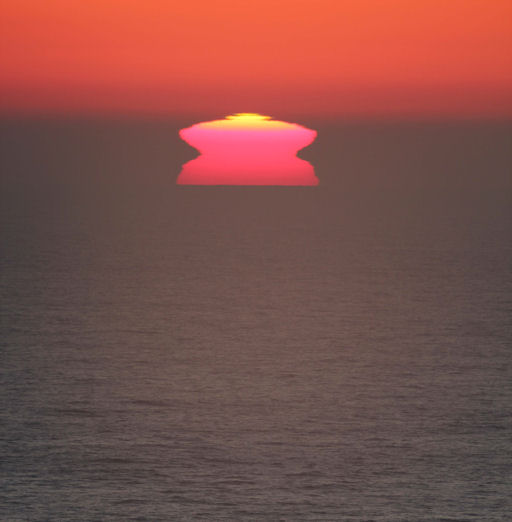
"This is how the first day of spring began in Australia," says Wyatt. "Recent fires in the Sydney area have contributed to redder than usual sunrises and sunsets. Temperature gradiants over the water produced the added bonus of a miraged sun."
Happy Equinox!
more images: from Monika Landy-Gyebnar of Balatonfured, Hungary
AURORAS UNDERFOOT: Solar activity is picking up, and no one has a better view of its effect on Earth than the crew of the International Space Station. During a geomagnetic storm on Sept. 17th, astronauts recorded a must-see movie of auroras dancing underfoot:
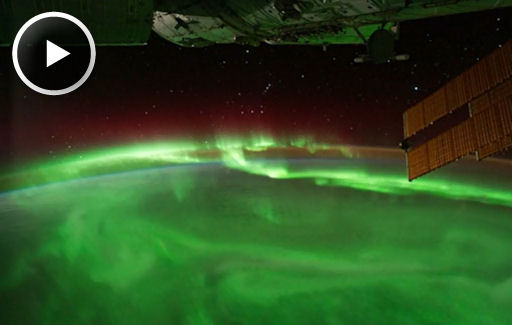
Taken over the southern Indian Ocean, the movie spans a 23-min period from 17:22:27 to 17:45:12 GMT on Sept. 17.
Note how the underbelly of the space station glows green from the reflected light of the auroras below. Also, in the distance, Sirius the dog star and Orion the Hunter can be seen rising feet-first into the night sky.
The storm, which registered a moderate 6 on the 0-to-9 K-index scale of geomagnetic disturbances, was caused by a coronal mass ejection (CME) hitting Earth's magnetic field. It was just a glancing blow, but with CMEs that is often enough to spark bright auroras over both ends of Earth. The space station was flying over the southern hemisphere at the time of the display. Observers in the northern hemisphere saw it too.
A similar storm could be in the offing this week. Another CME is heading toward Earth, and it appears likely to deliver a glancing blow on Sept. 22nd around 23:00 UT. Sky watchers above and below should be alert for auroras. Aurora alerts: text, voice.
September 2011 Aurora Gallery
[previous Septembers: 2010, 2009, 2008, 2007, 2006, 2005, 2004]
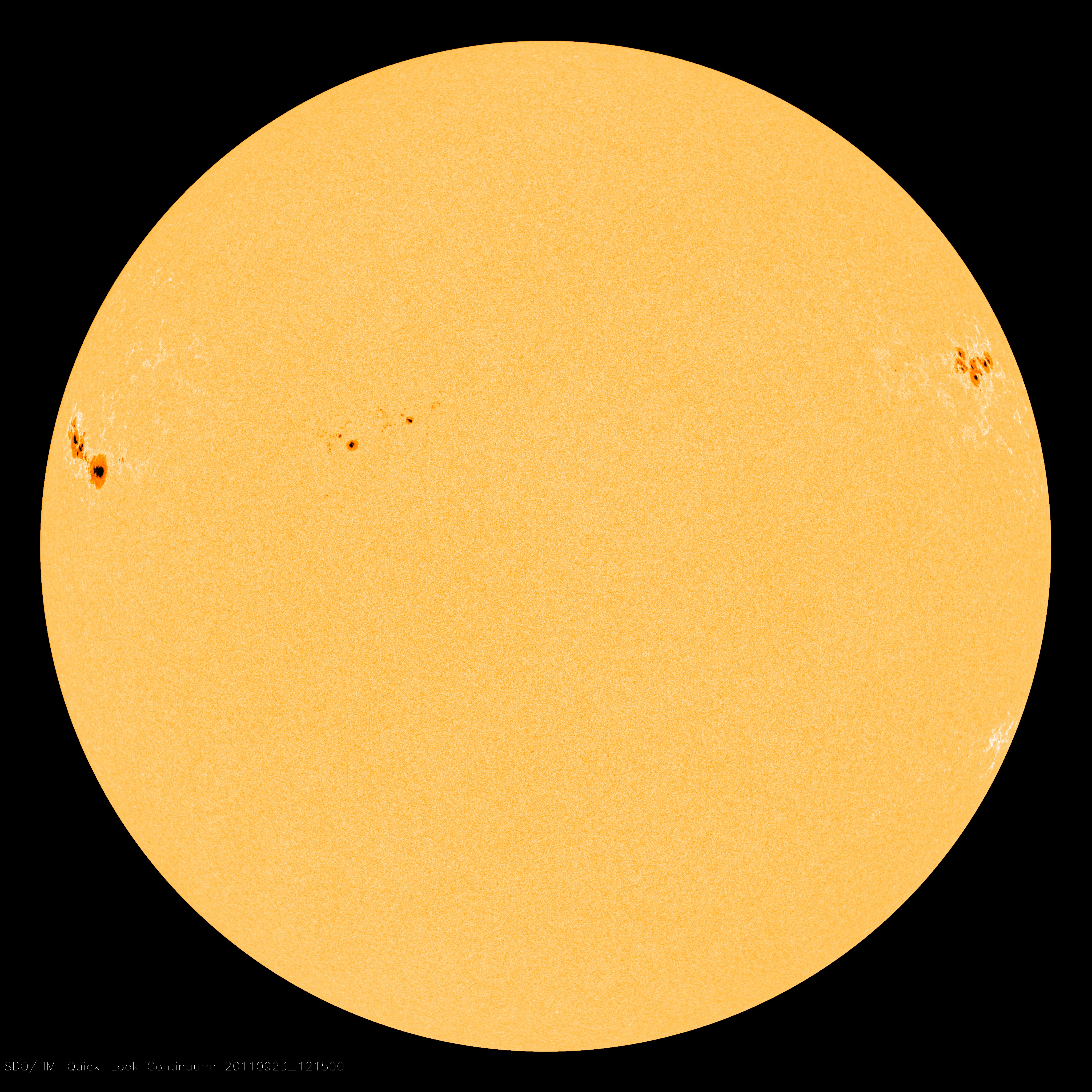
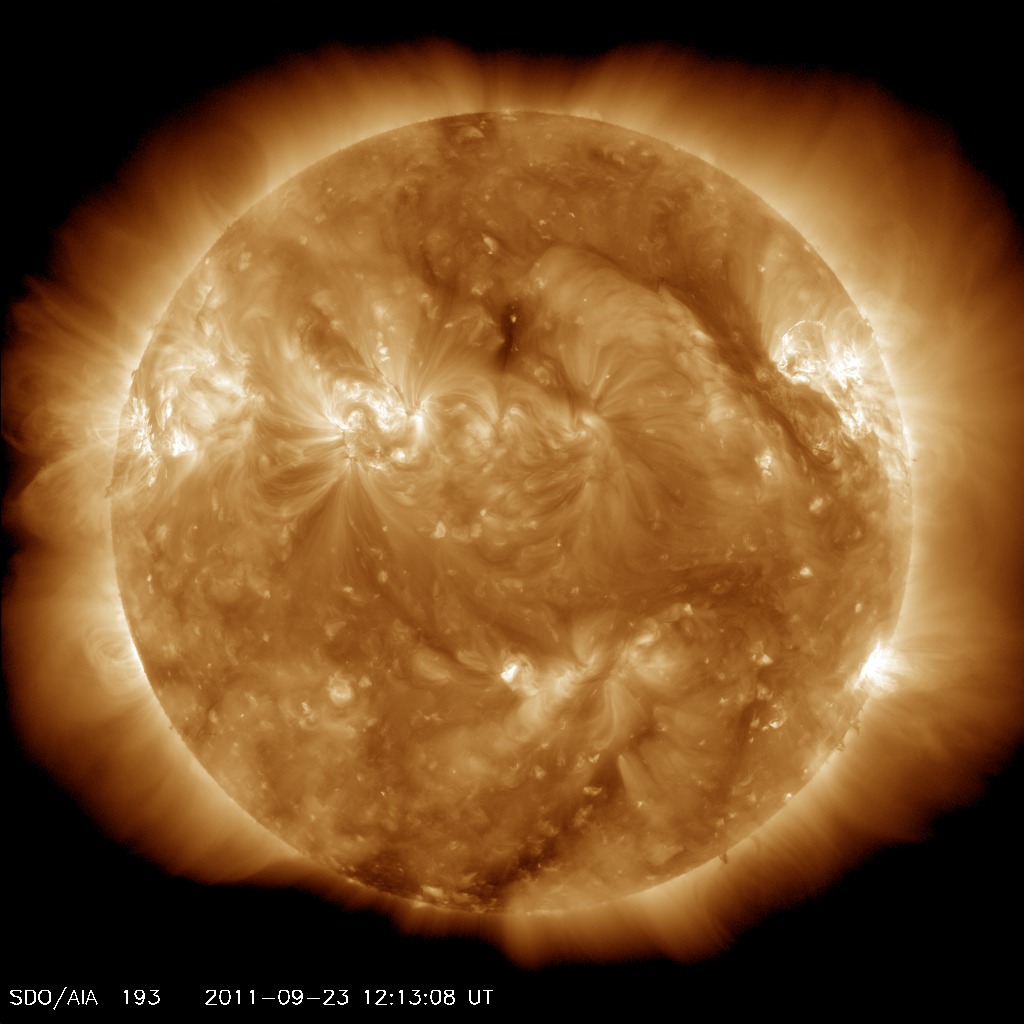
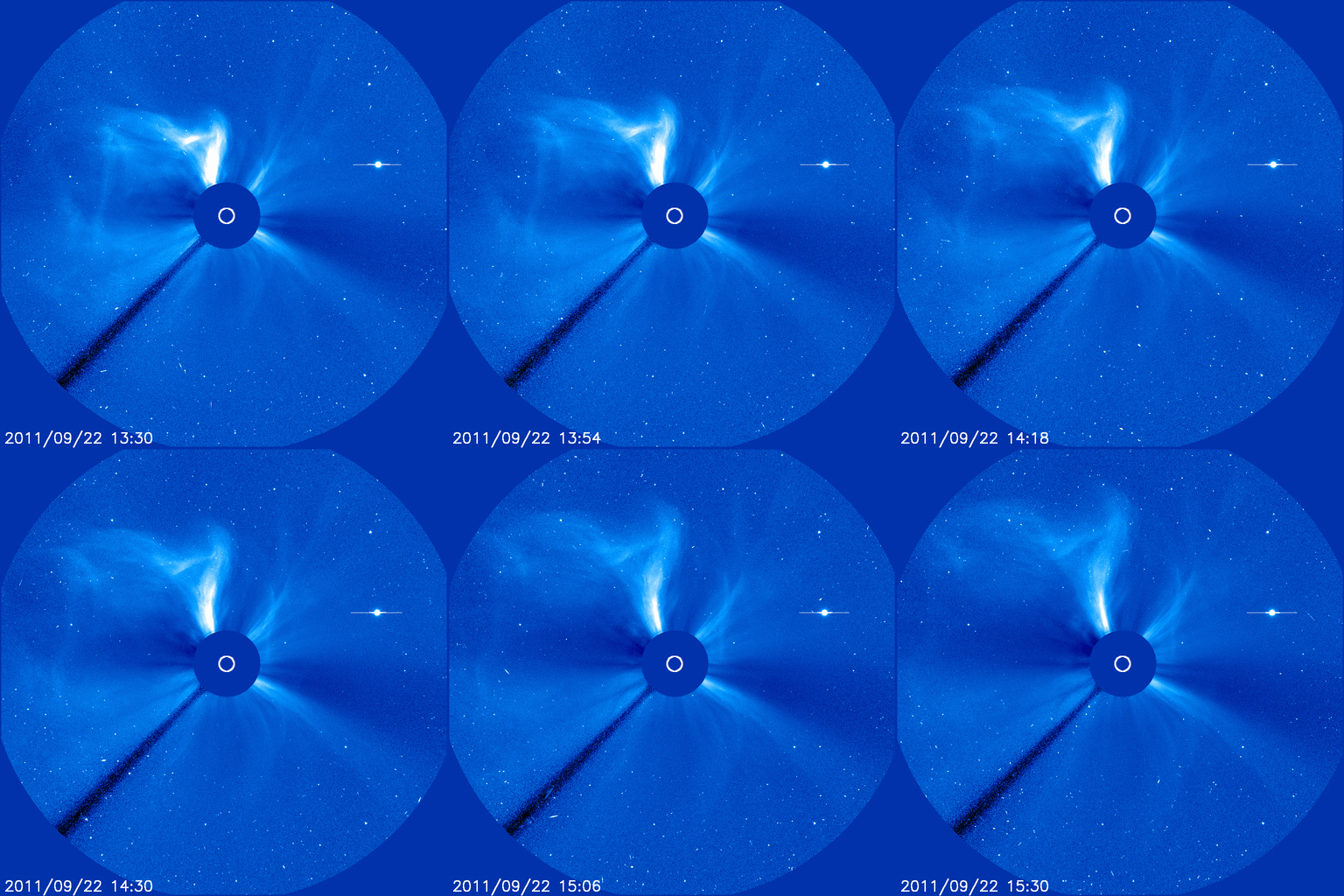
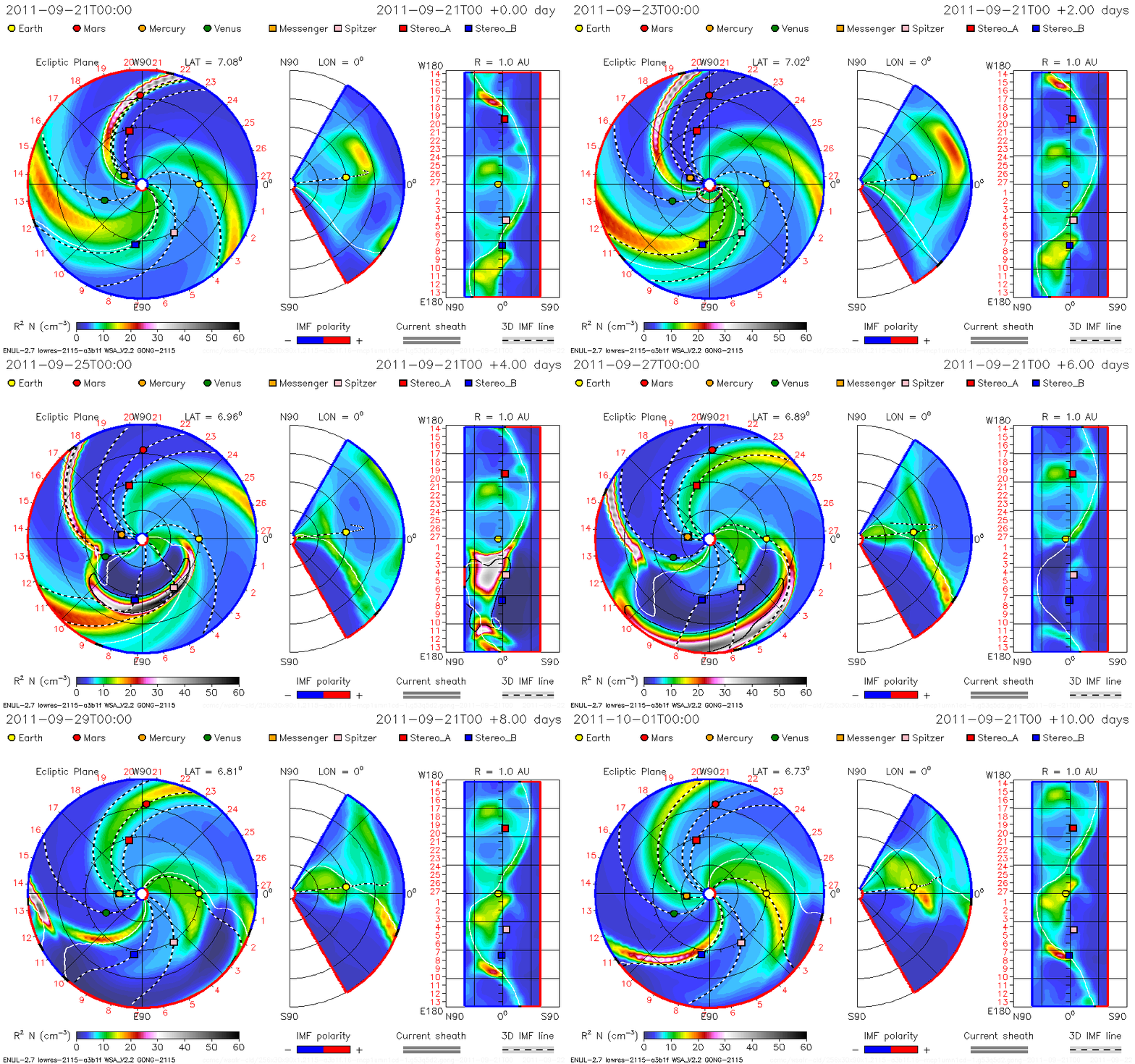
MAJOR X-FLARE + CME: Yesterday, Earth-orbiting satellites detected a long-duration X1.4-class solar flare coming from sunspot 1302 on the sun's eastern limb. The blast, which peaked at 1100 UT on Sept. 22nd, produced a significant coronal mass ejection (CME). Using data from the SOHO-STEREO fleet of spacecraft, analysts at the Goddard Space Weather Lab have modeled the trajectory of the CME and concluded that the body of the cloud will not hit Earth. A minor glancing encounter with the outskirts of the CME is, however, possible on Sept. 25th. [CME: movie, forecast track]
X-flares of Solar Cycle 24: There have been only a half-dozen X-flares since the beginning of new Solar Cycle 24. Here is a complete list so far, all in 2011: Feb. 15 (X2), March 9 (X1), Aug. 9 (X7), Sept. 6 (X2), Sept. 7 (X2), Sept. 22 (X1). Before these six, the previous X-flare occured on Dec.14, 2006, (X1) during old Solar Cycle 23.