Turn your cell phone into a field-tested satellite tracker. Works for Android and iPhone. | | |
UARS UPDATE: NASA's bus-sized UARS satellite returned to Earth sometime between 11:23 p.m. EDT on Sept. 23rd and 1:09 a.m. EDT on Sept. 24th. There are still no credible visual reports of the fireball. At a post-reentry teleconference, NASA officials showed a map of the possible re-entry track. UARS could have come down at any point along the green line, which crosses vast regions of the Pacific Ocean, North America, north Atlantic Ocean, Africa, and southern Indian Ocean. Odds favor an ocean landing, but no one knows the exact location of UARS debris.
SATURDAY X-FLARE: Behemoth sunspot 1302 unleashed another strong flare on Saturday morning--an X1.9-category blast at 0940 UT. NASA's Solar Dynamics Observatory recorded the extreme ultraviolet flash:
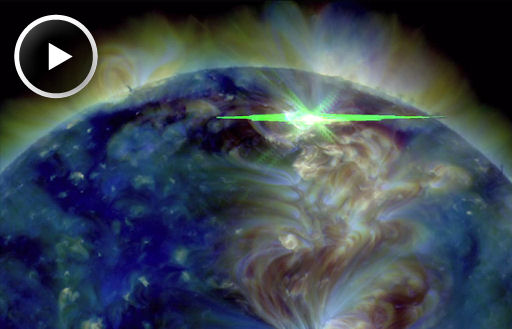
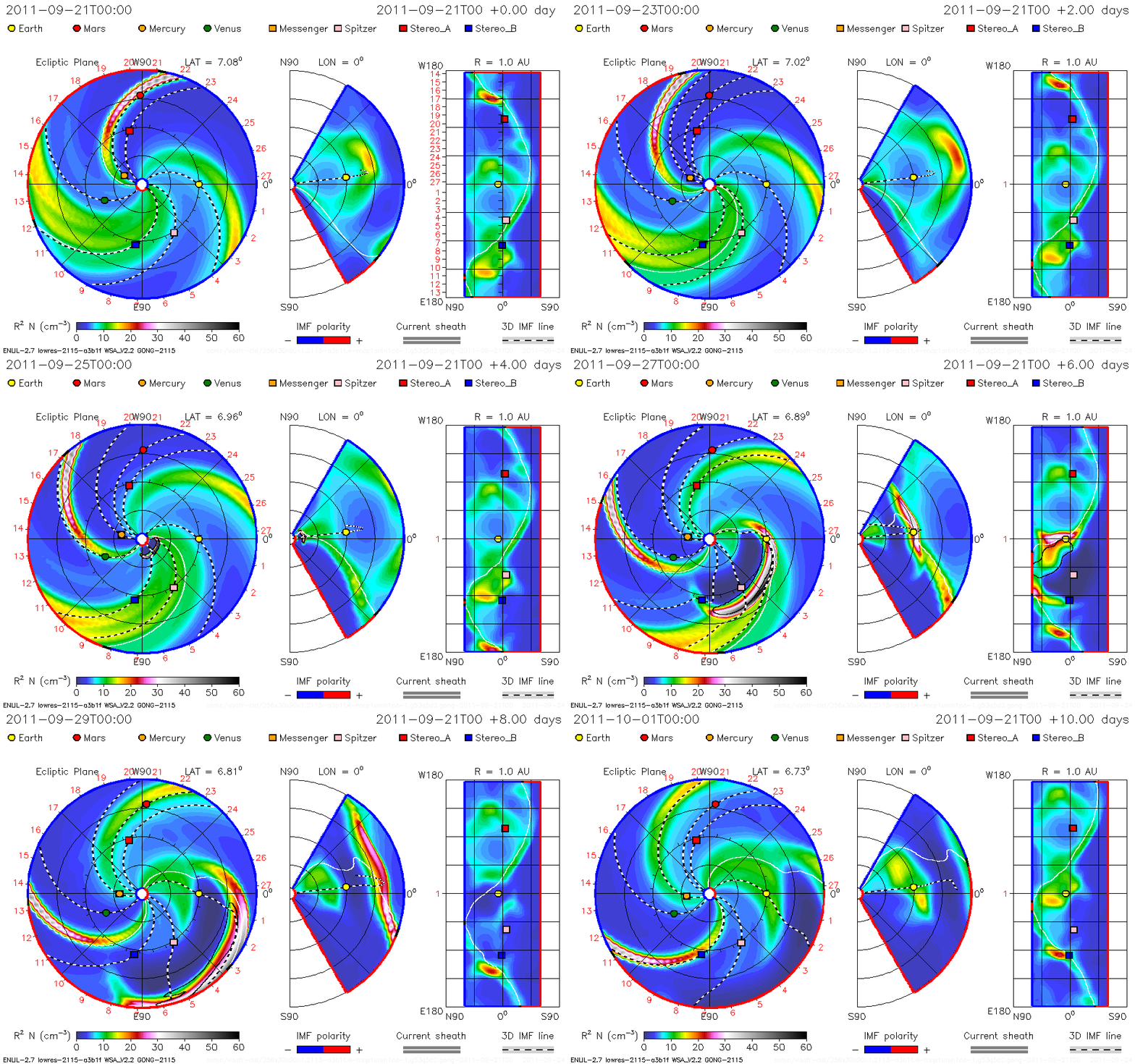
The movie also shows a shadowy shock wave racing away from the blast site. This is a sign that the blast produced a coronal mass ejection (CME). Analysts at the Goddard Space Weather Lab say the CME could deliver a glancing blow to Earth's magnetic field on Sept. 26 at 14:10 UT (+/- 7 hours); click here for an animated forecast track.
UPDATE: Sunspot AR1302 followed today's X2-flare with an M7-flare nearly as strong (movie). So far none of the blasts has been squarely Earth-directed, but this could change as the sunspot turns toward our planet in the days ahead. AR1302 is growing and shows no immediate signs of quieting down. Solar flare alerts: text, voice.
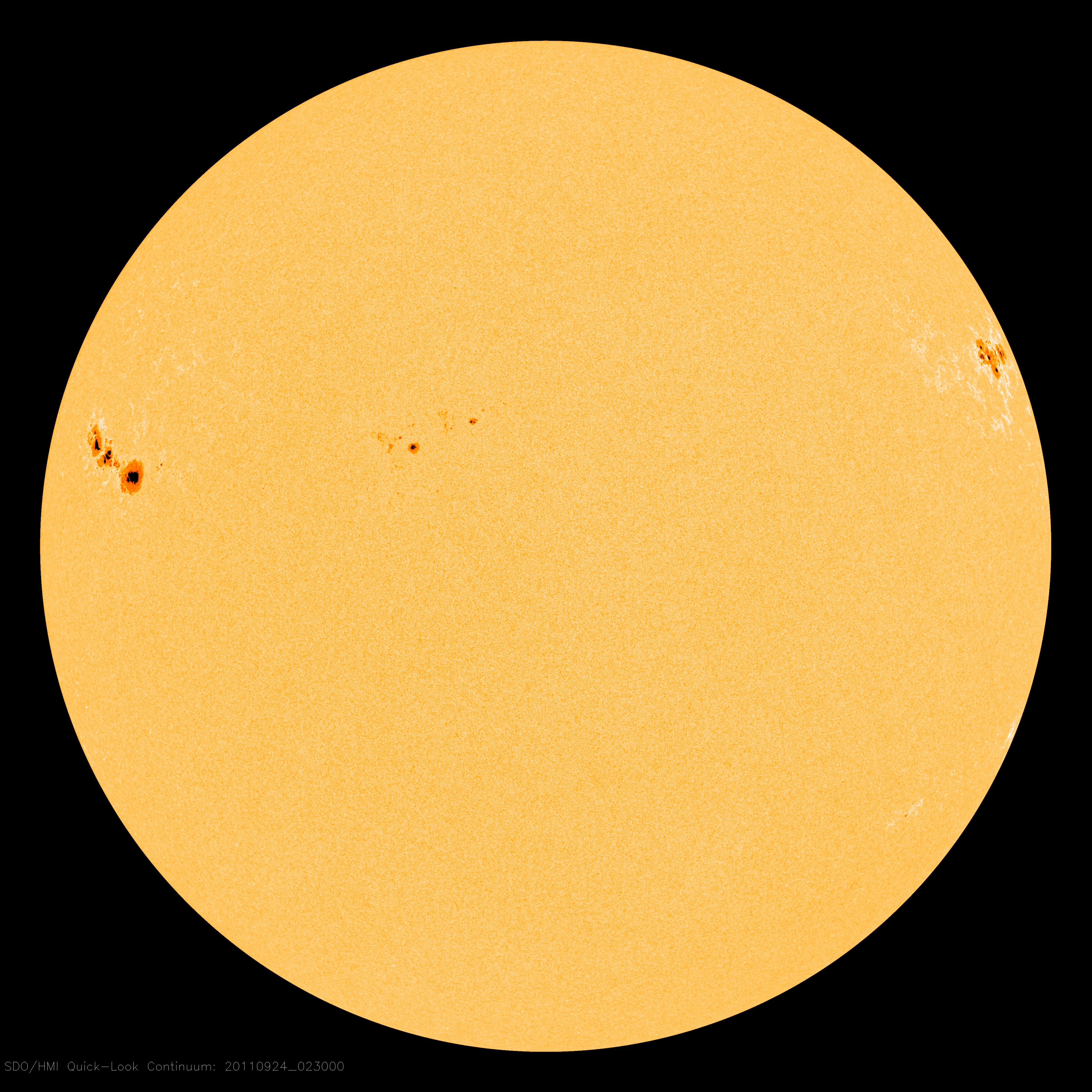
ACTIVE SUNSPOT: New sunspot 1302 has already produced two X-flares (X1.4 on Sept. 22nd and X1.9 on Sept. 24th), can another be far behind? NOAA forecasters put the 24-hour probability at 20%. The sheer size of the active region suggests the odds might be even higher than that:
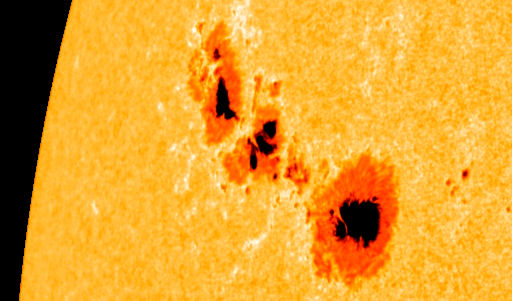
Each of the dark cores in this snapshot from the Solar Dynamics Observatory is larger than Earth, and the entire active region stretches more than 100,000 km from end to end. The sunspot's magnetic field is crackling with sub-X-class flares that could grow into a larger eruption as the sunspot continues to turn toward Earth. Solar flare alerts: text, voice.
more images: from Pavol Rapavy of Observatory Rimavska Sobota, Slovakia; from Cai-Uso Wohler of Bispingen, Germany; from Jo Dahlmans of Ulestraten The Netherlands; from P-M Hedén of Ålbo, Sweden; from Howard Eskildsen of Ocala, Florida
September 2011 Aurora Gallery
[previous Septembers: 2010, 2009, 2008, 2007, 2006, 2005, 2004]
Potentially Hazardous Asteroids (
PHAs) are space rocks larger than approximately 100m that can come closer to Earth than 0.05 AU. None of the known PHAs is on a collision course with our planet, although astronomers are finding
new ones all the time.
On September 24, 2011 there were 1250 potentially hazardous asteroids.
Notes: LD means "Lunar Distance." 1 LD = 384,401 km, the distance between Earth and the Moon. 1 LD also equals 0.00256 AU. MAG is the visual magnitude of the asteroid on the date of closest approach. | | The official U.S. government space weather bureau |
| | The first place to look for information about sundogs, pillars, rainbows and related phenomena. |
| | Researchers call it a "Hubble for the sun." SDO is the most advanced solar observatory ever. |
| | 3D views of the sun from NASA's Solar and Terrestrial Relations Observatory |
| | Realtime and archival images of the Sun from SOHO. |
| | from the NOAA Space Environment Center |
| | the underlying science of space weather |
| | for out-of-this-world printing and graphics |