They came from outer space--and you can have one! Genuine meteorites are now on sale in the Space Weather Store. | | |
LAST GASP: Decaying sunspot AR1618 (not to be confused with growing sunspot AR1620) erupted on Nov. 27th (1557 UT), producing a last-gasp solar flare ranking M1.6 on the Richter Scale of Flares. NASA's Solar Dynamics Observatory recorded the extreme ultraviolet flash:
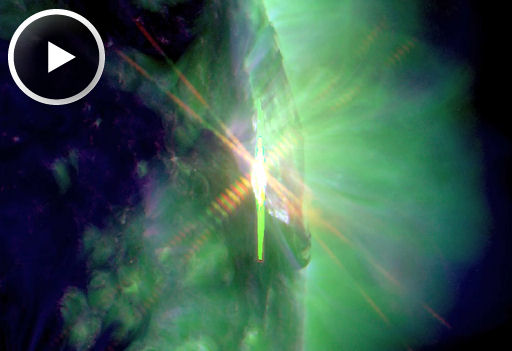
The movie shows a twisted plume of plasma flying away from the blast site, but only temporarily. The sun's gravity pulled the plume back to the stellar surface before it could escape. Extreme UV radiation from this explosion created some ripples of ionization in Earth's atmosphere above North America and Europe. Otherwise, the blast was not geoeffective. Solar flare alerts: text, voice.
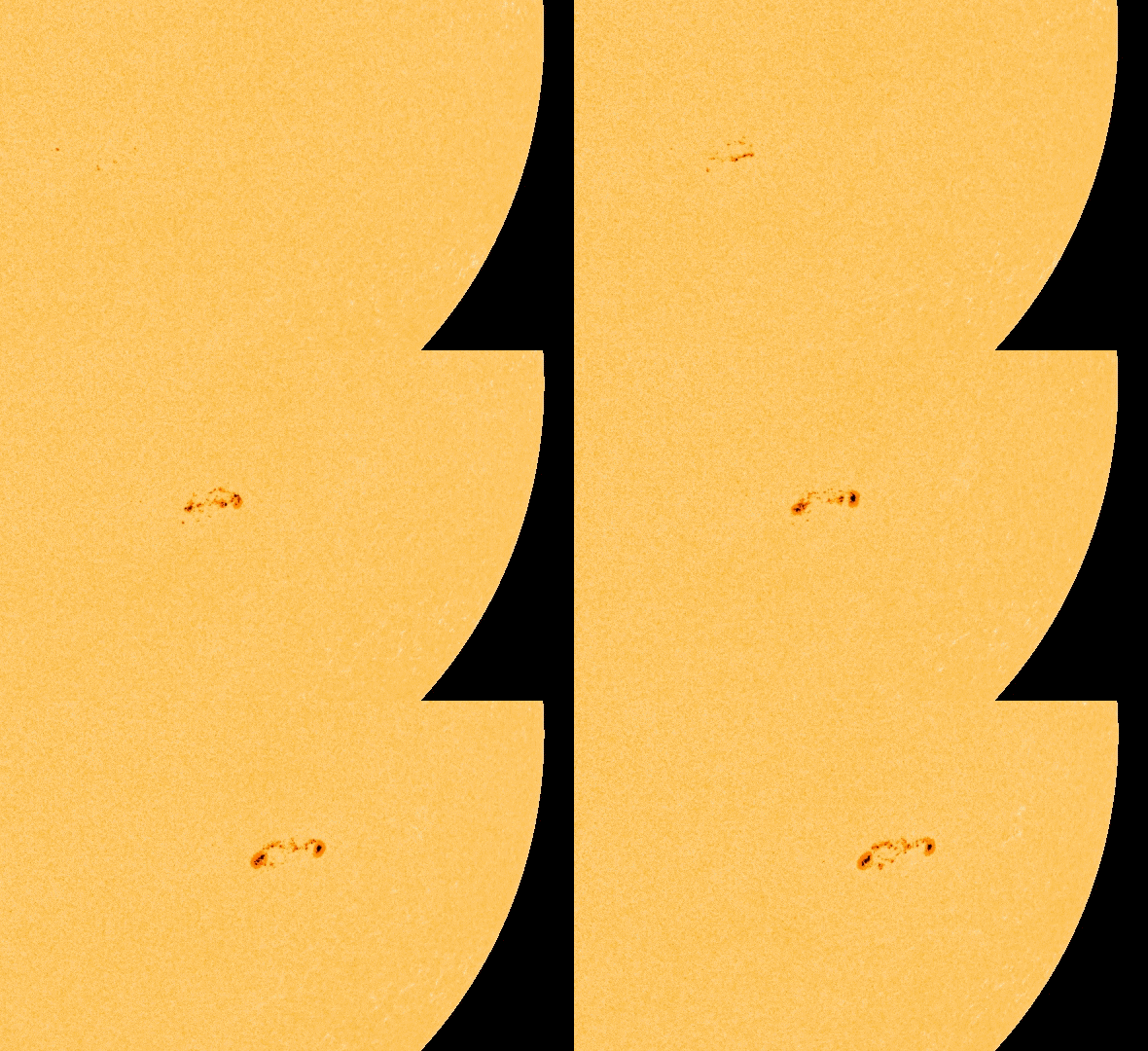
BIG SUNSPOT KEEPS GROWING: Sunspot AR1620 doubled in size again yesterday. It is now a behemoth almost 10 times as wide as Earth. A movie from NASA's Solar Dynamics Observatory shows the sunspot materializing over the past 48 hours:
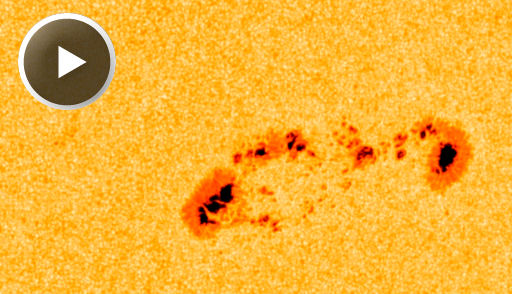
So far the sunspot has been relatively quiet, producing no strong flares. However, the sunspot's magnetic field is rapidly changing as the sunspot grows, and rapidly-changing magnetic fields have a tendency to reconnect and erupt. NOAA forecasters estimate a 35% chance of M-class eruptions in the next 24 hours. Solar flare alerts: text, voice.
Realtime Space Weather Photo Gallery
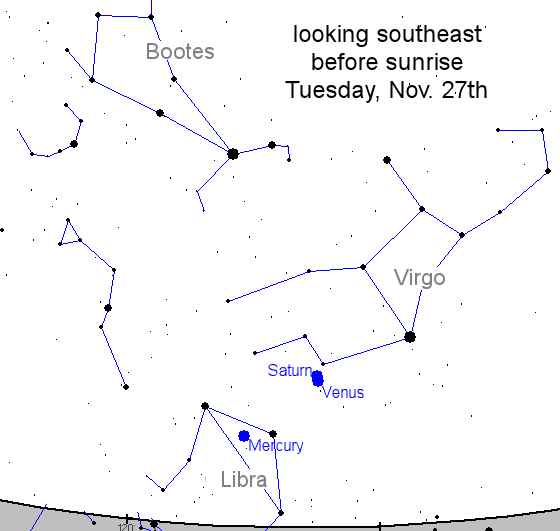
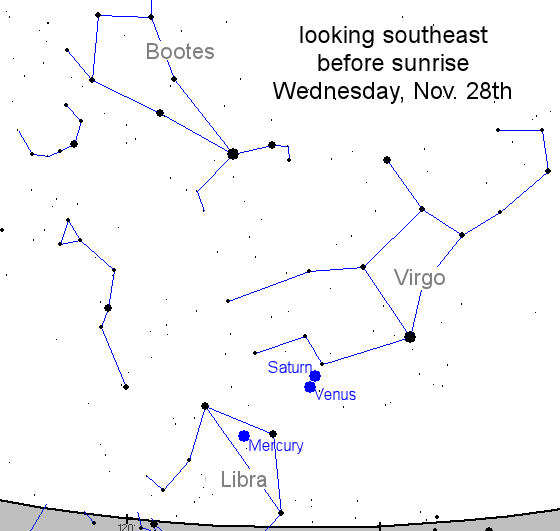
MORNING CONJUNCTION: As dawn begins on Wednesday morning, look southeast to find Venus and Saturn less than 2° apart in the constellation Virgo. Venus is very bright, Saturn much less so. A small telescope will reveal the rings of Saturn and the gibbous phase of Venus. Sky maps: Nov. 27, Nov. 28
Cole Clark of Big Lake, MN, photographed Venus passing by Saturn on the morning of Nov. 27th:
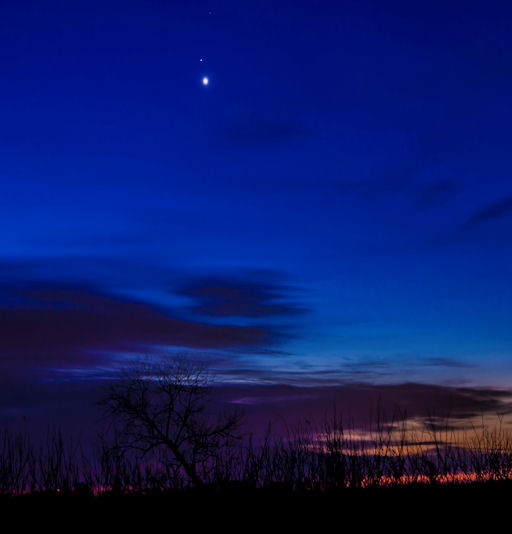
"Venus and Saturn were less than 1 degree apart," says Cole. "The morning was so beautiful with the nearly full Moon setting, the ISS gliding overhead, and Venus and Saturn in conjunction. It was a moment to live for...."
Realtime Conjunction Photo Gallery
Realtime Aurora Photo Gallery
Realtime Eclipse Photo Gallery
Realtime Noctilucent Cloud Photo Gallery
[previous years: 2003, 2004, 2005, 2006, 2007, 2008, 2009, 2011]
Potentially Hazardous Asteroids (
PHAs) are space rocks larger than approximately 100m that can come closer to Earth than 0.05 AU. None of the known PHAs is on a collision course with our planet, although astronomers are finding
new ones all the time.
On November 27, 2012 there were 1353 potentially hazardous asteroids.
Notes: LD means "Lunar Distance." 1 LD = 384,401 km, the distance between Earth and the Moon. 1 LD also equals 0.00256 AU. MAG is the visual magnitude of the asteroid on the date of closest approach. | | The official U.S. government space weather bureau |
| | The first place to look for information about sundogs, pillars, rainbows and related phenomena. |
| | Researchers call it a "Hubble for the sun." SDO is the most advanced solar observatory ever. |
| | 3D views of the sun from NASA's Solar and Terrestrial Relations Observatory |
| | Realtime and archival images of the Sun from SOHO. |
| | from the NOAA Space Environment Center |
| | the underlying science of space weather |