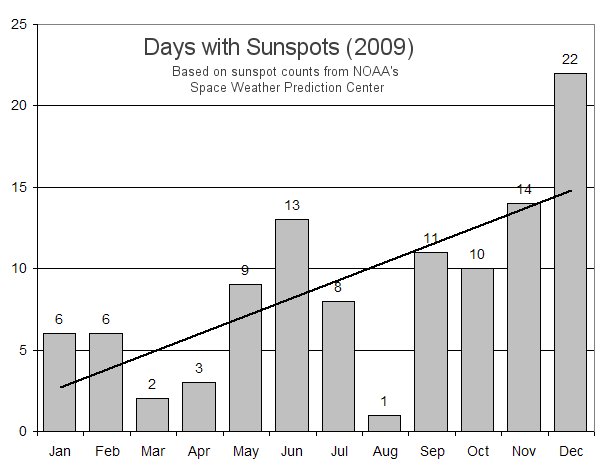
SATELLITE FLYBYS APP: Turn your iPhone or iPod into a field-tested satellite tracker! Spaceweather.com presents the Satellite Flybys app. | | | BLUE MOON ON NEW YEAR'S EVE: This Thursday, Dec. 31st, for the first time in almost twenty years, there's going to be a Blue Moon on New Year's Eve. Get the full story and party tips from Science@NASA. SUNSPOT SURGE: 2009 is ending with a flurry of sunspots. Indeed, if sunspot 1039 holds together just one more day (prediction: it will), the month of December will accumulate a total of 22 spotted days and the final tally for the year will look like this: 
The dark line is a linear least-squares fit to the data. If the trend continues exactly as shown (prediction: it won't), sunspots will become a non-stop daily occurance no later than February 2011. Blank suns would cease and solar minimum would be over. If the past two years have taught us anything, however, it is that the sun can be tricky and unpredictable. Stay tuned for surprises. BLUE MOON ECLIPSE: On Dec. 31st, the Blue Moon will dip into Earth's shadow for a partial lunar eclipse. The event is visible from Europe, Africa and Asia: map. At maximum eclipse, around 19:24 Universal Time, approximately 8% of the Moon will be darkly shadowed. Click on the image to launch an animated preview: 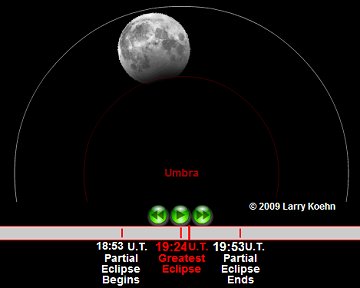
Blue Moons are rare (once every ~2.5 years). Blue Moons on New Year's Eve are rarer still (once every ~19 years). How rare is a lunar eclipse of a Blue Moon on New Year's Eve? A search of NASA's Five Millennium Catalogue of Lunar Eclipses provides an approximate answer. In the next 1000 years, Blue Moons on New Year's Eve will be eclipsed only 11 times (once every ~91 years). So this is a rare event, indeed.
December Northern Lights Gallery
[previous Decembers: 2008, 2007, 2006, 2005, 2001, 2000]
Explore the Sunspot Cycle |