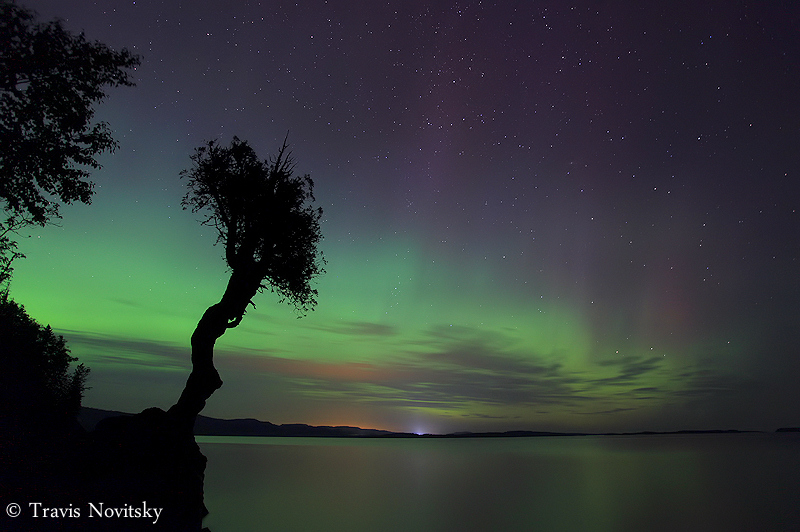
iPHONE VS ANDROID! Actually, it doesn't matter which phone you carry. Our cool, new app turns both smartphones into field-tested satellite trackers. | | | GEOMAGNETIC STORM--MORE TO COME? The solar storm of August 1st sent two CMEs toward Earth. The first one arrived yesterday, August 3rd, sparking mild but beautiful Northern Lights over Europe and North America (see below). The second CME is still en route. NOAA forecasters estimate a 35% chance of major geomagnetic storms when the cloud arrives on August 4th or 5th. High-latitude sky watchers should remain alert for auroras. NORTHERN LIGHTS: A coronal mass ejection (CME) hit Earth's magnetic field on August 3rd at 1740 UT. The impact sparked a G2-class geomagnetic storm that lasted nearly 12 hours--time enough for auroras to spread all the way from Europe to North America. Travis Novitsky sends this picture from Grand Portage, Minnesota: 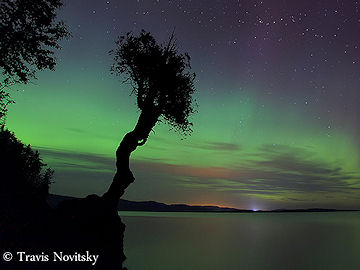
"The Northern Lights made a pretty good showing last night!" says Novitsky. "I was lucky to catch them during a break in the clouds. I took all these pictures between 11:00 p.m. and 12:00 a.m local time using my Canon 5D Mark II." "Wow!" says photographer Tony Wilder of Chippewa Falls, Wisconsin. "It was a sweet surprise to catch the auroras over Lake Wissota. The Northern Lights never get old." With the possible arrival of a second CME on August 4th, tonight might be even better than last night. Imagine that as you browse the gallery. NEW IMAGES: August Northern Lights Gallery
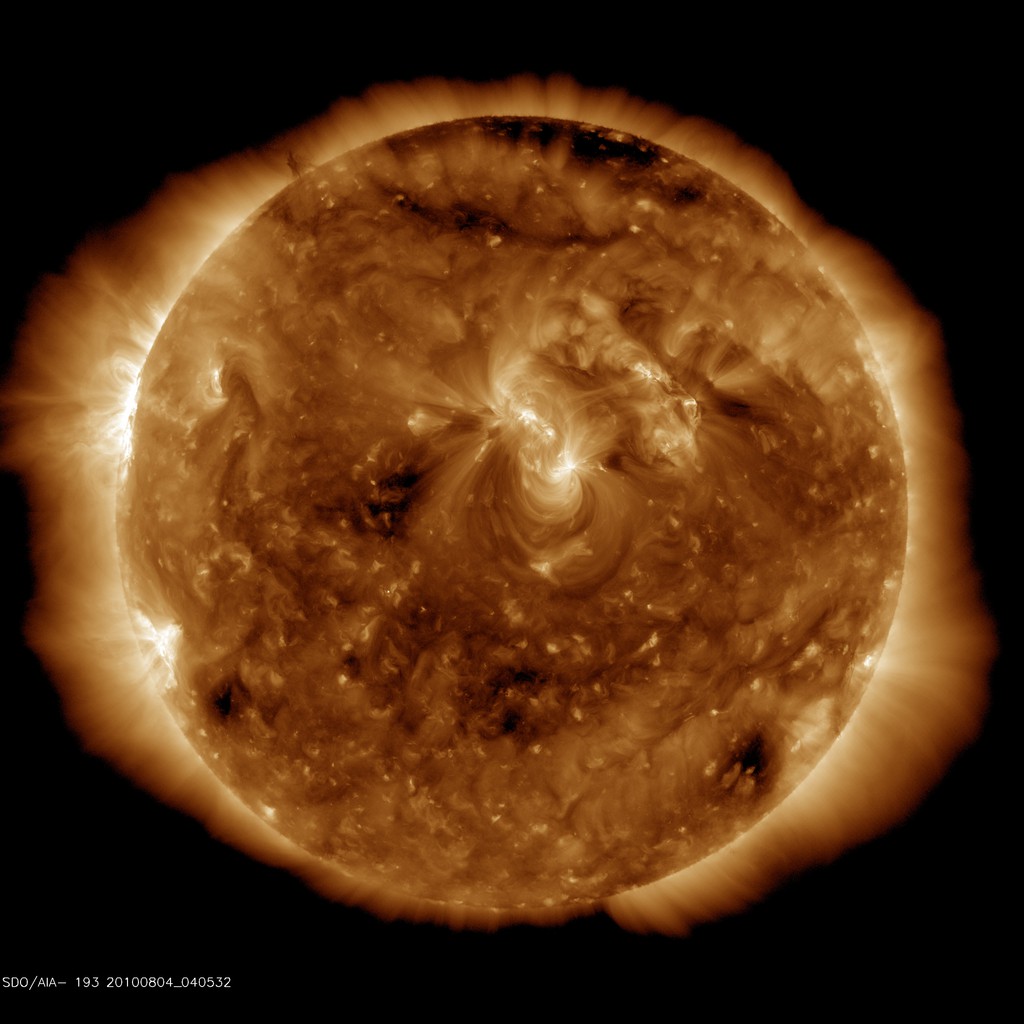
[previous Augusts: 2009, 2008, 2007, 2006, 2005, 2004, 2003] COMPLEX ERUPTION ON THE SUN: On August 1st, the entire Earth-facing side of the sun erupted in a tumult of activity. There was a C3-class solar flare, a solar tsunami, multiple filaments of magnetism lifting off the stellar surface, large-scale shaking of the solar corona, radio bursts, a coronal mass ejection and more. This extreme ultraviolet snapshot from the Solar Dynamics Observatory shows the sun's northern hemisphere in mid-eruption: 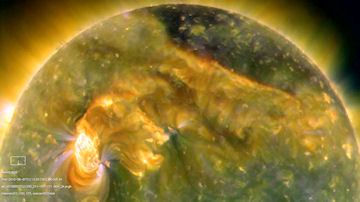
Different colors in the image represent different gas temperatures ranging from ~1 to 2 million degrees K. Watch the movie. Some parts of the sun heat up during the eruption, other parts cool down. These are priceless data for solar physicists working to understand the inner workings of solar storms. Stay tuned for more movies and analyses in the days ahead.
Solar Eclipse Photo Gallery
[NASA: South Pacific Eclipse] [animated map] |