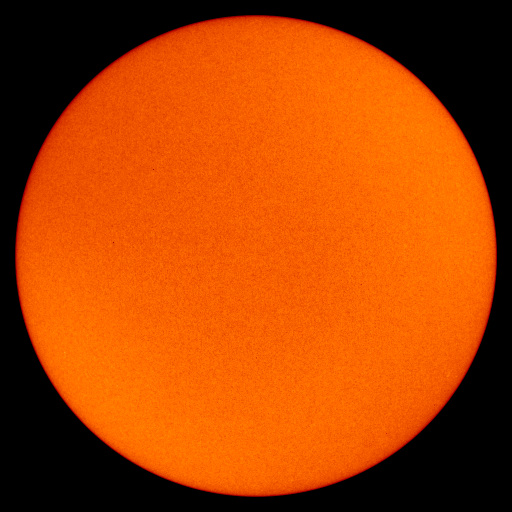
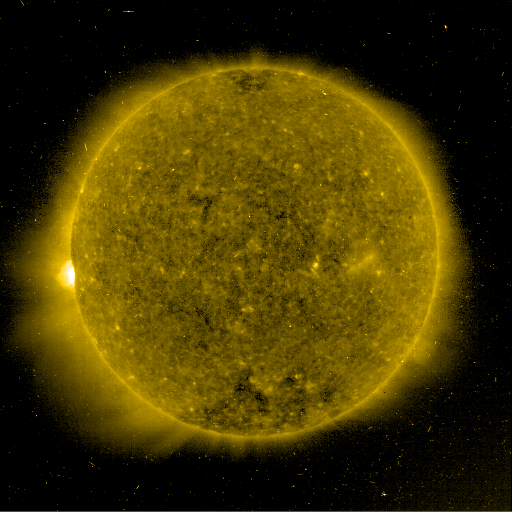
| FLYBY ALERT! Space shuttle Discovery launches on May 31st. Get your flyby alerts from Space Weather PHONE | | | NEW MEXICO FIREBALL: On May 12th, a brilliant green fireball (probably meteoritic) flew over eastern New Mexico and lit up the ground like a full Moon. Using a Sandia Labs all-sky camera and a 60-80 MHz radio receiver, Thomas Ashcraft not only photographed the fireball but also recorded distant radio stations echoing eerily from the fireball's ionized tail. Click here and enjoy the show. SOLAR ACTIVITY: Yesterday's solar "fire fountain" has subsided and the source has revealed itself. "It's a crackling, energetic region on the sun's surface," reports Pete Lawrence, who sends this picture from Selsey, UK: 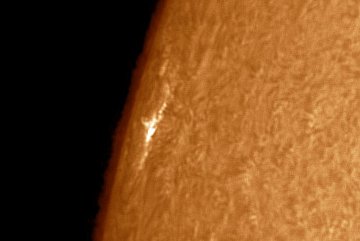
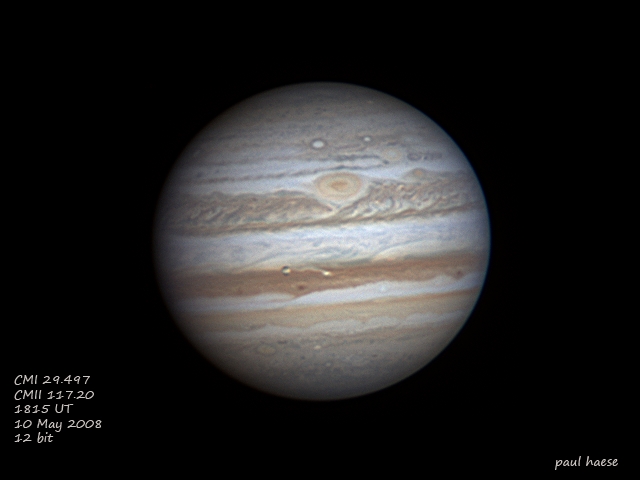
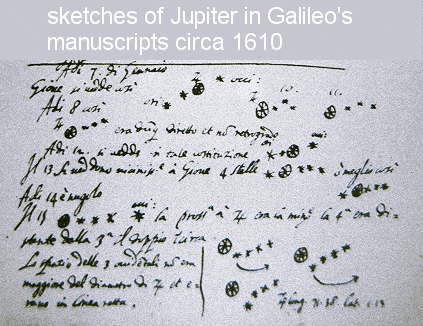
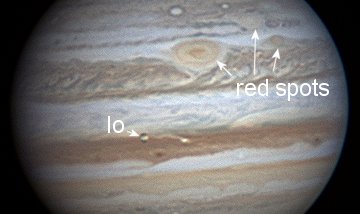
The core of the region has not coelesced into an actual sunspot, but it is nevertheless lively and interesting to watch: "A few bright flares have been occurring this morning," says Lawrence. "If you've got clear skies and a solar telescope, don't forget to keep a look out as anything can happen!" more images: from Greg Piepol of Rockville, Maryland; from Stephen Ames of Hodgenville, Kentucky; from Peter Paice of Belfast, Northern Ireland WHAT WOULD GALILEO SAY? Before you read any further, click here. That's what Galileo saw in 1610 when he turned his small telescope toward Jupiter: a fuzzy disk surrounded by four point-like moons. It wasn't much to look at, but his pioneering observations upended 17th century cosmology. Times have changed. Fast forward 398 years to the backyard of amateur astronomer Paul Haese in Blackwood, South Australia: "I took this picture of Jupiter on May 10th using my peltier cooled 14-inch Celestron telescope." 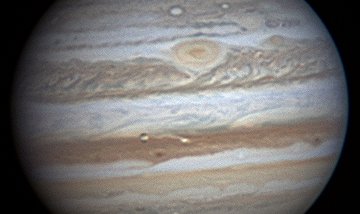
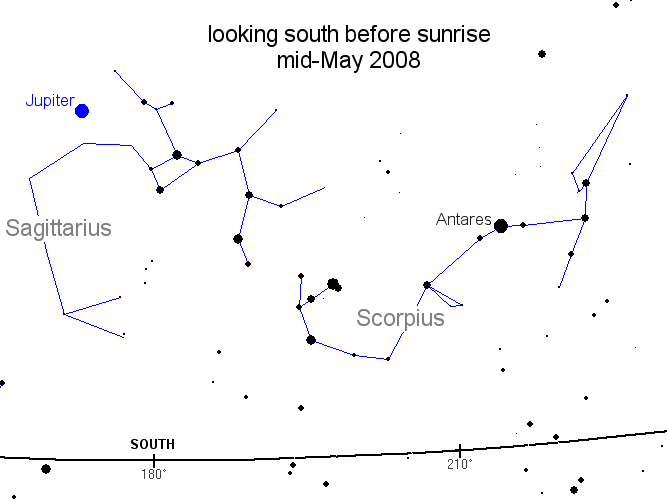
"The seeing was great," he says. Jupiter's moon Io appears in the foreground not as a dimensionless point of light, but a true 3D orb. The Great Red Spot, an anti-cyclone twice as wide as Earth, reveals its inner swirls while two companion red spots turn nearby: labels. The overall detail is breathtaking. "I'm a happy camper, says Haese. "This is my best picture of Jupiter yet." And it didn't even upend cosmology. What would Galileo say to that? [Galileo replies: "If I had used a 14-inch Celestron back in 1610, I would have undoubtedly observed that the Medicean planet has more than four moons, and I would have needed to name them not only for Prince Cosimo, but for his entire extended family!"] Readers, Jupiter is a wonderful target for any backyard telescope and it's easy to find. Before dawn, look south for a bright light in the constellation Sagittarius: sky map.
April 2008 Aurora Gallery
[Aurora Alerts] [Night-sky Cameras] |