Don't just watch shooting stars. Wear them! Authentic meteorite jewelry for Christmas is now available in the SpaceWeather Store. | | |
COMET LOVEJOY IN THE MORNING: Noted astronomer John Bortle urges observers (especially in the southern hemisphere) to "begin searching for Comet Lovejoy's bright tail projecting up out of the morning twilight beginning at dawn. The tails of some of the major sungrazing comets have been extraordinarily bright. Comet Lovejoy's apparition has been so bizarre up to this point that it is difficult to anticipate just what might happen next ... [including] the exact sort of tail it might unfurl in the morning sky."
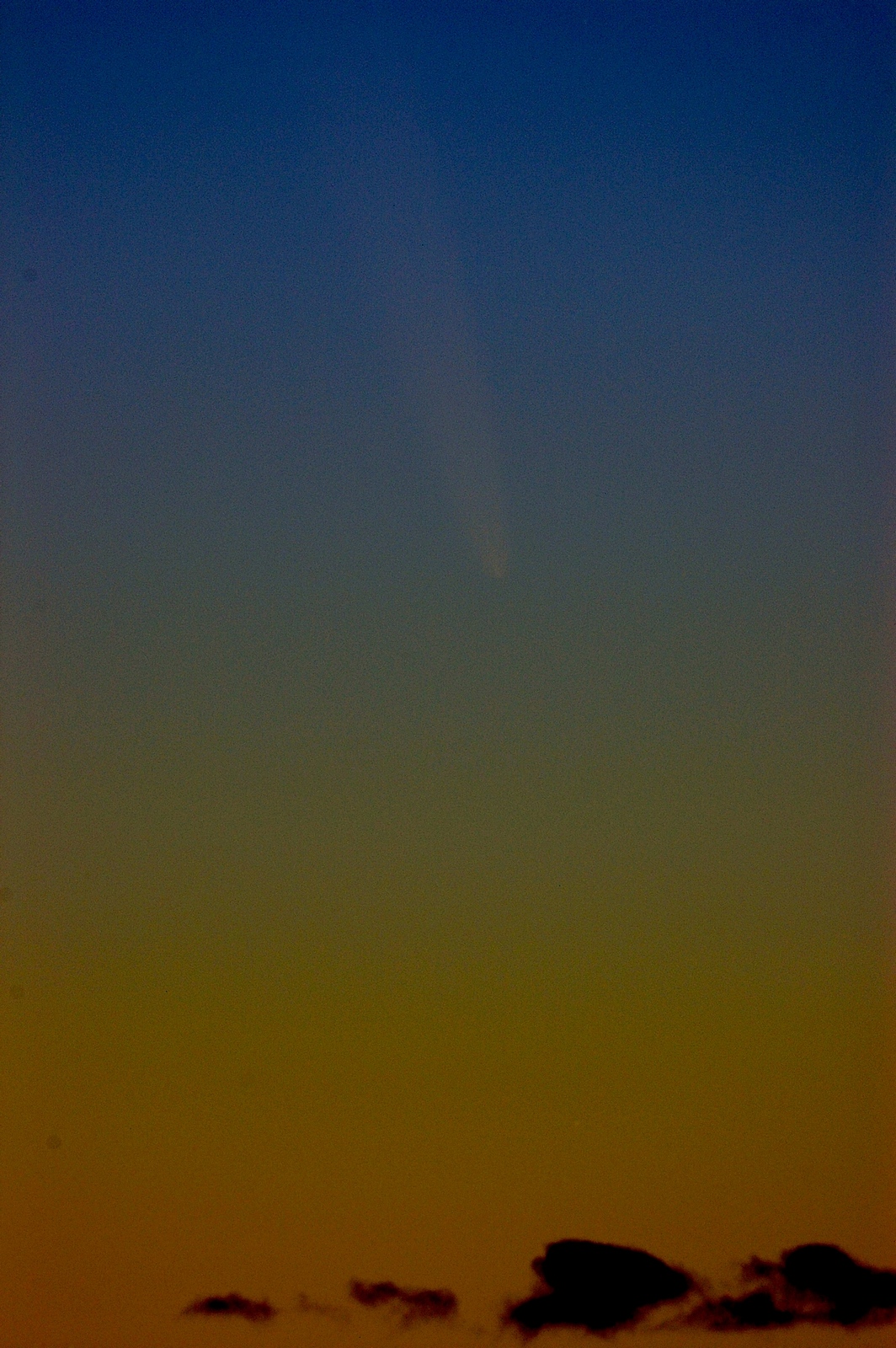
This just in! The ghostly tail of Comet Lovejoy was sighted this morning shining through the twilight glow of dawn over Australia. Peter Sayers sends this picture from Devonport, Tasmania:
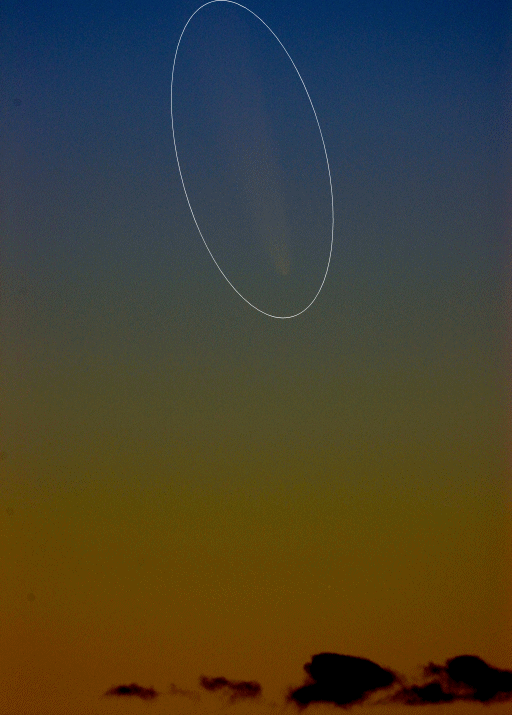
"I was surprised to be able to see Comet Lovejoy in our Tasmanian summer early morning twilight with the waning Moon," says Sayers. "The comet's tail was just barely naked eye and perhaps a degree long."
The visibility of the tail could improve in the days ahead as the comet moves away from the sun and the background sky darkens accordingly. Early rising sky watchers should be alert for this rare apparition. [finder chart]
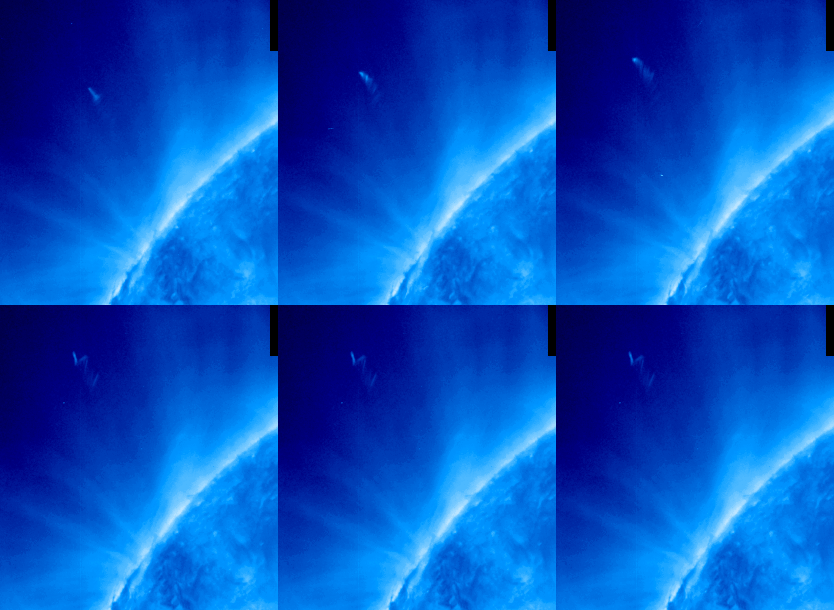
SPIRAL COMET TAIL: As Comet Lovejoy recedes intact from its Dec. 16th close encounter with the sun, researchers are pondering a mystery: What made the comet's tail wiggle so wildly in transit through the sun's atmosphere? The effect is clear in this sequence of extreme UV images recorded by NASA's STEREO-B spacecraft:
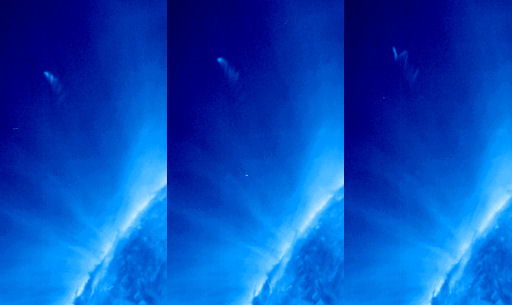
"Why the wiggles?" wonders Karl Battams of the Naval Research Lab. "We're not sure. There might be some kind of helical motion going on. Perhaps we're seeing material in the tail magnetically 'clinging' to coronal loops and moving with them. [Coronal loops are huge loops of magnetism that emerge from the sun's surface and thread the sun's atmosphere.] There are other possibilities too, and we will certainly investigate those!"
Battams notes that these images can be combined with similar images from STEREO-A on the other side of the sun to produce a three dimensional picture. "When we pair these together, and throw in the SDO images too, we should be able to get an incredibly unique 3-D picture of how this comet is reacting the the intense coronal heat and magnetic loops. We are going to learn a lot."
TIANGONG 1 AND MARS: This week, China's new space station, Tiangong 1, is making a series of bright passes through the morning skies of North America. On Dec. 18th, Kevin Fetter of Brockville, Canada, caught the 8.5-metric-ton spaceship flying past the planet Mars (video):
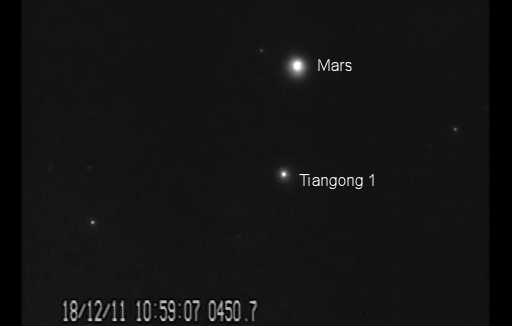
Tiangong 1 is unoccupied now, but China is planning to send Taikonauts to visit the experimental station at least once and possibly twice in 2012. To prepare for their arrival, last Thursday automated systems onboard Tiangong 1 began a series of air quality checks inside the station's 15-cubic meter pressurized volume.
Tiangong 1 is currently about as bright as the stars of the Big Dipper (a value that will approximately double when future spacecraft dock with it). To see it, check Spaceweather's Simple Satellite Tracker or your cell phone for local flyby times.
Dec. 10th Total Lunar Eclipse Gallery