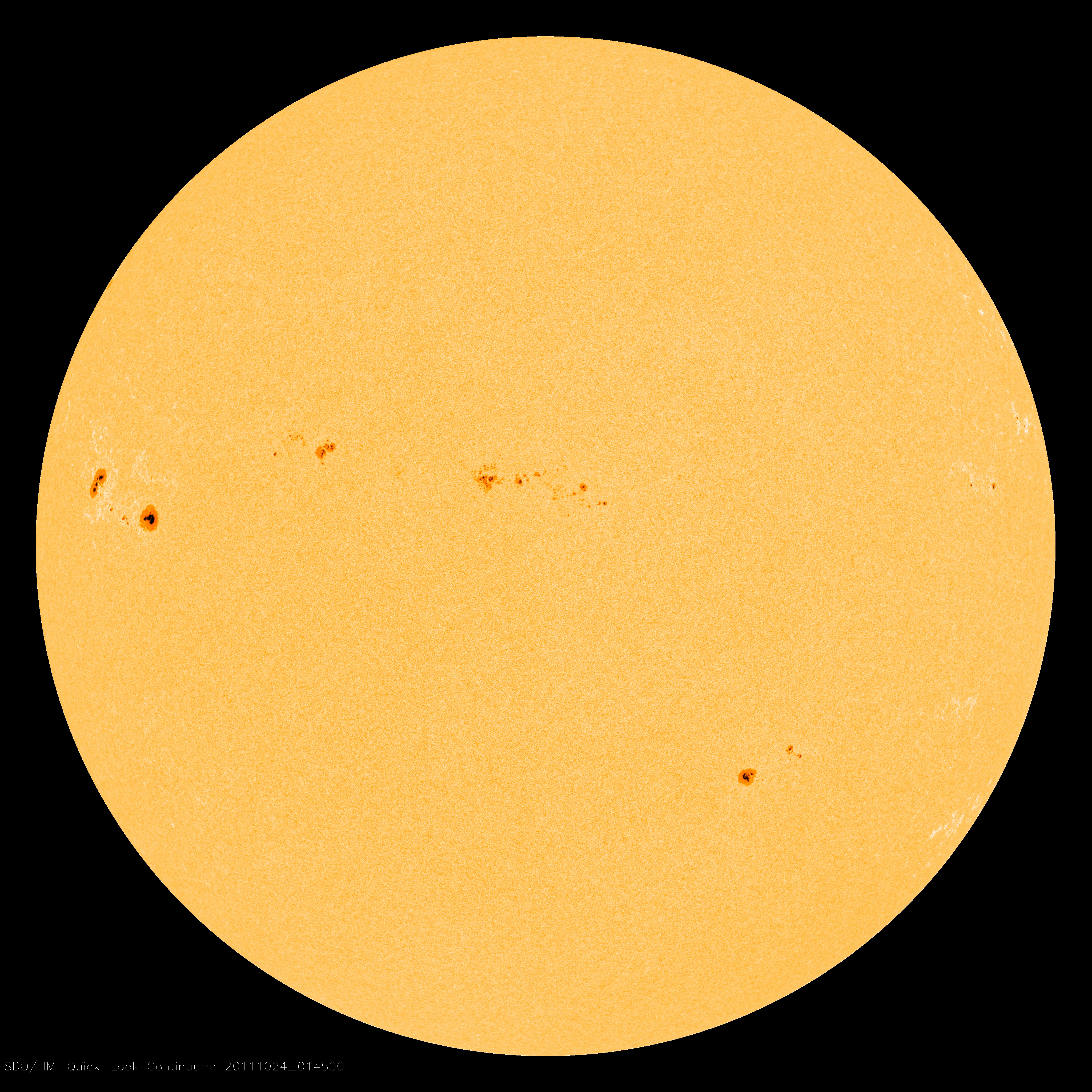
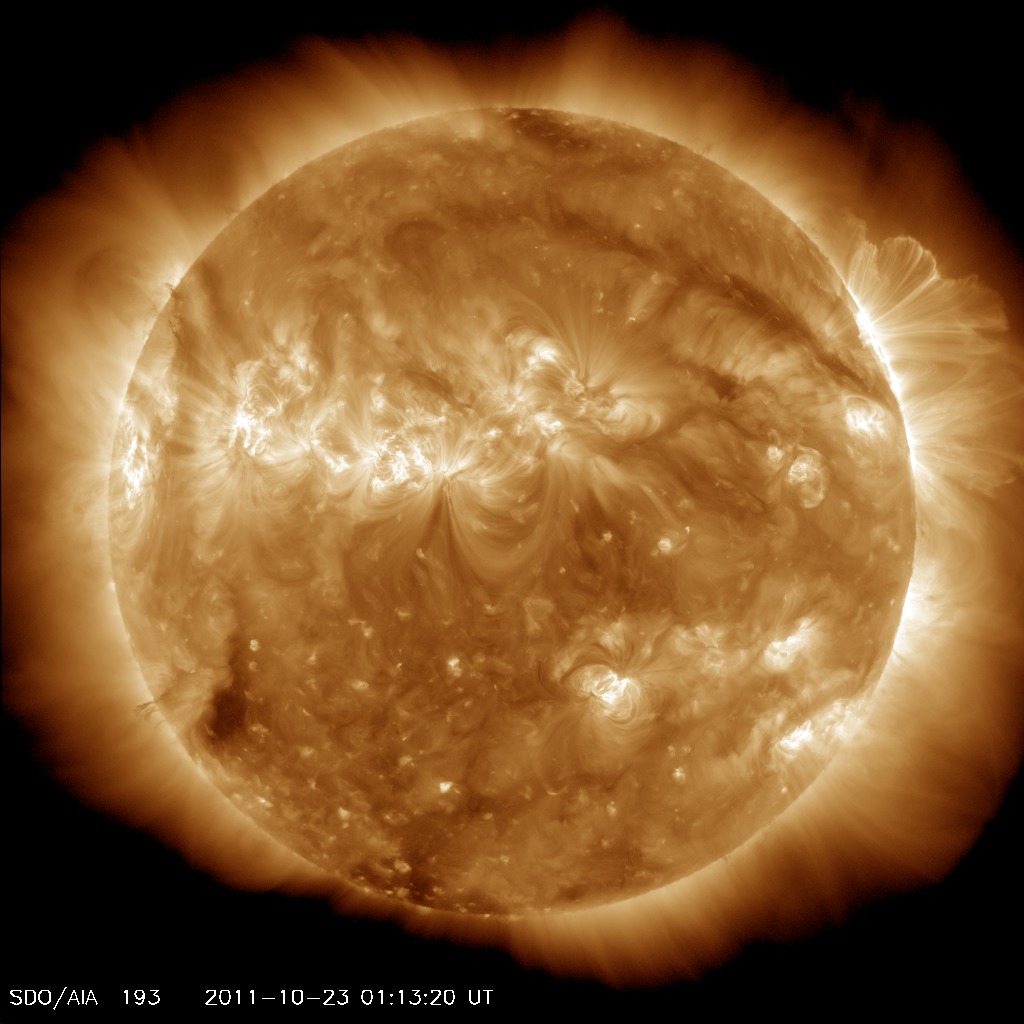
Metallic photos of the sun by renowned photographer Greg Piepol bring together the best of art and science. Buy one or a whole set. They make a stellar gift. | | | CME IMPACT: A CME hit Earth's magnetic field on Oct. 24th at approximately 1800 UT (02:00 pm EDT). Acording to analysts at the Goddard Space Weather Lab, the impact caused a strong compression of Earth's magnetic field, allowing solar wind to penetrate all the way down to geosynchronous orbit for a brief period between 19:06 UT and 19:11 UT. Earth-orbiting spacecraft could have been directly exposed to solar wind plasma during that time. The impact also sparked a geomagnetic storm, underway now. Geir Øye sends this picture from Ørsta, Norway: 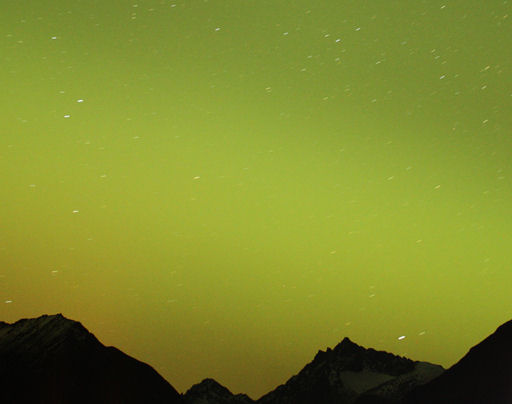
"The sky was brightly illuminated by auroras this evening," says Øye. "The picture, above, was taken at 19.20 UT [just after the most extreme compression of the magnetosphere]." High-latitude sky watchers should remain alert for auroras as Earth's magnetic field continues to reverberate from the CME impact. The best time to look is usually during the hours around local midnight. Aurora alerts: text, voice. COMET CORPSE: "Doomsday Comet" Elenin was briefly famous for inaccurate predictions that it might hit Earth. Instead it disintegrated as it approached the sun last month. (Doomsday canceled.) Over the weekend, Italian astronomer Rolando Ligustri spotted the comet's remains. It's the elongated cloud in this Oct. 22nd photo of the star field where Elenin would have appeared if it were still intact: 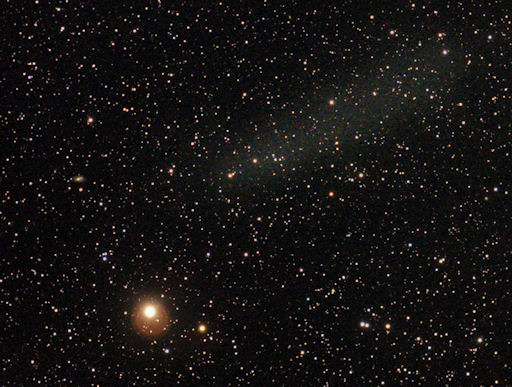
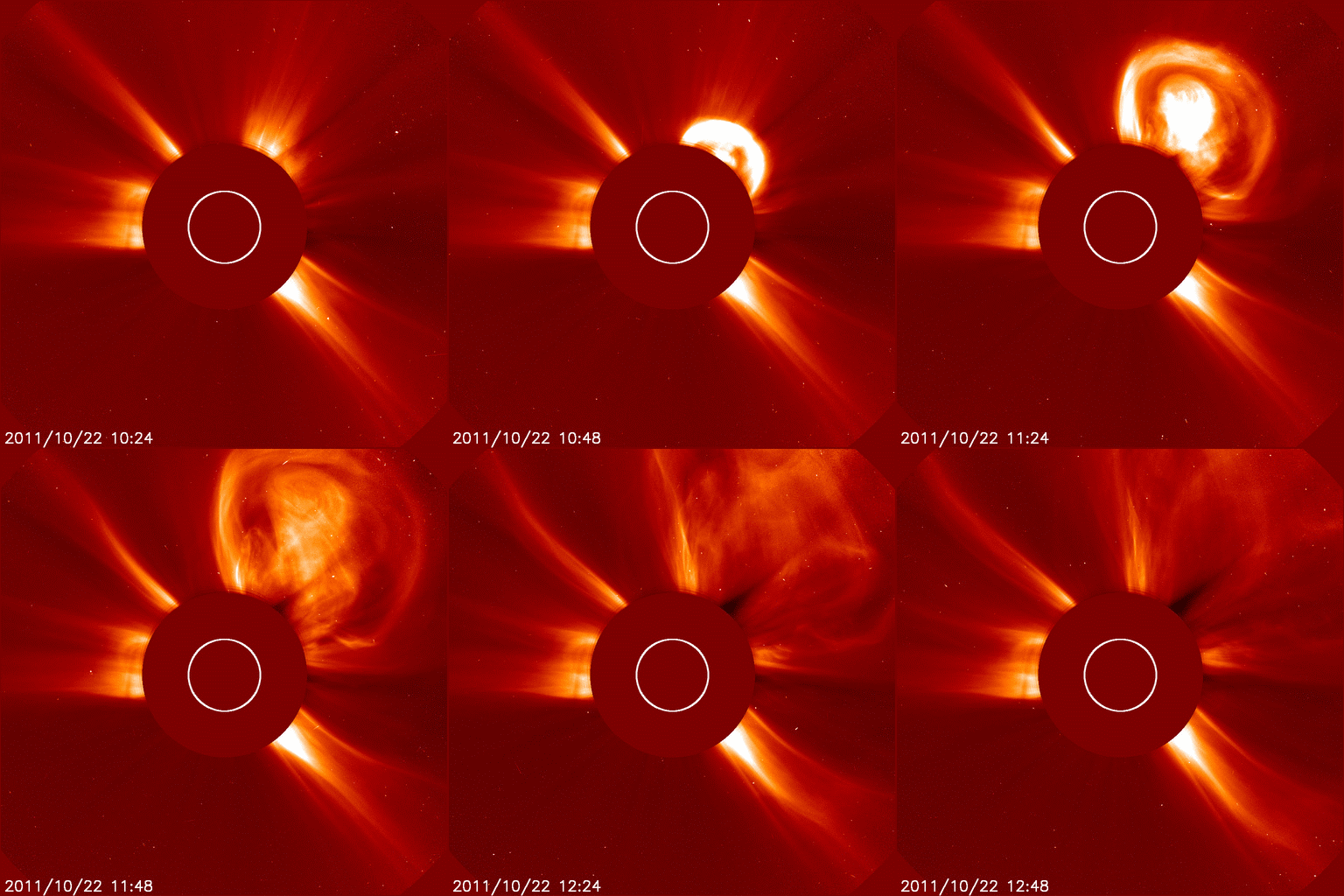
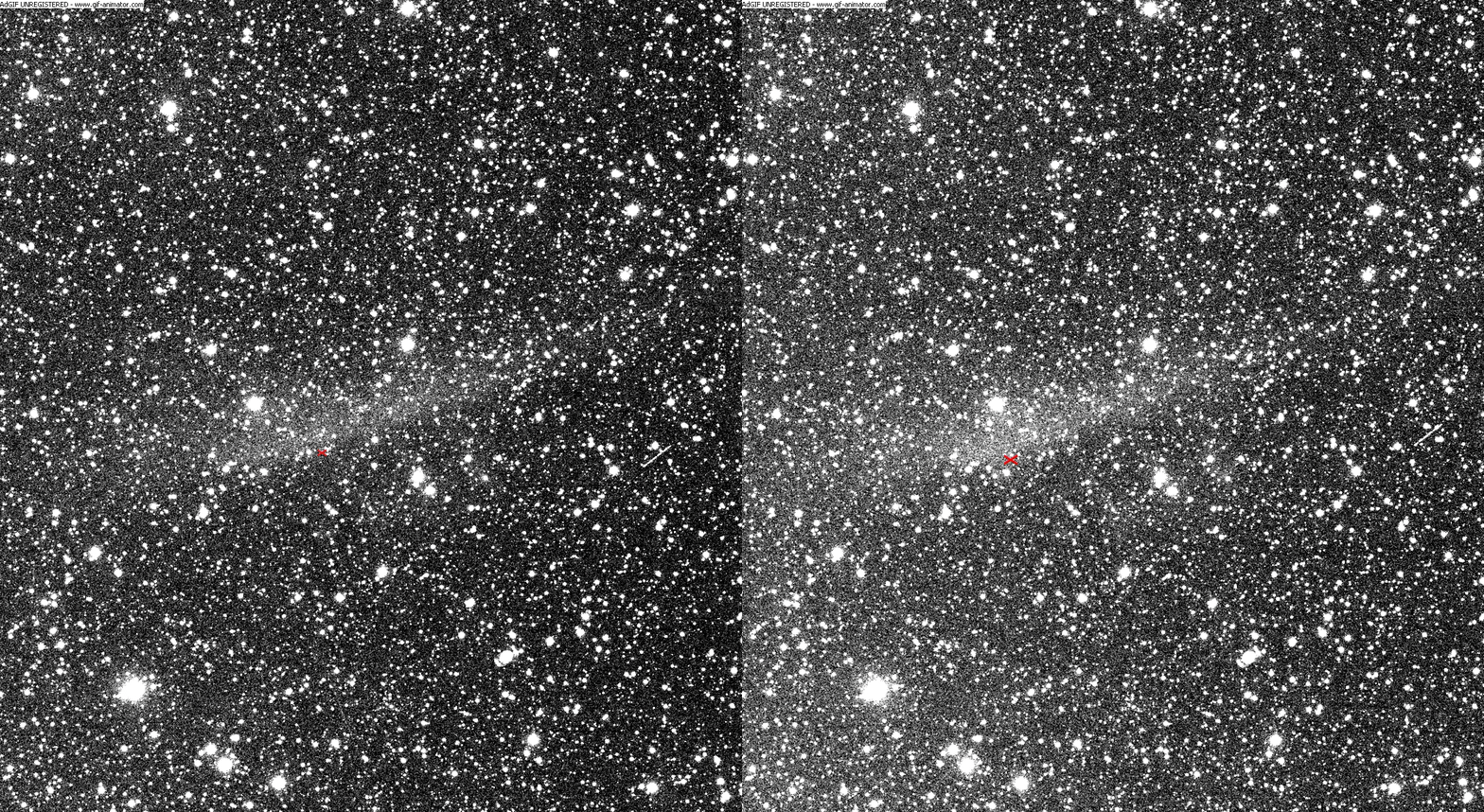
Another team of astronomers--Ernesto Guido, Giovanni Sostero and Nick Howes--spotted the cloud on the same night. At first they were skeptical. "The cloud was extremely faint and diffuse," says Guido. "We wondered if it might be scattered moonlight or some other transient artifact." But when the team looked again on Oct. 23, the cloud was still there. A two-night blink animation shows that the cloud is moving just as the original comet would have. Note: Some readers have noticed a fast-moving streak to the to the lower right of the debris cloud. That is an unrelated asteroid, 2000 OJ8 (magnitude 14), which happened to be in the field of view at the same time as the cloud of Elenin. More information about this discovery and continued tracking of the "comet corpse" may be found at the Remanzacco Observatory Astronomy Blog. SPACE WEATHER FORECAST FOR MARS: A bright CME blasted off the sun yesterday, Oct. 22nd, and it appears to be heading for Mars. Analysts at the Goddard Space Weather Lab expect the cloud to reach the Red Planet on Oct. 26th (forecast track). A brief discussion of what CMEs can do to Mars follows this SOHO image of the eruption: 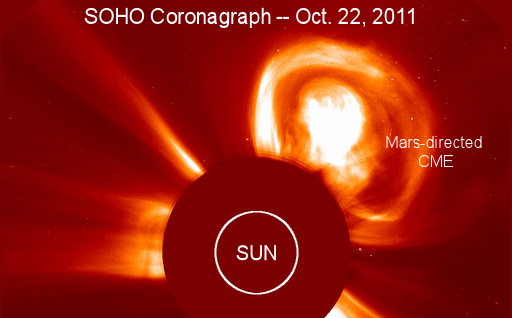
Mars has a unique response to solar storms shaped by the planet's strange magnetic topology. Unlike Earth, which has a global magnetic field, Mars is patchily covered by dozens of "magnetic umbrellas"--remnants of an over-arching planetary field that decayed billions of years ago. When Mars gets hit by a CME, the resulting magnetic storms take place in the umbrellas. Circumstantial evidence collected by Mars Global Surveyor in the 1990s suggests that the tops of the umbrellas light up with bright ultraviolet auroras during such storms. Because the structures are distributed around the planet, these auroras can appear even at the equator. Mars rovers and satellites should be alert for aurora equatoralis on Oct. 26th. Bonus: Magnetic umbrellas are at the heart of one of Mars's greatest mysteries: What happened to the atmosphere? Billions of years ago, the air on Mars was thick enough to protect vast expanses of water on the planet’s surface. Now, however, the atmosphere is 100 times thinner than Earth's and the surface is bone dry. Some researchers believe that magnetic storms in the umbrellas could rip parcels of atmosphere away from Mars and propel air-filled magnetic bubbles into space. In this way, space weather could be directly responsible for the desiccation of the Red Planet. Potentially Hazardous Asteroids ( PHAs) are space rocks larger than approximately 100m that can come closer to Earth than 0.05 AU. None of the known PHAs is on a collision course with our planet, although astronomers are finding new ones all the time. On October 24, 2011 there were 1256 potentially hazardous asteroids. Notes: LD means "Lunar Distance." 1 LD = 384,401 km, the distance between Earth and the Moon. 1 LD also equals 0.00256 AU. MAG is the visual magnitude of the asteroid on the date of closest approach. | | The official U.S. government space weather bureau | | | The first place to look for information about sundogs, pillars, rainbows and related phenomena. | | | Researchers call it a "Hubble for the sun." SDO is the most advanced solar observatory ever. | | | 3D views of the sun from NASA's Solar and Terrestrial Relations Observatory | | | Realtime and archival images of the Sun from SOHO. | | | from the NOAA Space Environment Center | | | the underlying science of space weather | | | for out-of-this-world printing and graphics | |