They came from outer space--and you can have one! Genuine meteorites are now on sale in the Space Weather Store. | | |
SUNSET PLANETS: When the sun goes down tonight, step outside and look west. Venus and the crescent Moon are shining together through the twilight glow of sunset. It's a nice way to end the day. Images: #1, #2, #3, #4, #5, #6, #7.
SUBSIDING STORM: A geomagnetic storm caused by Monday's M9-class solar flare and Tuesday's CME impact is over. The aurora watch is cancelled for all but higher latitudes around the Arctic Circle. [aurora gallery]
STORM RECAP: As expected, a CME hit Earth's magnetic field on Jan. 24th at approximately 1500 UT (10 am EST). The impact produced a G1-class geomagnetic storm and bright auroras around the Arctic Circle. As the storm crested, Göran Strand of Östersund, Sweden, took a panoramic photo and wrapped it 360-degrees to create this composition, which he calls Planet Aurora:
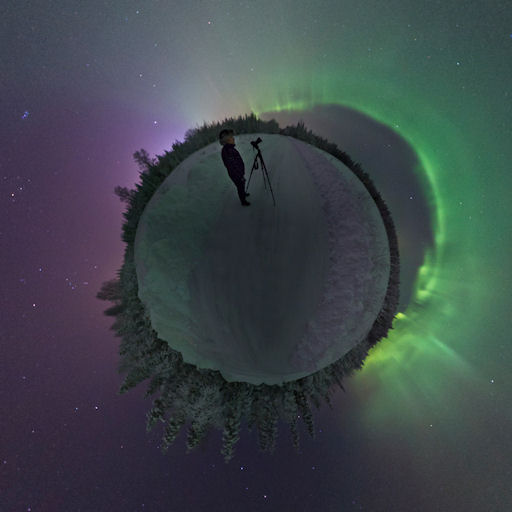
Even veteran aurora watchers were impressed. "This was one of the best Northern Lights displays that I've ever seen, and I mean ever in over 5000 hours on the ice," says Andy Keen of Inari, Finland. "It was, in short, truly spectacular and something that will live with me for a lifetime." In the Abisko National Park of Sweden, aurora tour guide Chad Blakely contributed a similar report: "Eight tourists and I were treated to one of the most wonderful displays I have ever seen. The auroras began as we were eating dinner and continued into the very early hours of the morning. Words can not describe the excitement we shared."
The storm subsided as it crossed the Atlantic and petered out almost completely by the time it reached North America. Only observers in Scandinavia, Iceland and Greenland witnessed the full display:

"We went out with snowmobiles to wait for the incoming storm," says photographer Antti Pietikäinen of Muonio in the Finnish Lapland. "The show started slowly, but after 15mins the landscape was green! This was the first time for Thomas (pictured above) to see the Northern Lights. He was very happy." Aurora alerts: text, voice.
UPDATED: January 2012 Aurora Gallery
[previous Januaries: 2010, 2009, 2008, 2007, 2005, 2004]
Comet Lovejoy Gallery
[previous comets: McNaught, Holmes, Lulin, Tuttle, Ikeya-Zhang]
Potentially Hazardous Asteroids (
PHAs) are space rocks larger than approximately 100m that can come closer to Earth than 0.05 AU. None of the known PHAs is on a collision course with our planet, although astronomers are finding
new ones all the time.
On January 25, 2012 there were 1272 potentially hazardous asteroids.
Notes: LD means "Lunar Distance." 1 LD = 384,401 km, the distance between Earth and the Moon. 1 LD also equals 0.00256 AU. MAG is the visual magnitude of the asteroid on the date of closest approach. | | The official U.S. government space weather bureau |
| | The first place to look for information about sundogs, pillars, rainbows and related phenomena. |
| | Researchers call it a "Hubble for the sun." SDO is the most advanced solar observatory ever. |
| | 3D views of the sun from NASA's Solar and Terrestrial Relations Observatory |
| | Realtime and archival images of the Sun from SOHO. |
| | from the NOAA Space Environment Center |
| | the underlying science of space weather |