Are we alone? Your iPhone has the answer. Download the all-new Drake Equation app to calculate the population of the Milky Way. | | |
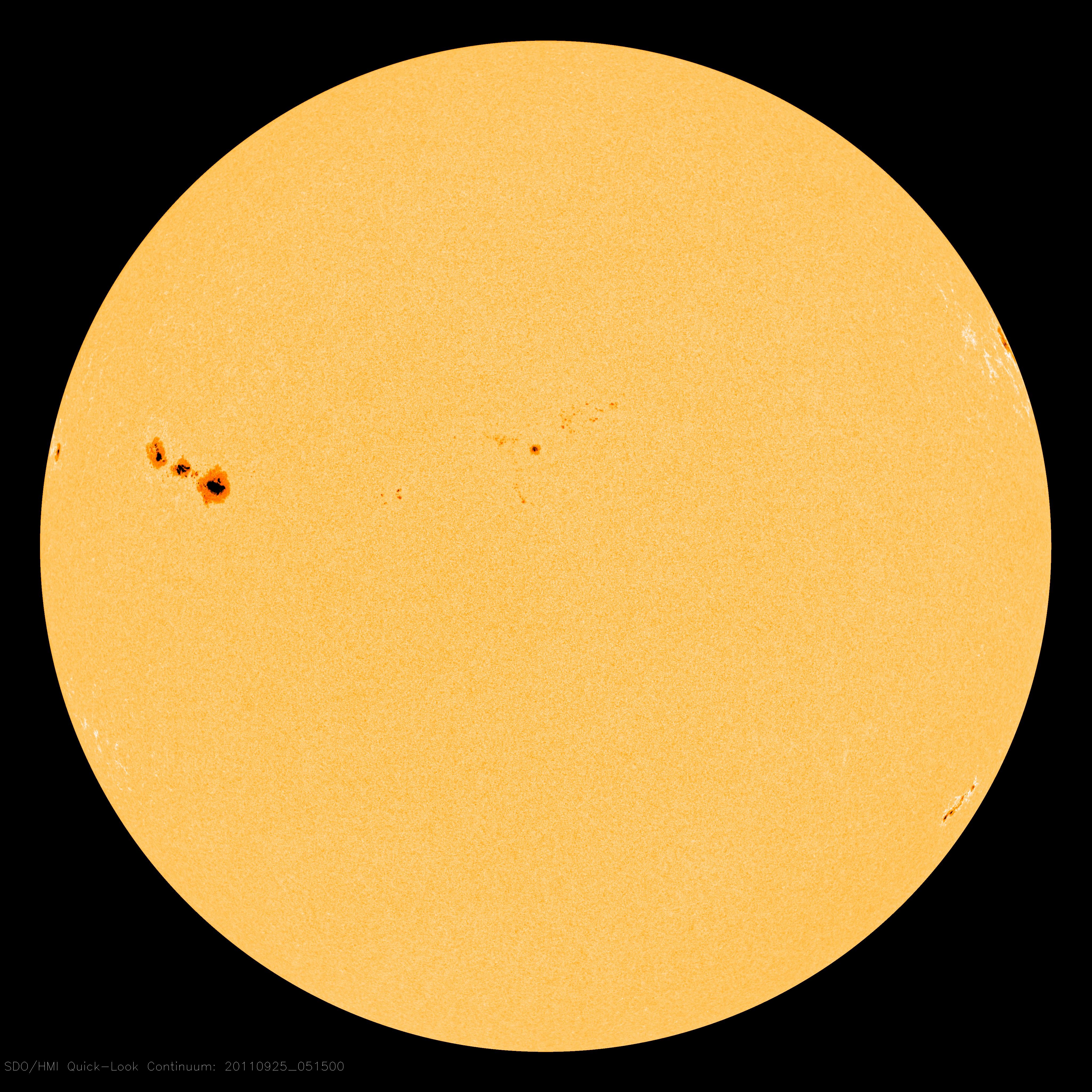
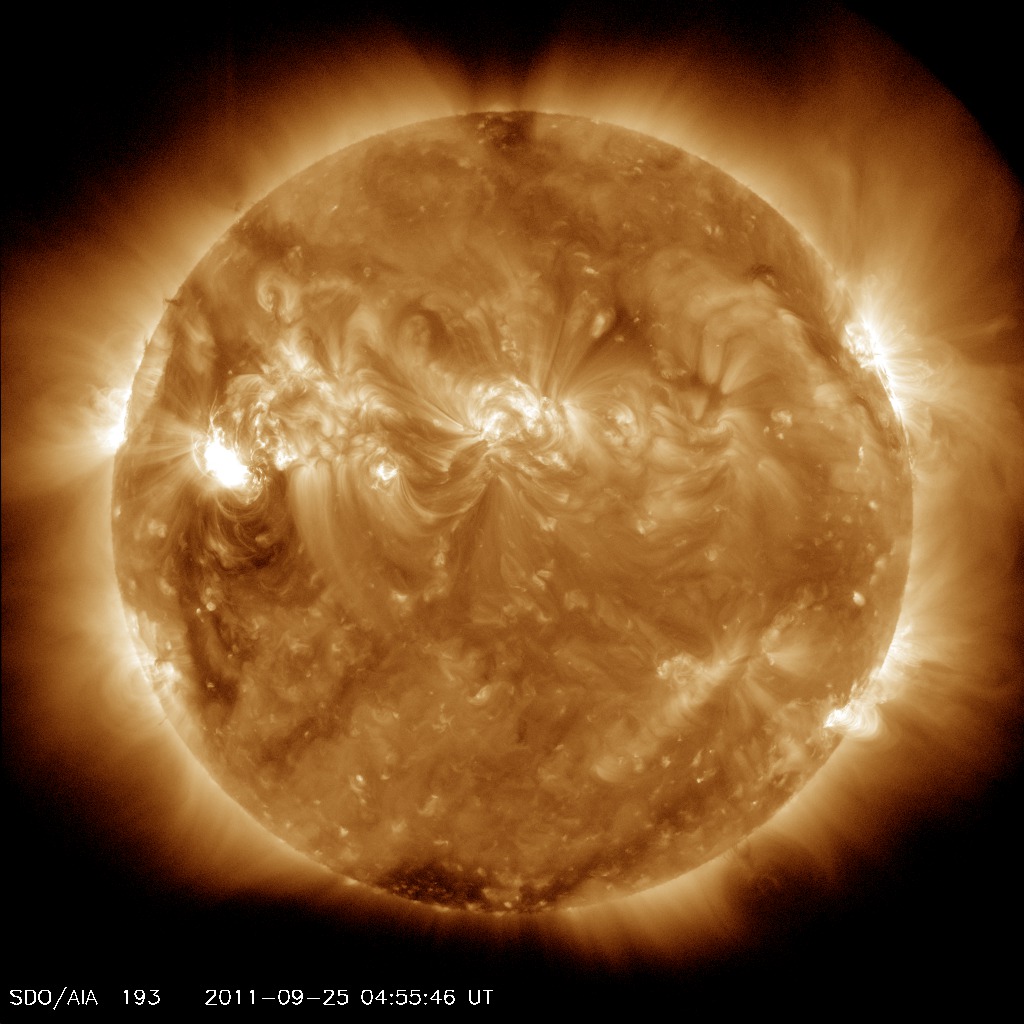
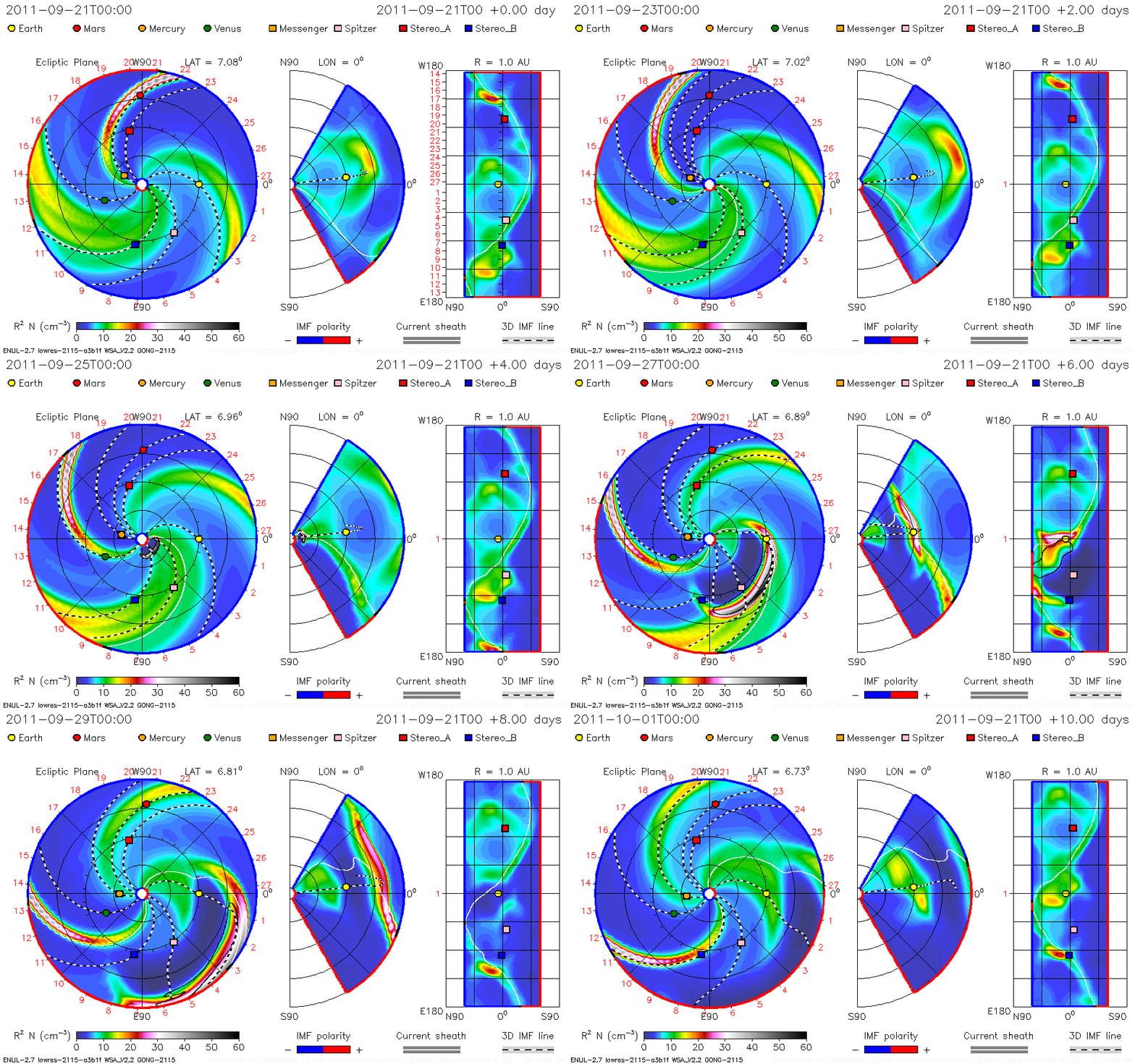
GEOMAGNETIC STORM WARNING: A pair of closely-spaced CMEs propelled by explosions of sunspot AR1302 on Sept. 24th are heading not-quite directly toward Earth. A significant glancing blow to our planet's magnetic field is possible on Sept. 26th around 14:00 UT (+/- 7 hours). NOAA forecasters estimate a 30% chance of strong geomagnetic storms when the clouds arrive. [CME forecast track] Aurora alerts: text, voice.
STRONG SOLAR ACTIVITY: Having already unleashed two X-flares since Sept. 22nd, sunspot AR1302 appears ready for more. The active region has a complex "beta-gamma-delta" magnetic field that harbors energy for strong M- and X-class eruptions. Flares from AR1302 will become increasingly geoeffective as the sunspot turns toward Earth in the days ahead.
Marko Posavec of Koprivnica, Croatia, photographed the behemoth sunspot between flares on Sept. 24th:
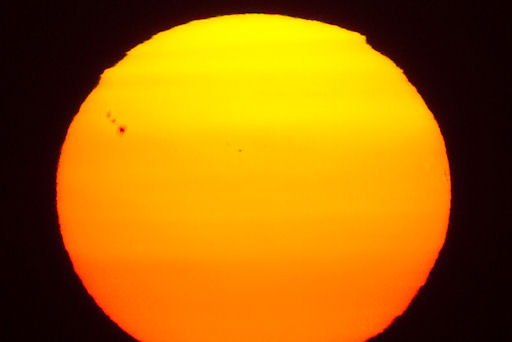
Photo details: Olympus E-510, Sigma 50-500mm lens (at 500mm), 1/640 sec. exposure, f/18, ISO 100
"Sunspot complex 1302 is incredibly easy to spot at sunrise or sunset," says Posavec. "Be careful, though. Even the low-hanging sun is bright enough to damage your eyes if you look at it through optics of any kind." Safe solar filters may be found in the SpaceWeather Store.
more images: from Alan Friedman of Buffalo, NY; from Monika Landy-Gyebnar of Balatonfured, Hungary; from Piet Berger of Simpelveld, Netherlands; from Howard Eskildsen of Ocala, Florida; from Dzmitry Kananovich of Tallinn, Estonia; from Chris Schur of Payson, Az; from John Stetson of Falmouth, Maine; from Grenier of Paris France; from Maximilian Teodorescu of Magurele, Romania; from Cai-Uso Wohler of Bispingen, Germany; from Philippe Van den Doorn of Rixensart, Belgium
SOLAR STATIC: Active sunspot 1302 has turned the sun into a shortwave radio transmitter. Shock waves rippling from the sunspot's exploding magnetic canopy excite plasma oscillations in the sun's atmosphere. The result is bursts of static that may be heard in the loudspeakers of shortwave radios on Earth. Amateur radio astronomer Thomas Ashcraft recorded this sample from his backyard observatory in New Mexico on Sept. 24th:
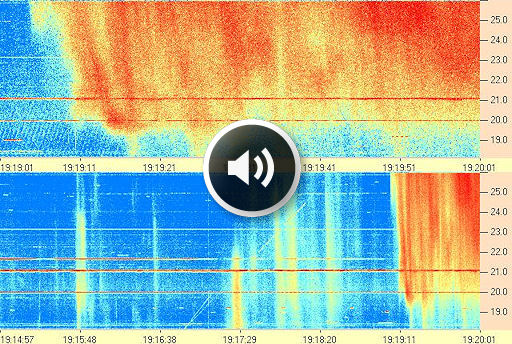
Dynamic spectrum: The horizontal axis is time (h:m:s), the vertical axis is frequency (MHz). Image credit: Wes Greenman
"Saturday was a super-strong solar day with near continuous flaring and radio sweeps," says Ashcraft. "The sound file (above) corresponds to an M3 flare at 1918 UTC. It was the strongest radio sweep of the observing day."
"Try listening to the radio bursts in stereo," he advises. "I was recording on two separate radios at 21.1 MHz and 21.9 MHz, and I put each one into its own channel of the audio file. This gives a spatial dimension as the bursts sweep down in frequency."
September 2011 Aurora Gallery
[previous Septembers: 2010, 2009, 2008, 2007, 2006, 2005, 2004]