Metallic photos of the sun by renowned photographer Greg Piepol bring together the best of art and science. Buy one or a whole set. They make a stellar gift. | | |
GEOMAGNETIC STORM IN PROGRESS: A major geomagnetic storm is in progress following the impact of a CME on August 5th around 1800 UT. Sky watchers at all latitudes should be alert for auroras after nightfall. Tip: the best hours for aurora sightings are usually around local midnight. Aurora alerts: text, voice.
Analysts at the Goddard Space Weather Lab say that the CME impact may have strongly compressed Earth's magnetic field, directly exposing satellites in geosynchronous orbit to solar wind plasma. Stay tuned for updates on this aspect of the storm.
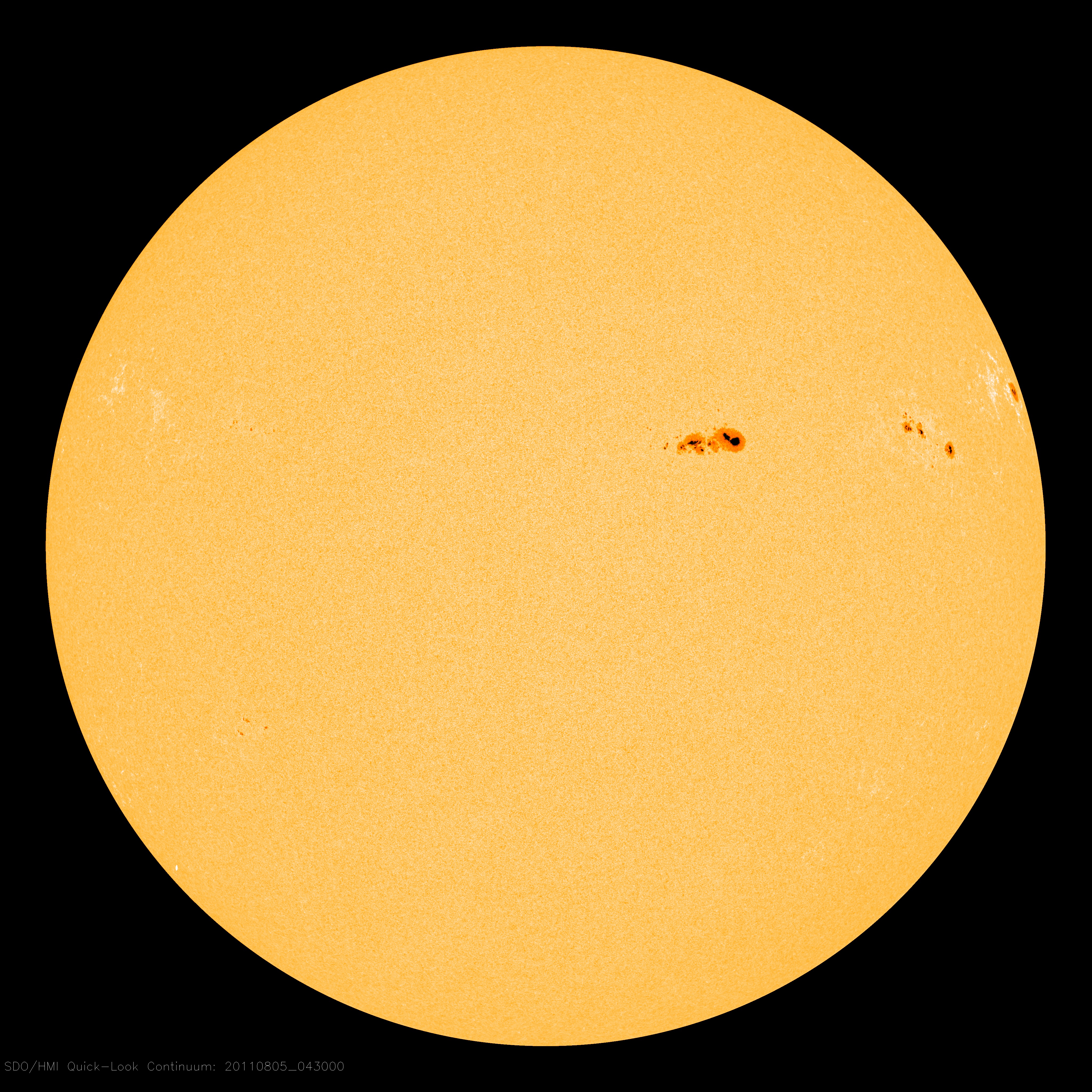
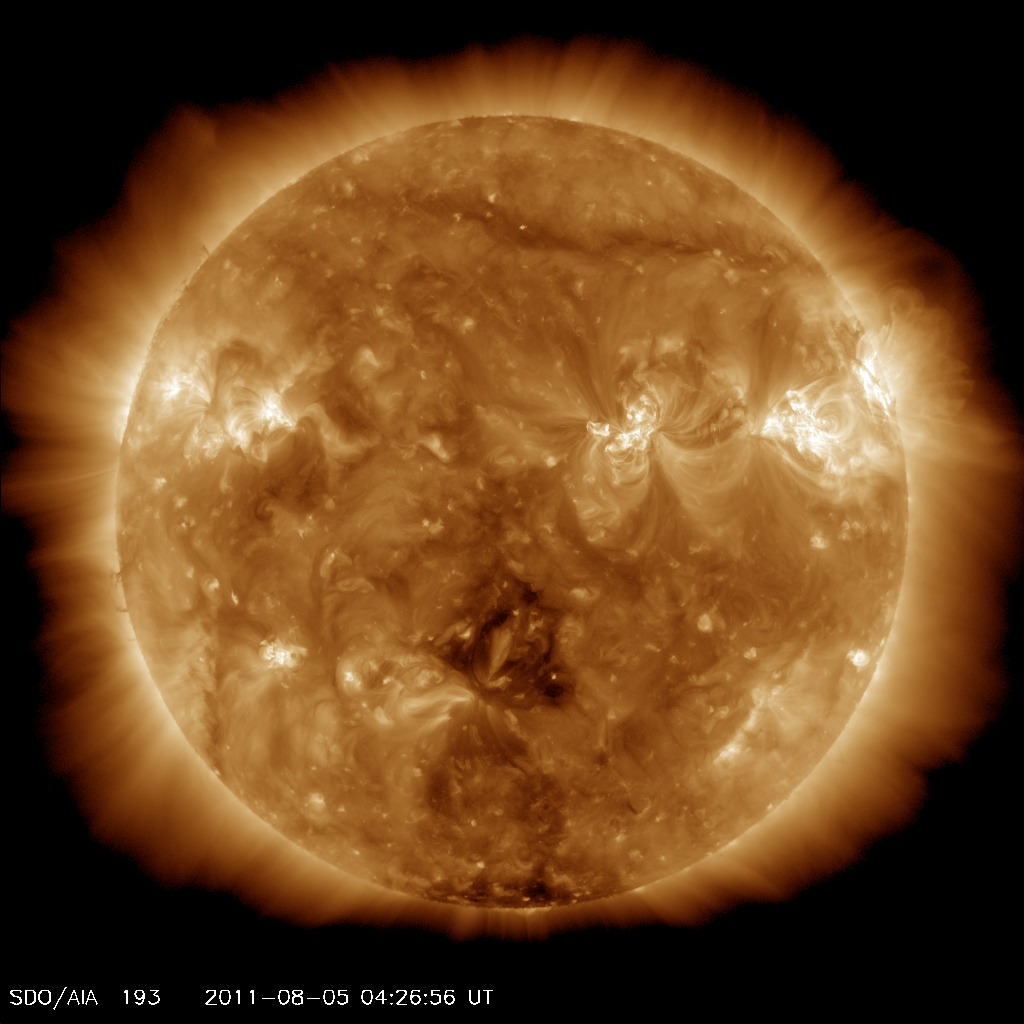
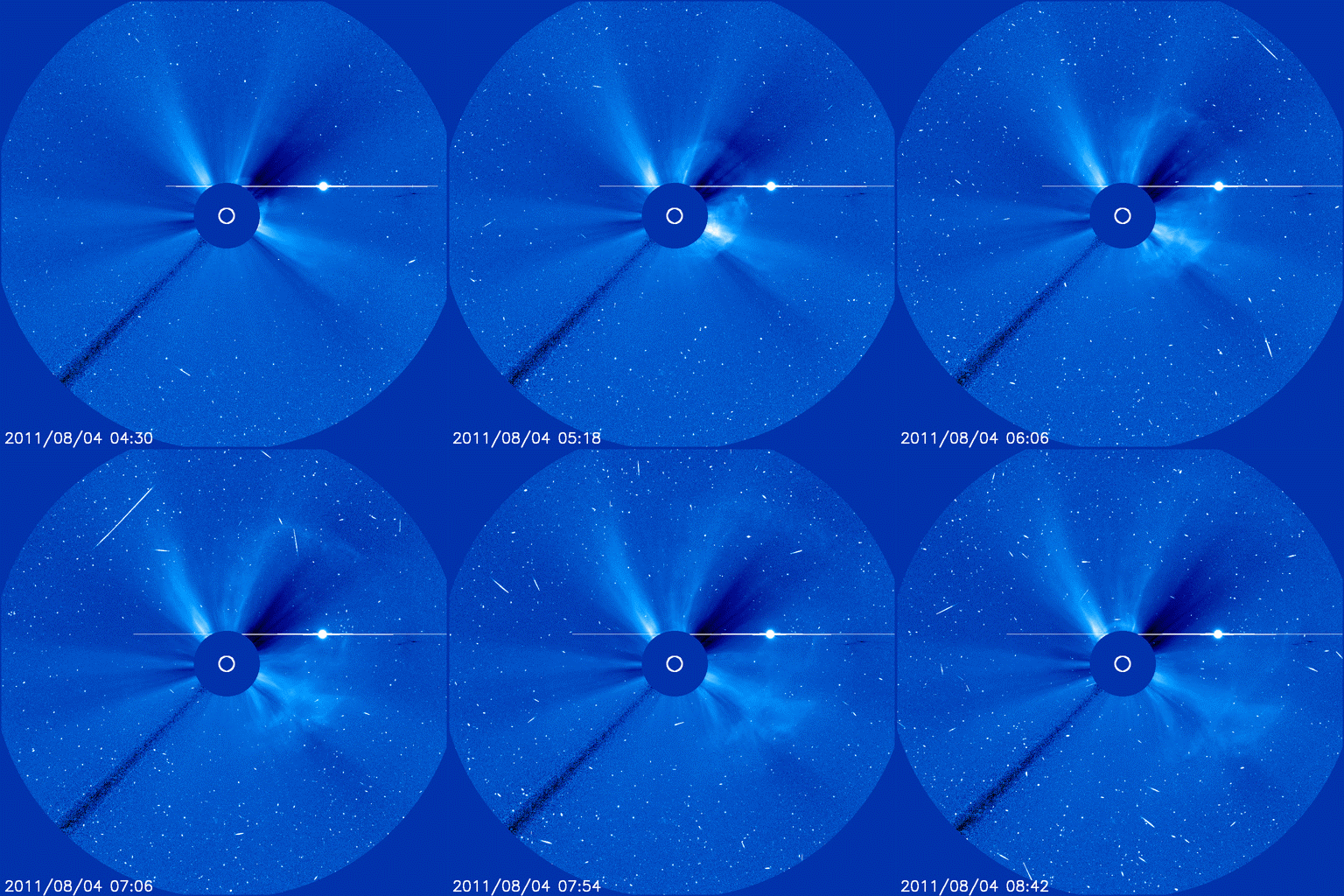
The arriving CME left the sun on August 4th, propelled by an M9.3-category eruption in the magnetic canopy of sunspot 1261. Click on the image to view a movie of the expanding cloud recorded by the Solar and Heliospheric Observatory:
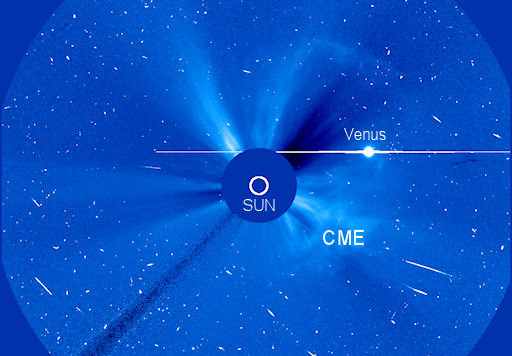
Note: The many speckles in this movie are caused by energetic solar protons hitting the camera.
July 2011 Aurora Gallery
[previous Julys: 2010, 2009, 2008, 2007, 2006, 2005, 2004, 2003]
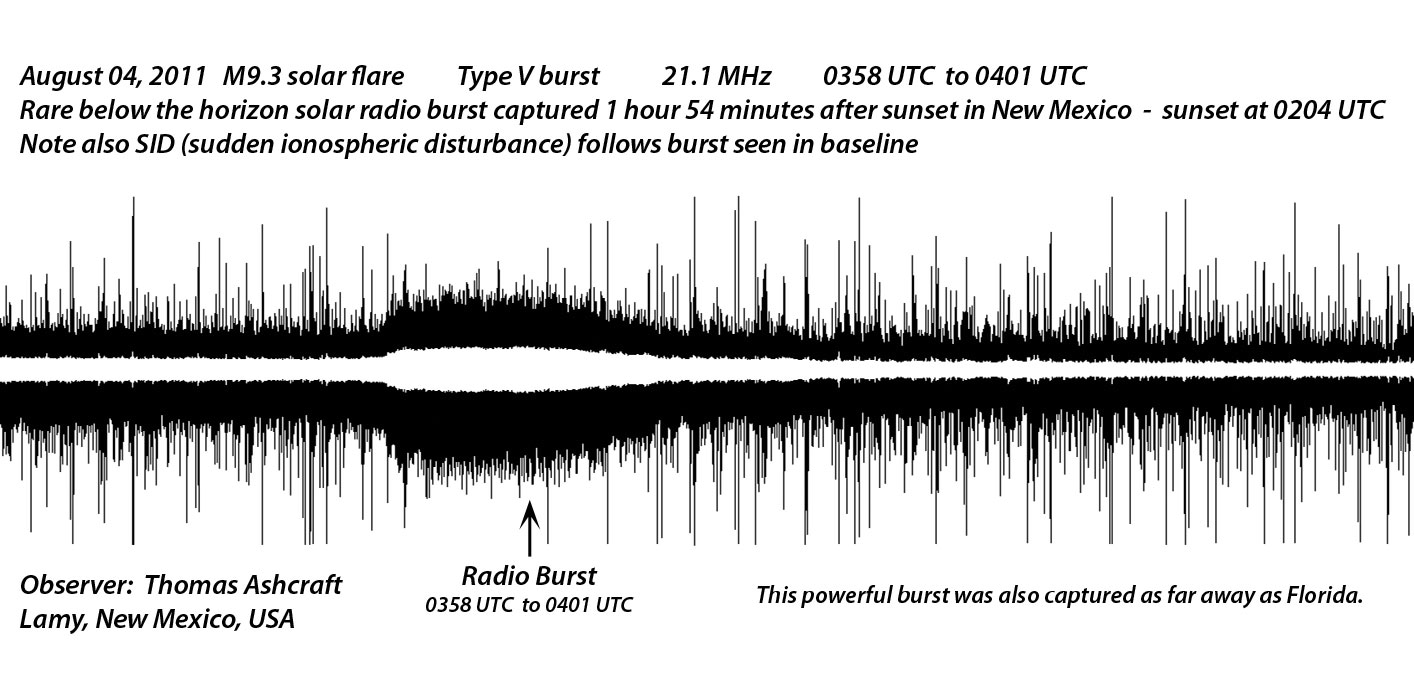
NIGHT-TIME SOLAR RADIO BURST: The M9-class solar flare of August 4th produced a burst of shortwave static so powerful that receivers on Earth picked it up after sunset. "A RadioJove observer in Florida recorded the burst when the sun was 38 degrees below the horizon," reports amateur radio astronomer Thomas Ashcraft. Ashcraft's own radio telescope in New Mexico recorded the event 1 hour and 54 minutes after sunset:
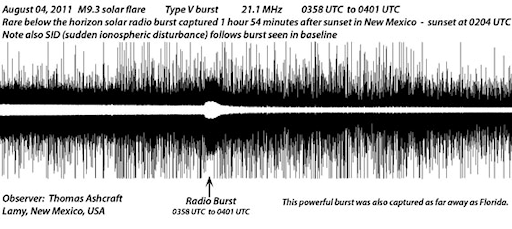
"To my knowledge, receptions like this are very rare," says Ashcraft.
Indeed they are. This event brings to mind the iconic night-time solar radio burst of March 8, 1958. Five radio telescopes at the University of Florida picked up emissions from the sun while observing the planet Jupiter in tthe middle of the night. On the other side of the world, radio astronomers in daylit Australia confirmed that a powerful solar radio burst had taken place at that exact time. The event is described in a 1959 Nature paper by pioneering radio astronomers Alex Smith and Tom Carr. They considered the possibility that solar radio waves might have been reflected by the Moon or carried to the night side of Earth by ionospheric ducting. In tthe end, they could not conclusively explain what happened and to this day night-time solar radio bursts remain a puzzle.
2011 Noctilucent Cloud Gallery
[previous years: 2003, 2004, 2005, 2006, 2007, 2008, 2009]
Potentially Hazardous Asteroids (
PHAs) are space rocks larger than approximately 100m that can come closer to Earth than 0.05 AU. None of the known PHAs is on a collision course with our planet, although astronomers are finding
new ones all the time.
On August 5, 2011 there were 1241 potentially hazardous asteroids.
Notes: LD means "Lunar Distance." 1 LD = 384,401 km, the distance between Earth and the Moon. 1 LD also equals 0.00256 AU. MAG is the visual magnitude of the asteroid on the date of closest approach. | | The official U.S. government space weather bureau |
| | The first place to look for information about sundogs, pillars, rainbows and related phenomena. |
| | Researchers call it a "Hubble for the sun." SDO is the most advanced solar observatory ever. |
| | 3D views of the sun from NASA's Solar and Terrestrial Relations Observatory |
| | Realtime and archival images of the Sun from SOHO. |
| | from the NOAA Space Environment Center |
| | the underlying science of space weather |
| | for out-of-this-world printing and graphics |