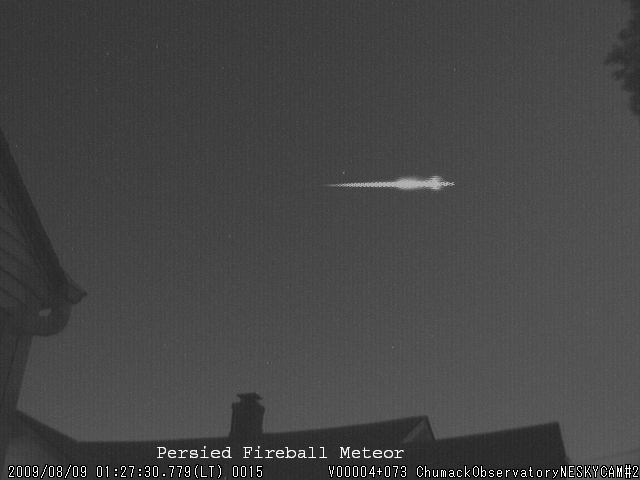
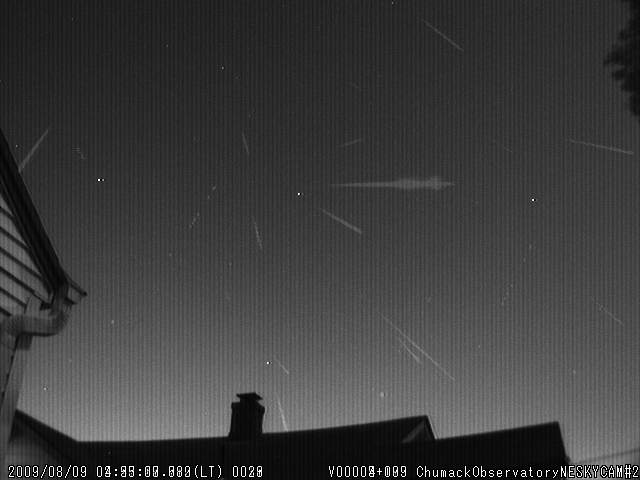
| THERE'S AN APP FOR THAT: You can now experience the Perseid meteor shower on your iPhone. It's cloud-proof! Learn more and give it a try. | | | SPACEWEATHER RADIO: The US Air Force Space Surveillance Radar is scanning the skies over North America. When a Perseid meteor passes overhead--"ping"--there is an echo. Tune into Spaceweather Radio for a live audio feed from the radar facility. PERSEID FIREBALL: "On August 9th I photographed 17 Perseids," reports John Chumack of Dayton, Ohio. "The best one was a fireball of magnitude -8, about 40 times brighter than Venus. It had a double explosion, too!" 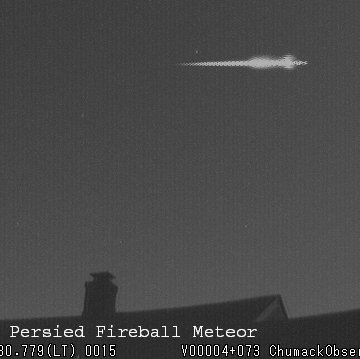
"The Perseid meteor shower is definitely underway," he says. It should get even better in the nights ahead. Members of the International Meteor Organization are now counting more than 25 Perseids per hour: data. The rate is expected to increase almost 10-fold on the night of August 11th and 12th when Earth passes through a denser-than-usual filament of comet dust crossing Earth's orbit. Oberving tips may be found in the Science@NASA story "The Perseids are Coming." 2009 Perseid Photo Gallery
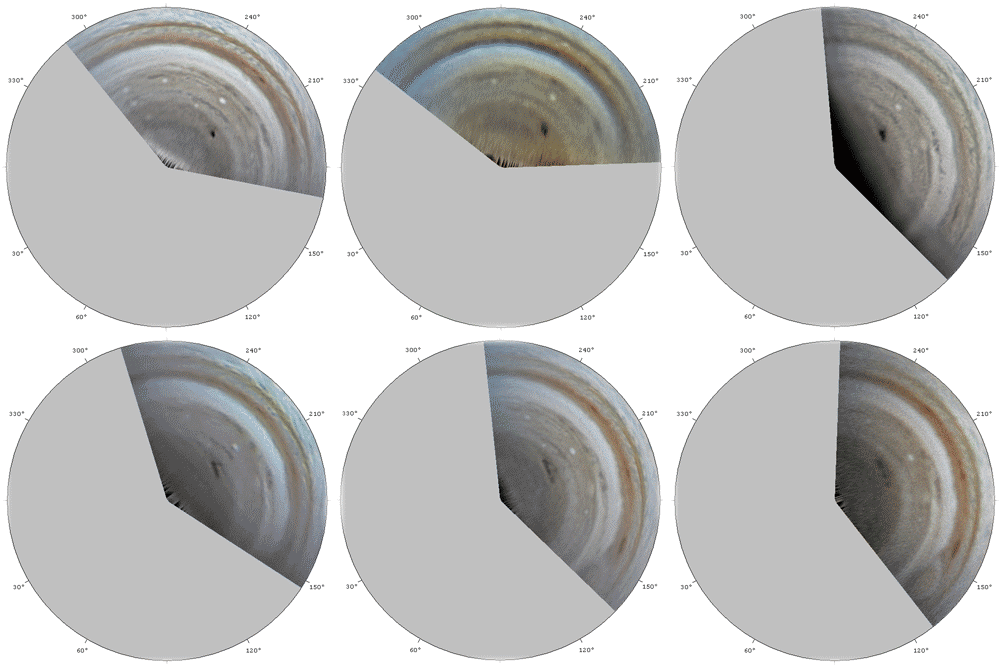
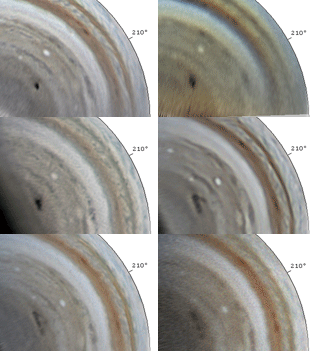
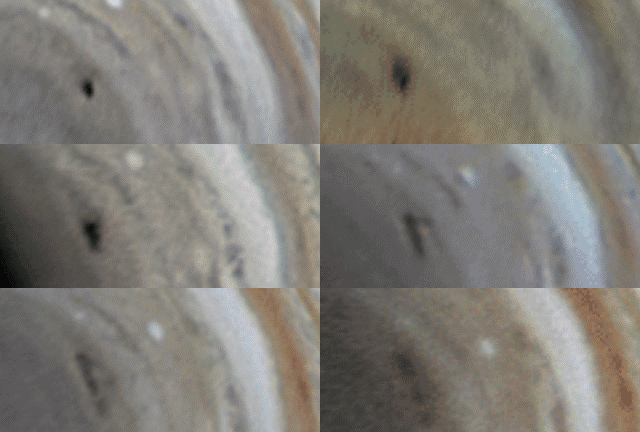
[previous Perseids: 2008, 2007, 2006, 2005, 2004, 2001] EVOLUTION OF AN IMPACT: Since July 19th, when Anthony Wesley of Australia discovered the scattered remains of a mystery impactor in the high clouds of Jupiter, amateur astronomers around the world have been photographing the planet every night. "German astronomer Hans Joerg Mettig has converted some of the best images into polar projections," says Theo Ramakers, "and I have stitched them together to make a movie." Click on the image to set the scene in motion: 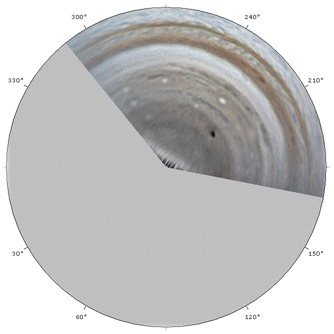
Animations: large, small, zoom
The 3-week animation, which begins with Wesley's discovery image, shows the cindery cloud expanding, swirling, and ultimately being torn into three or more pieces by turbulent south polar winds. "The spot has really progressed dramatically," says Ramakers. No one knows how the movie will end. Planetary scientists say the debris could evolve in interesting and unexpected ways before it finally disperses some weeks from now. Astronomers who wish to contribute scenes can monitor the cloud near Jupiter's System II longitude 210°. For predicted times when it will cross the planet's central meridian, add 2 hours to Sky and Telescope's predicted transit times for Jupiter's Great Red Spot. more images: from Mike Hood of Kathleen, Georgia; from George Tarsoudis of Alexandroupolis - Evros, Greece; from W.Verhesen of Sittard, The Netherlands; from Glenn Jolly of Gilbert, Arizona; from Alphajuno of League City, Texas;
2009 Noctilucent Photo Gallery
[previous years: 2008, 2007, 2006, 2005, 2004, 2003]
July 2009 Aurora Gallery
[previous Julys: 2008, 2007, 2006, 2005, 2004, 2003]
Explore the Sunspot Cycle |