Metallic photos of the sun by renowned photographer Greg Piepol bring together the best of art and science. Buy one or a whole set. They make a stellar gift. | | |
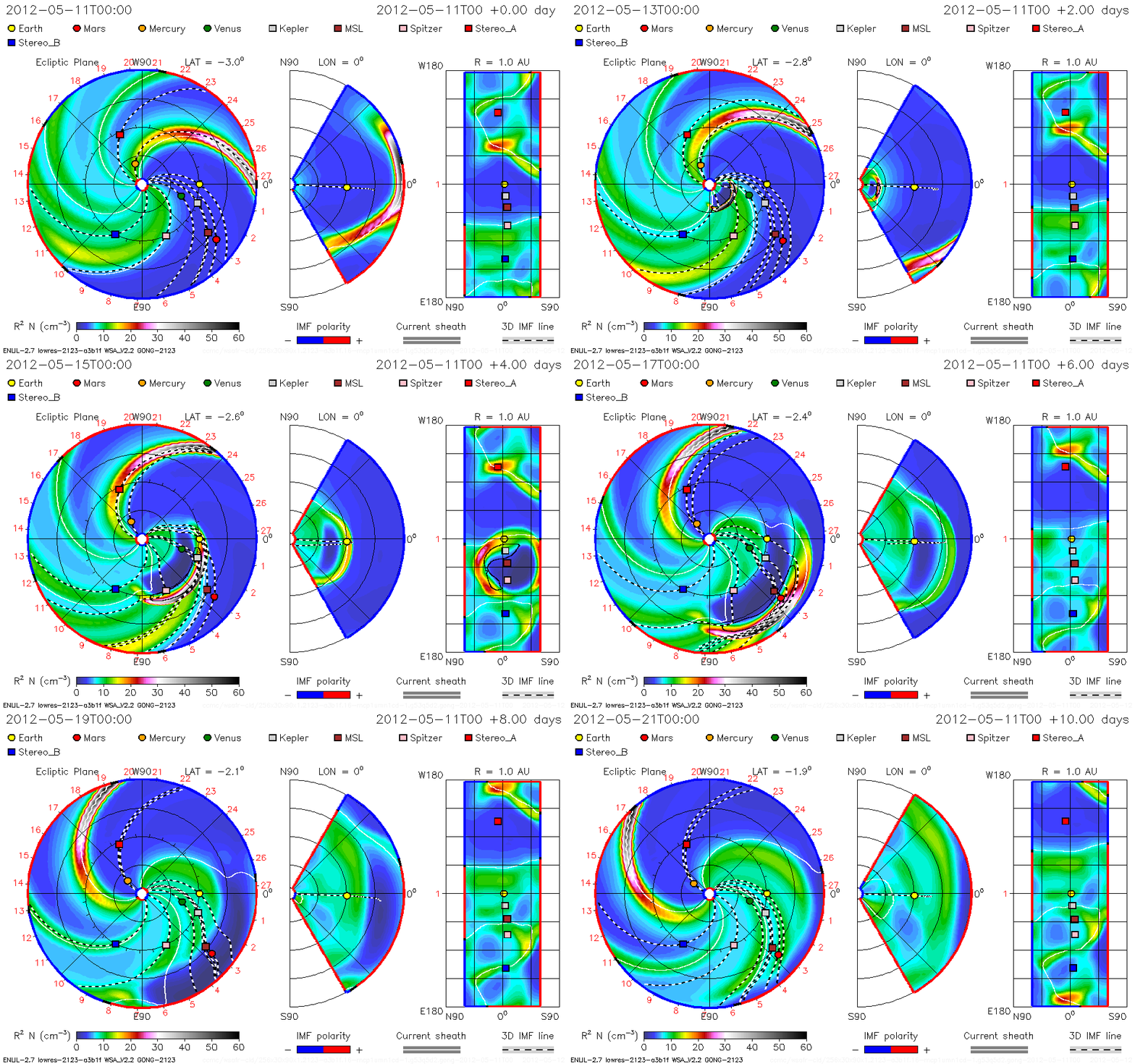
INCOMING CME (UPDATED): On May 11th at 23:54 UT, a coronal mass ejection raced away from the sun faster than 1000 km/s. The fast-moving cloud will deliver a glancing blow to Earth's magnetic field on May 14th around 14:30 UT, according to a revised forecast track prepared by analysts at the Goddard Space Weather Lab. Mars is also in the line of fire. Magnetic storm alerts: text, phone.
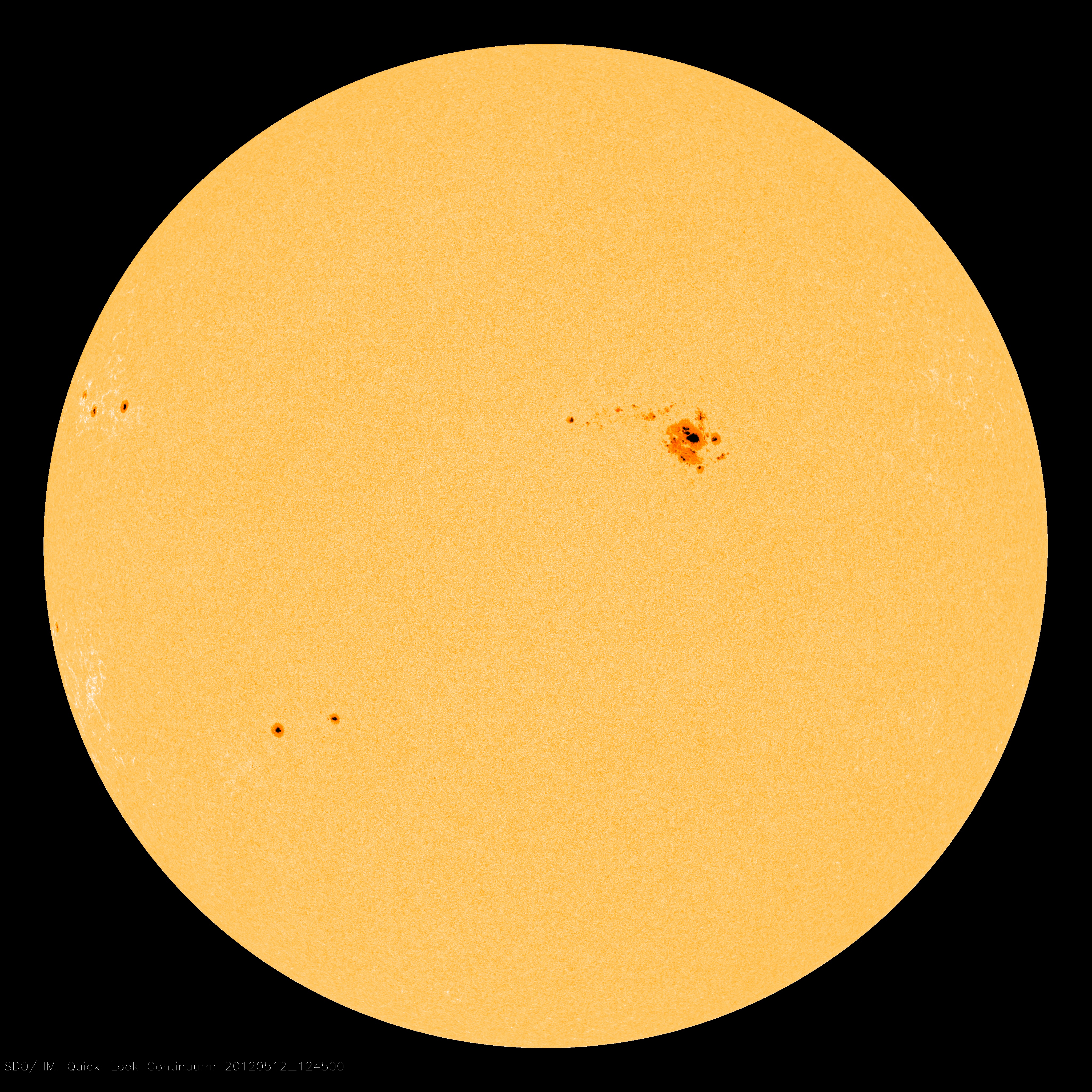
SUNSET OVER PARIS: Huge sunspot AR1476 poses a threat for strong solar flares, but for the past two days the so-called "active region" has been mostly quiet. What the sunspot lacks in drama, however, it more than makes up for in beauty. Consider this photo of last night's sunset over Paris:

"Shooting from the Bridge of Concorde, I captured the sunspot setting behind the Eiffel Tower," says photographer VegaStar Carpentier. The light of the low-hanging sun was perfectly dimmed for a 1/1000s exposure @ ISO 400. "I used a Canon EOS 1000D."
The quiet is probably temporary. NOAA forecasters estimate a 75% chance of M-class flares and a 20% chance of X-flares during the next 24 hours.
more images: from the Charlie Bates Solar Astronomy Project of Atlanta, GA; from Luis Argerich of Buenos Aires, Argentina; from Eduard Garcia Ribera of Ager, Lleida, Catalonia; from Andy Devey of Sorbas, Spain; from Vasilis Wooseas of Greece, Amvrakikos Wetlands National Park; from Giuseppe Petricca of Pisa, Tuscany, Italy; from Catalin Fus of Krakow, Poland
SPACESHIP IN THE SUN: The sunspot number briefly jumped yesterday when a winged silhouette crossed the solar disk over Hampshire, UK. James West was watching the sun with a solar-filtered telescope when the transit occured:
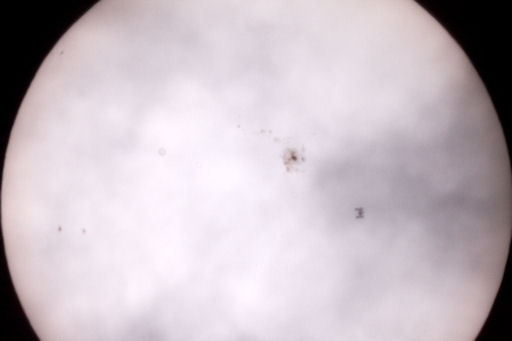
"The International Space Station passed right by giant sunspot AR1476," says West. "The sky was partly cloudy but I caught the transit anyway."
The sunspot-spaceship encounter was no surprise to West. It had been predicted beforehand by CalSky.org. Readers who wish to take this kind of photo should check CalSky for transit predictions and read West's observing tips. A safe solar observing system might also come in handy: Space Weather Store.
Potentially Hazardous Asteroids (
PHAs) are space rocks larger than approximately 100m that can come closer to Earth than 0.05 AU. None of the known PHAs is on a collision course with our planet, although astronomers are finding
new ones all the time.
On May 12, 2012 there were 1287 potentially hazardous asteroids.
Recent & Upcoming Earth-asteroid encounters: | Asteroid | Date(UT) | Miss Distance | Mag. | Size |
| 2012 JU | May 13 | 0.5 LD | -- | 13 m |
| 2010 KK37 | May 19 | 2.3 LD | -- | 31 m |
| 4183 Cuno | May 20 | 47.4 LD | -- | 5.7 km |
| 2002 VX94 | May 26 | 72.8 LD | -- | 1.1 km |
| 2002 AC | Jun 16 | 62.2 LD | -- | 1.2 km |
| 1999 BJ8 | Jun 16 | 68.8 LD | -- | 1.1 km |
| 2005 GO21 | Jun 21 | 17.1 LD | -- | 2.2 km |
| 2003 KU2 | Jul 15 | 40.3 LD | -- | 1.3 km |
| 2004 EW9 | Jul 16 | 46.8 LD | -- | 2.1 km |
| 2002 AM31 | Jul 22 | 13.7 LD | -- | 1.0 km |
Notes: LD means "Lunar Distance." 1 LD = 384,401 km, the distance between Earth and the Moon. 1 LD also equals 0.00256 AU. MAG is the visual magnitude of the asteroid on the date of closest approach. | | The official U.S. government space weather bureau |
| | The first place to look for information about sundogs, pillars, rainbows and related phenomena. |
| | Researchers call it a "Hubble for the sun." SDO is the most advanced solar observatory ever. |
| | 3D views of the sun from NASA's Solar and Terrestrial Relations Observatory |
| | Realtime and archival images of the Sun from SOHO. |
| | from the NOAA Space Environment Center |
| | the underlying science of space weather |