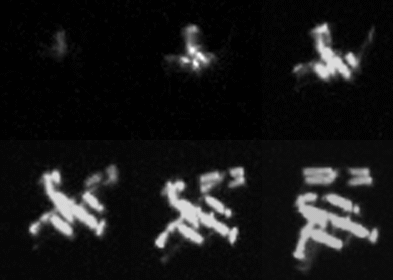
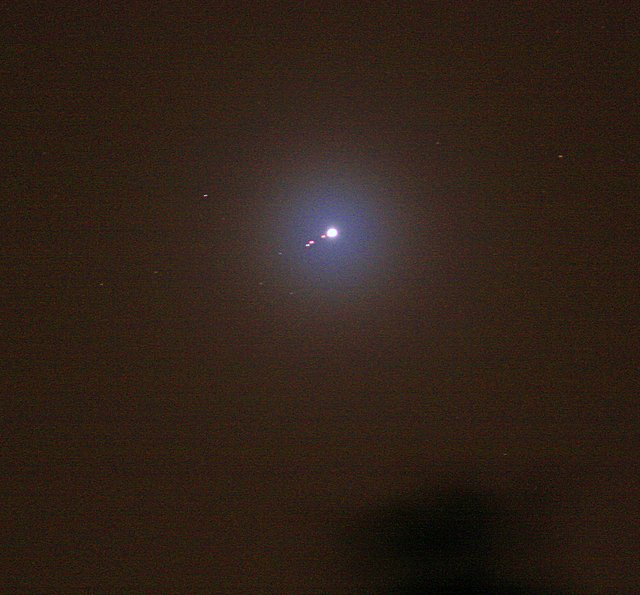
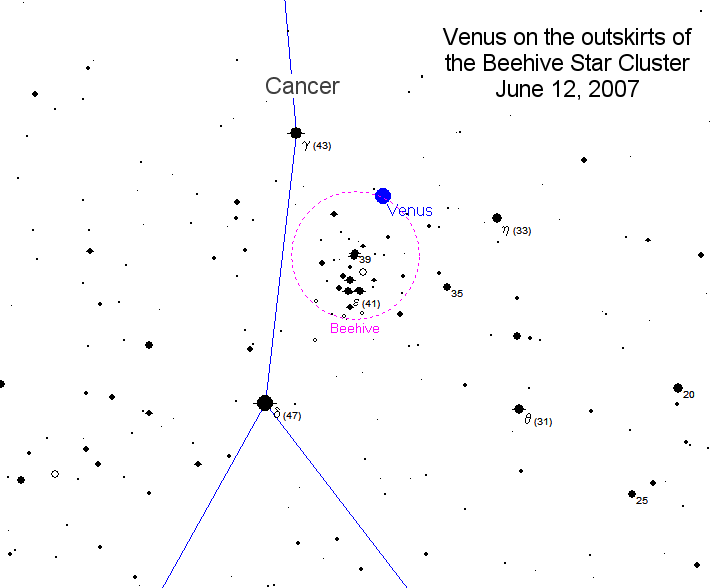
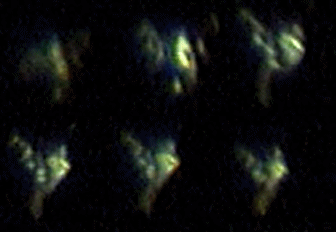
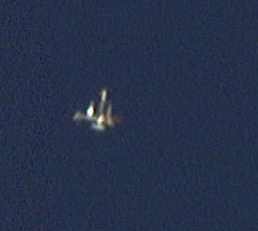
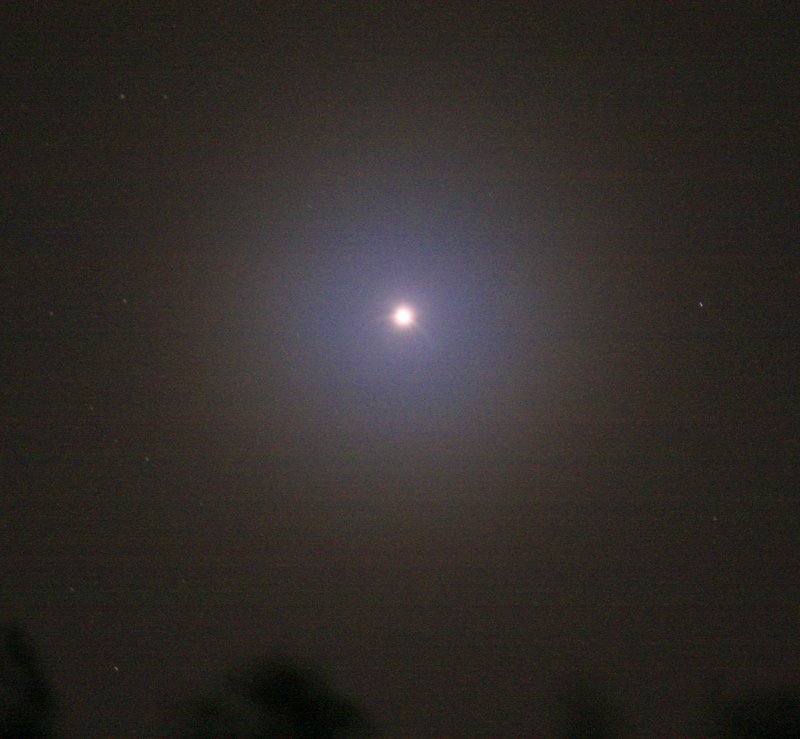
 The space shuttle is docked to the ISS. Would you like a call when the pair fly over your backyard? Sign up for SpaceWeather PHONE. The space shuttle is docked to the ISS. Would you like a call when the pair fly over your backyard? Sign up for SpaceWeather PHONE. VENUS IN THE BEEHIVE: Did a supernova explode in the Beehive star cluster? No, that's just Venus. The brightest of all planets is gliding through the cluster's verge tonight. After sunset, take your binoculars outside, face west and scan the sky around Venus. Behold the Beehive: sky map. TWO SPACESHIPS: Astronauts from the space shuttle Atlantis are working hard on the International Space Station, installing a new pair of solar wings to power the station. Yesterday, during their first spacewalk, the space station orbited over the Netherlands where Ralf Vandebergh used a digital camera and a backyard telescope to make this movie: 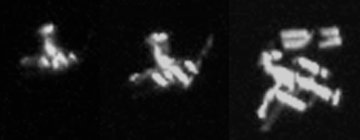
Click to play the movie!
"During the flyby, I watched the spacewalk live on NASA TV," says Vandebergh. "It was an amazing experience to see the ISS through my viewfinder and, at the same time, to hear mission control announcing 2 minutes until sunset." As Vandebergh's images show, Atlantis and the ISS are easy to see through backyard telescopes, and the view will improve in the days ahead when astronauts unfurl the station's new solar panels. The trick is knowing when to look. more images: from Frank Ryan Jr of Shannon, Ireland; from David Campbell of Didcot, Oxfordshire, UK; from Rudolf Dobesberger of Neuzeug Austria BLUE PLANETS: Winds of 30 to 40 mph were swirling around DeSoto, Kansas, last week when photographer Doug Zubenel "stepped outside to enjoy the windy black night. Immediately, I noticed a corona around Venus," he says, and it was blue. Next, he turned his telescope toward Jupiter, and it was blue, too: 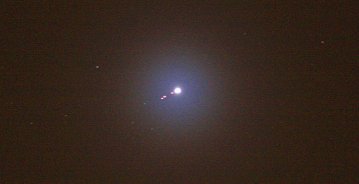
"Note three of Jupiter's largest moons lined up next to Jupiter at the 8 o'clock postion," says Zubenel. Where did all this blue come from? Atmospheric optics expert Les Cowley measured the diameter of the halo and concluded that "it was caused by dust particles about 38 micron (1.5/1000") across. Coronas are mostly created by diffraction around the rims of small particles. It hardly matters whether the particles are water drops, pollen, stratospheric dust or in this case dust raised by local high winds."
2007 Noctilucent Photo Gallery
[Listen!] [Night-sky Cameras] |