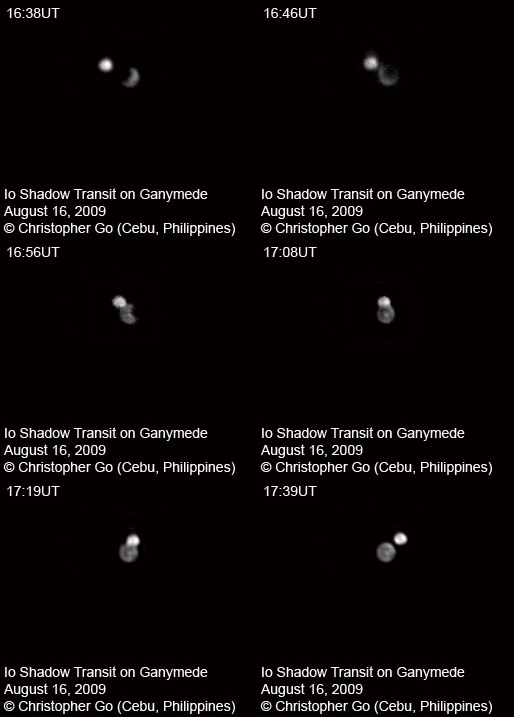
| BEWARE THE MARS HOAX: If you have marked your calendar for August 27th to remind yourself to watch Mars swell to the size of a full Moon, go back and add these words: Mars Hoax! Contrary to a widespread email alert, Mars will not come close to Earth on August 27th and it can never rival the full Moon in the night skies of our planet. Science@NASA has the full story. JUPITER MOON MOVIE: Four hundred years ago when Galileo discovered the moons of Jupiter, the satellites appeared in his primitive telescope as tiny, almost infinitesimal specks of light pirouetting around the giant planet. Their discovery transformed 17th century cosmology and made Galileo famous, but he never saw them as anything more than star-like pinpricks. The "Galilean satellites" were second-class citizens in the heirarchy of known worlds. What would Galileo say now? On August 16th, Philippine astrophotographer Christopher Go used a modern 11-inch Celestron telescope to photograph Io casting its shadow on Ganymede. Click on the image to launch the movie: 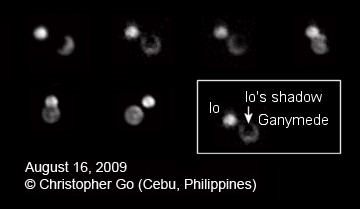
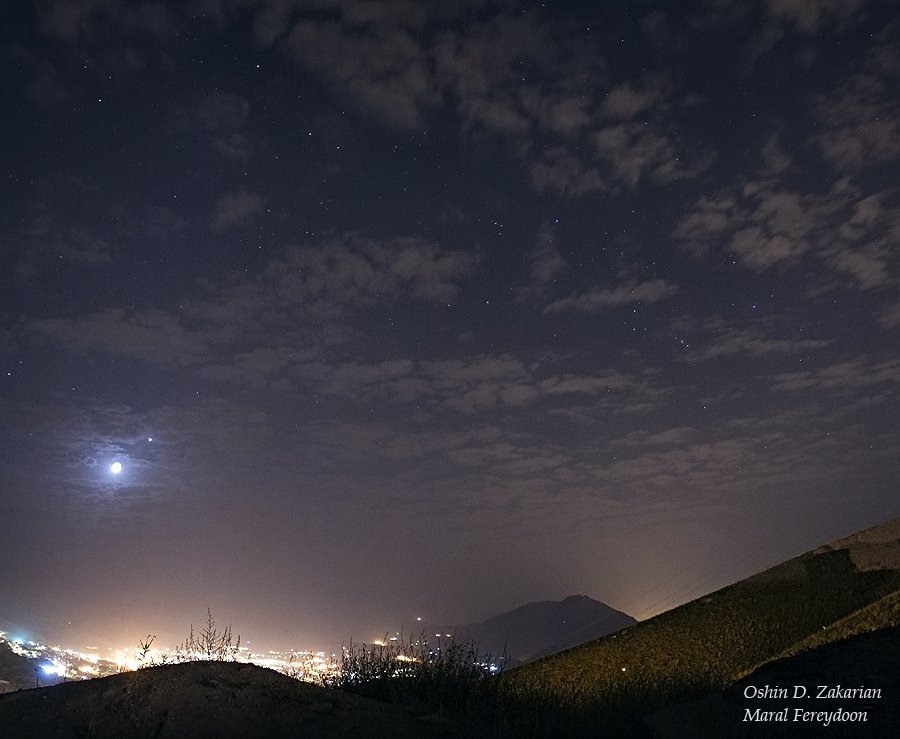
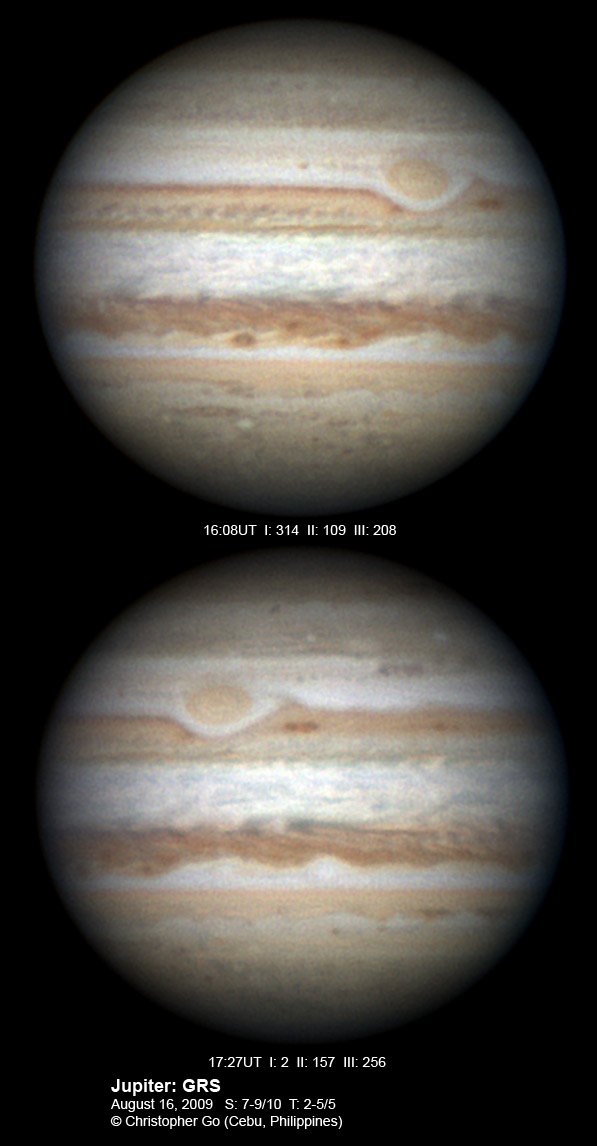
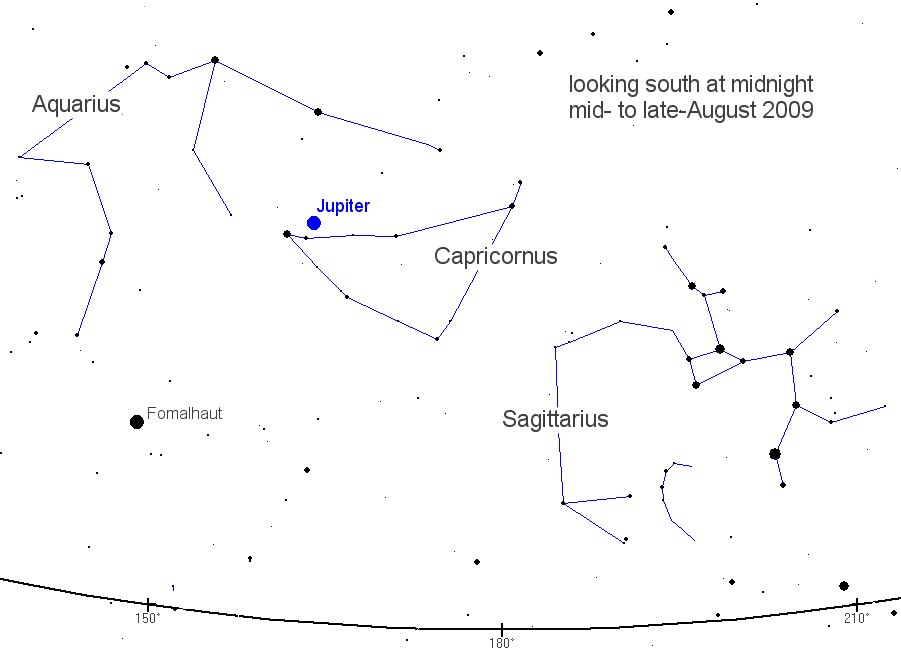
"I captured this rare event through a hole in the clouds," says Go. "It was a lucky clearing!" In the movie, Io and Ganymede reveal themselves as fully-formed worlds with surface markings and a spherical shape. Io's circular shadow cuts a dark swath across Ganymede, transforming that giant moon (it is larger than Mercury) into a succession of crescents rarely seen by observers. Indeed, as far as we know, no telescope on Earth or space has ever photographed one of Jupiter's moons casting its circular shadow so clearly across another. "While imaging the shadow transit, I took the time to photograph Jupiter itself," says Go. "The Great Red Spot, an anticyclone twice the size of Earth, was very prominent." At this point, one imagines Galileo would jump up and exclaim--"bring me a telescope!" If only we could. August 2009 is a superb time to watch the giant planet. Jupiter is at its closest to Earth and outshines every star in the night sky. Backyard optics reveal giant storms, clouds, moons, moon shadows and occasionally an explosive surprise. The place to look is here. PERSIAN DAWN: This morning in Iran, Venus and the Moon got together and with their combined luminosity rivaled the city lights of Tehran itself. Oshin D. Zakarian sends this photo from a hilltop overlooking the city: 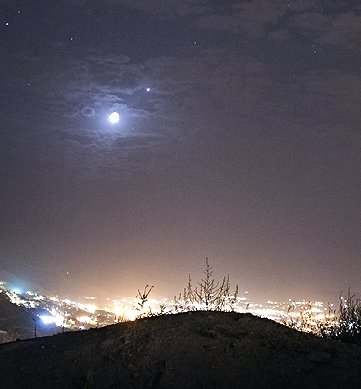 . .
"The elegant crescent Moon was only 3o away from dazzling Venus in the morning sky," says Babak Tafreshi who admired the view alongside Zakarian. "The pair were visible even through clouds." Scenes like this are worth waking up for. The next Venus-Moon pairing is less than a month away--on Wednesday morning, Sept 16th. Get a reminder call from Spaceweather PHONE. more images: from Tunç Tezel of Pamukkale, Turkey; from Amir H. Abolfath of Persepolise, Fars, Iran; from Danny Ratcliffe of Deception Bay, QLD Australia; from Mohamad Soltanolkottabi of Esfahan, Iran; from Babak Tafreshi of Lavasan, Alborz Mountains, Iran; from Ugur Ikizler of Mudanya - Bursa / Turkey; from Achim Schaller of Marzell, Black Forest, Germany;
2009 Perseid Photo Gallery
[Science@NASA: The Perseids are Coming, Horse Flies and Meteors]
2009 Noctilucent Photo Gallery
[previous years: 2008, 2007, 2006, 2005, 2004, 2003]
Explore the Sunspot Cycle |