Metallic photos of the sun by renowned photographer Greg Piepol bring together the best of art and science. Buy one or a whole set. They make a stellar gift. | | |
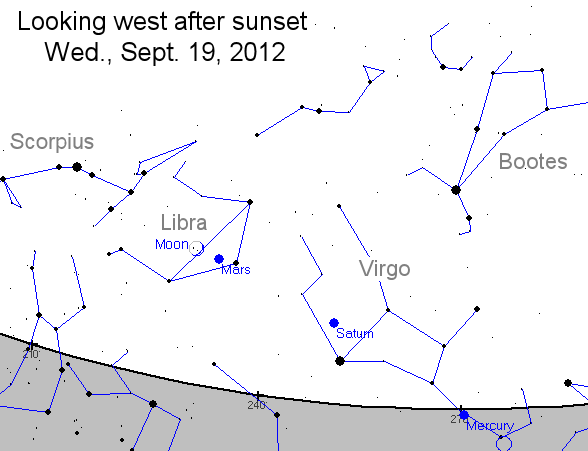
CRESCENT MOON AND MARS: Looking for Mars? Tonight the Red Planet is easy to find less than 2o from the crescent Moon. Look for the pair shining side-by-side in the western sky after sunset. Sky map. Images: #1.
DISAPPEARING ASTEROID: More than a week after amateur astronomers witnessed an explosion in the cloudtops of Jupiter more powerful than an atomic bomb, no debris has appeared at the blast site. "I took a picture of Jupiter on Sept. 15th using the same telescope that I used to observe the brilliant fireball flash above Jupiter's clouds on the morning of Sept. 10th," reports Dan Petersen of Racine, Wisconsin, the man who saw the explosion first. "This photo shows that five days after the explosion there was still no signature debris cloud near 'ground zero.'"
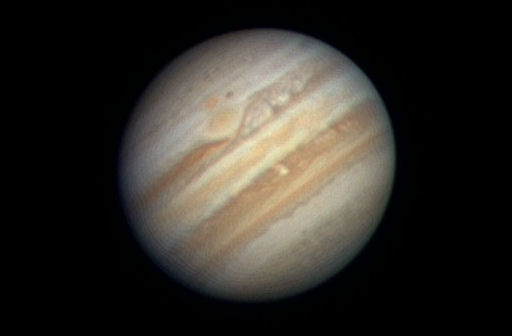
The absense of debris suggests that the source of the explosion, probably an asteroid, was small. Studies show that Jupiter is a frequent target for 10-meter class space rock, and this is almost certainly another example of Jupiter getting hit. The giant planet absorbed the explosion and swallowed the remains of the asteroid whole.
Realtime Space Weather Photo Gallery
AUTUMN LIGHTS: Northern autumn is only days away, and that means aurora season is underway. For reasons researchers don't fully understand, equinoxes are the best times to see Northern Lights. The show is well underway at Summit Station, an NSF-sponsored research facility on top of the Greenland ice sheet, where Ed Stockard snapped this photo on Sept. 17th:
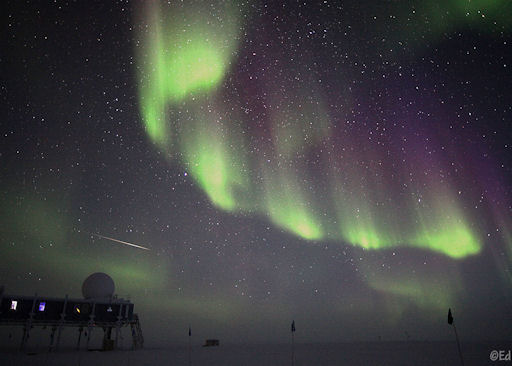
"The auroras came on fast and furious, moving and dancing across the entire sky," says Stockard. "Aurora season has definitely begun on top of the ice sheet. Bring on the lights! Tonight's temperature was - 35F with five knots of wind.... time to dress for the space weather."
NOAA forecasters estimate a 25% to 30% chance of strong polar geomagnetic storms for the next three nights as a series of solar wind streams gently buffet Earth's magnetic field. High latitude sky watchers should remain alert for auroras. Aurora alerts: text, voice.
Realtime Aurora Photo Gallery
Realtime Noctilucent Cloud Photo Gallery
[previous years: 2003, 2004, 2005, 2006, 2007, 2008, 2009, 2011]
Potentially Hazardous Asteroids (
PHAs) are space rocks larger than approximately 100m that can come closer to Earth than 0.05 AU. None of the known PHAs is on a collision course with our planet, although astronomers are finding
new ones all the time.
On September 19, 2012 there were 1330 potentially hazardous asteroids.
Notes: LD means "Lunar Distance." 1 LD = 384,401 km, the distance between Earth and the Moon. 1 LD also equals 0.00256 AU. MAG is the visual magnitude of the asteroid on the date of closest approach. | | The official U.S. government space weather bureau |
| | The first place to look for information about sundogs, pillars, rainbows and related phenomena. |
| | Researchers call it a "Hubble for the sun." SDO is the most advanced solar observatory ever. |
| | 3D views of the sun from NASA's Solar and Terrestrial Relations Observatory |
| | Realtime and archival images of the Sun from SOHO. |
| | from the NOAA Space Environment Center |
| | the underlying science of space weather |