 The space shuttle flies in March. Would you like a call when it soars over your backyard? Spaceweather PHONE!
COOL SOLAR MYSTERY: One pole of the sun is cooler than the other. That's the surprising conclusion announced yesterday by scientists who have been analyzing data from the ESA-NASA Ulysses spacecraft: full story.
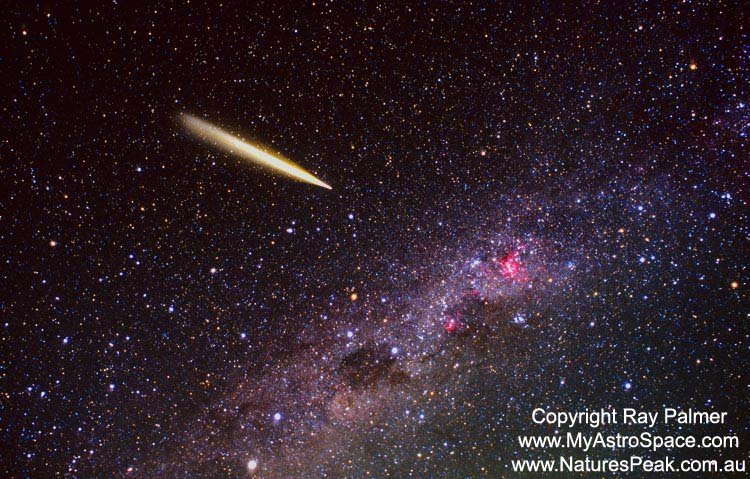
ROCKET EXPLOSION: Australian astronomer Ray Palmer was photographing the Southern Cross from his observatory in Western Australia on Feb. 19th when a flaming plume cut across the Milky Way. "I had no idea what it was," he says. "It was moving very slowly and I was able to track it for 35 minutes."

Photo details: Nikon FM2, 50mm lens, Kodak Elite Chrome 200, 30 minutes.
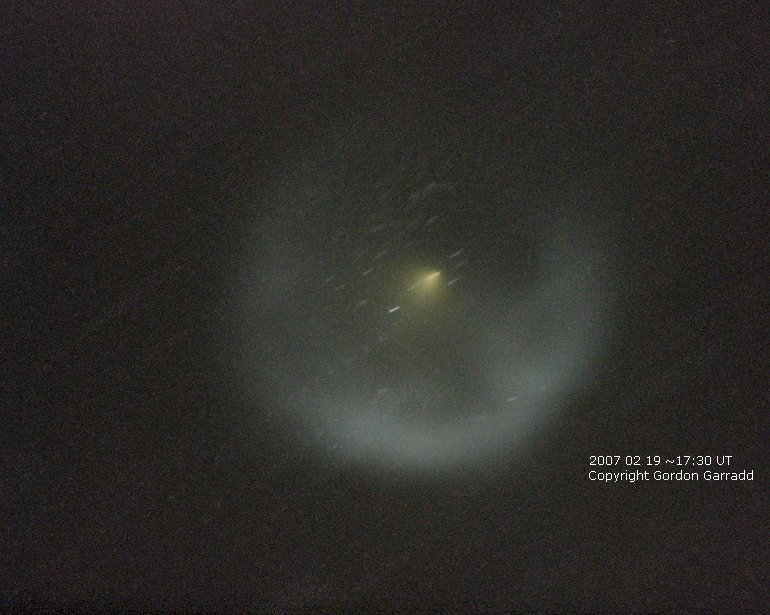
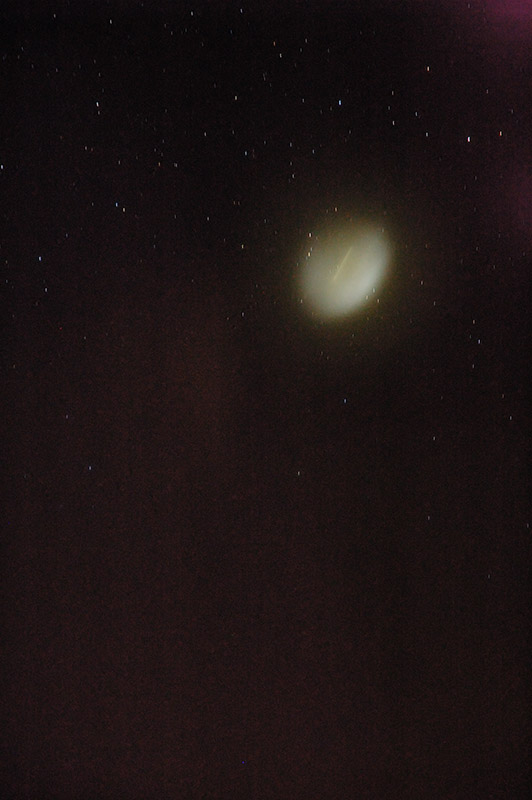
In mid-apparition the object exploded. Gordon Garradd of New South Wales photographed an expanding cloud filled with specks of debris. Tim Thorpe of South Australia saw it, too. "Quite a surreal scene," he says.
What was it? It was a mystery for almost 24 hours until satellite expert Daniel Deak matched the trajectory of the plume in Palmer's photo with the orbit of a derelict rocket booster--"a Briz-M, catalog number 28944."
One year ago, the Briz-M sat atop a Russian Proton rocket that left Earth on Feb. 28, 2006, carrying an Arabsat-4A communications satellite. Shortly after launch, the rocket malfunctioned, leaving the satellite in the wrong orbit and the Briz-M looping around Earth partially-filled with fuel. On Feb. 19, 2007, for reasons unknown, the fuel tanks ruptured over Australia.
Jon P. Boers of the USAF Space Surveillance System confirms the ID and notes "later, on the other side of the world, our radar saw 500+ pieces in that orbit." Today the count is up to 1111 fragments. "[We're seeing] more fragments as the cloud expands," he explains.
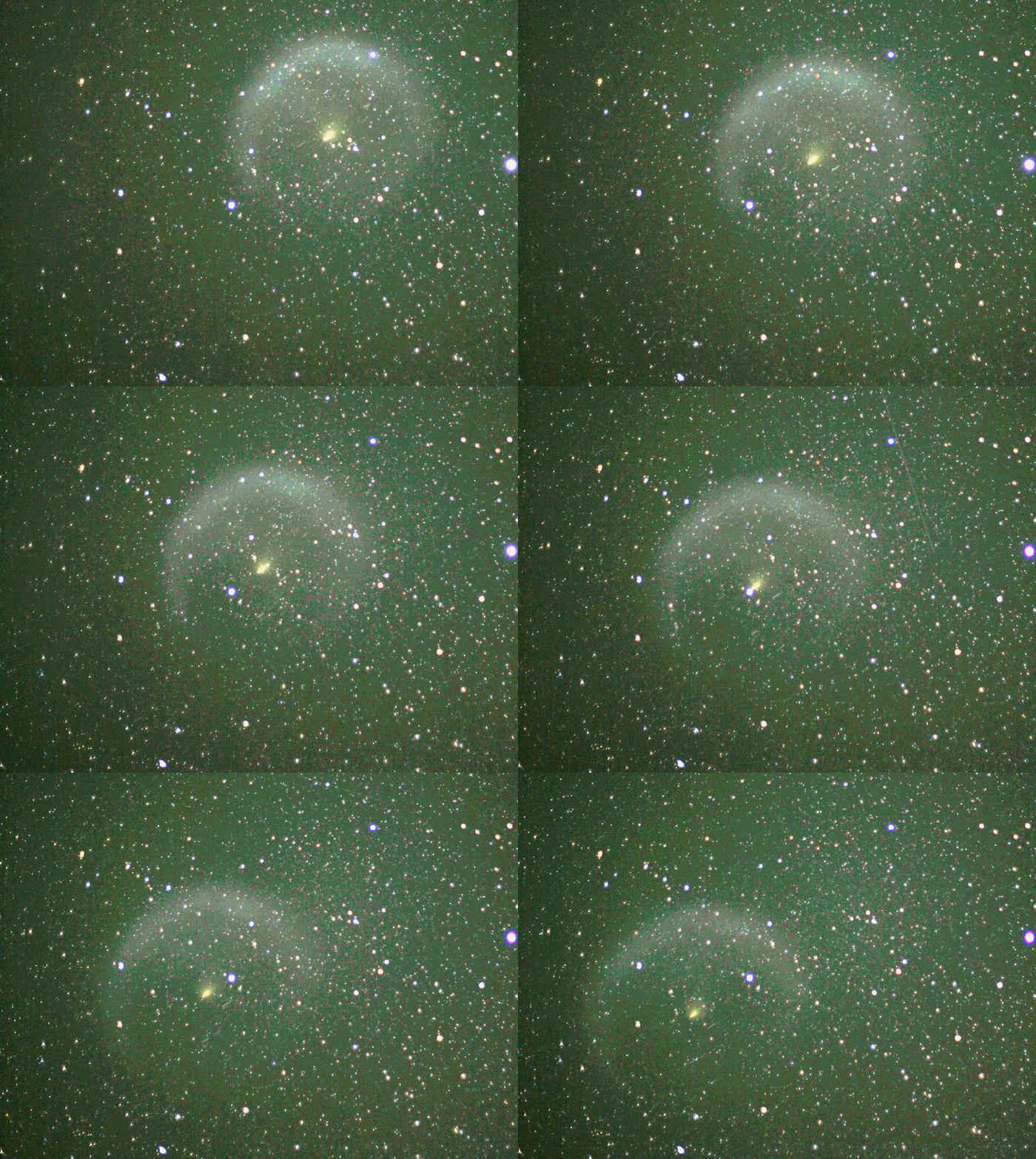
Some of the fragments are visible in this movie made by Rob McNaught at the Siding Spring Observatory, NSW, Australia:
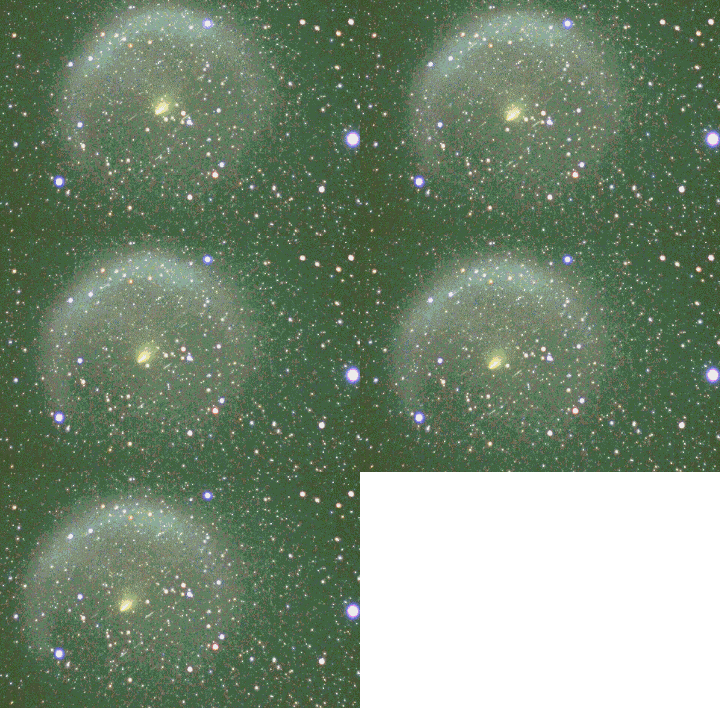
Photo details: Canon 5D, 50mm lens, f/1.4, 20 x 20sec exposures.
"Spica is at the right edge of the animation and the fragments are moving to the north and east," he says.
One thousand-plus fragments makes this "a major breakup event," says Mark Matney of NASA's Orbital Debris Office at the Johnson Space Center. "There is no immediate threat to the space station, but we're analyzing the orbits to assess any long-term hazard."
"Unlike recent high profile breakups, Briz-M is in an orbit that is difficult for most radars to see," adds Boers. "The generation of element sets on all the pieces will take weeks to accomplish."
Note: Many readers have asked how this event compares to last month's Chinese anti-sat test, which shattered a derelict satellite in low-Earth orbit producing more than 700 catalogued fragments. The Briz-M event could be worse--or not. It depends on the size and distribution of the 1000+ fragments. Ongoing radar studies will provide a better answer in the days and weeks ahead.



 SPACE WEATHER

 SPACE WEATHER