AI writing is everywhere -- except here. This website is written by Dr. Tony Phillips, a carbon-based lifeform with 30 yrs of forecasting experience. Our guarantee: If you find a mistake, it was made by a real human being.
|
|
|
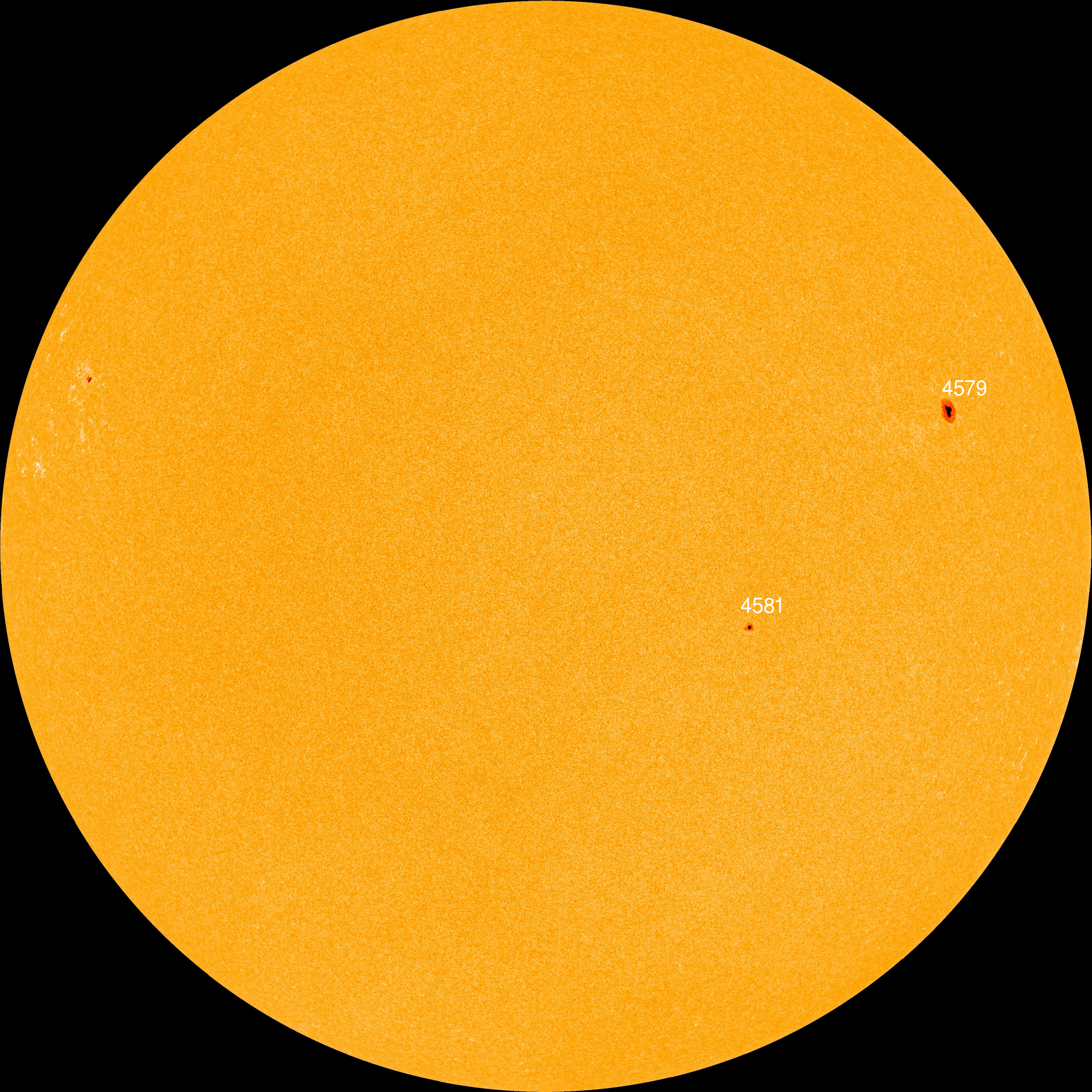
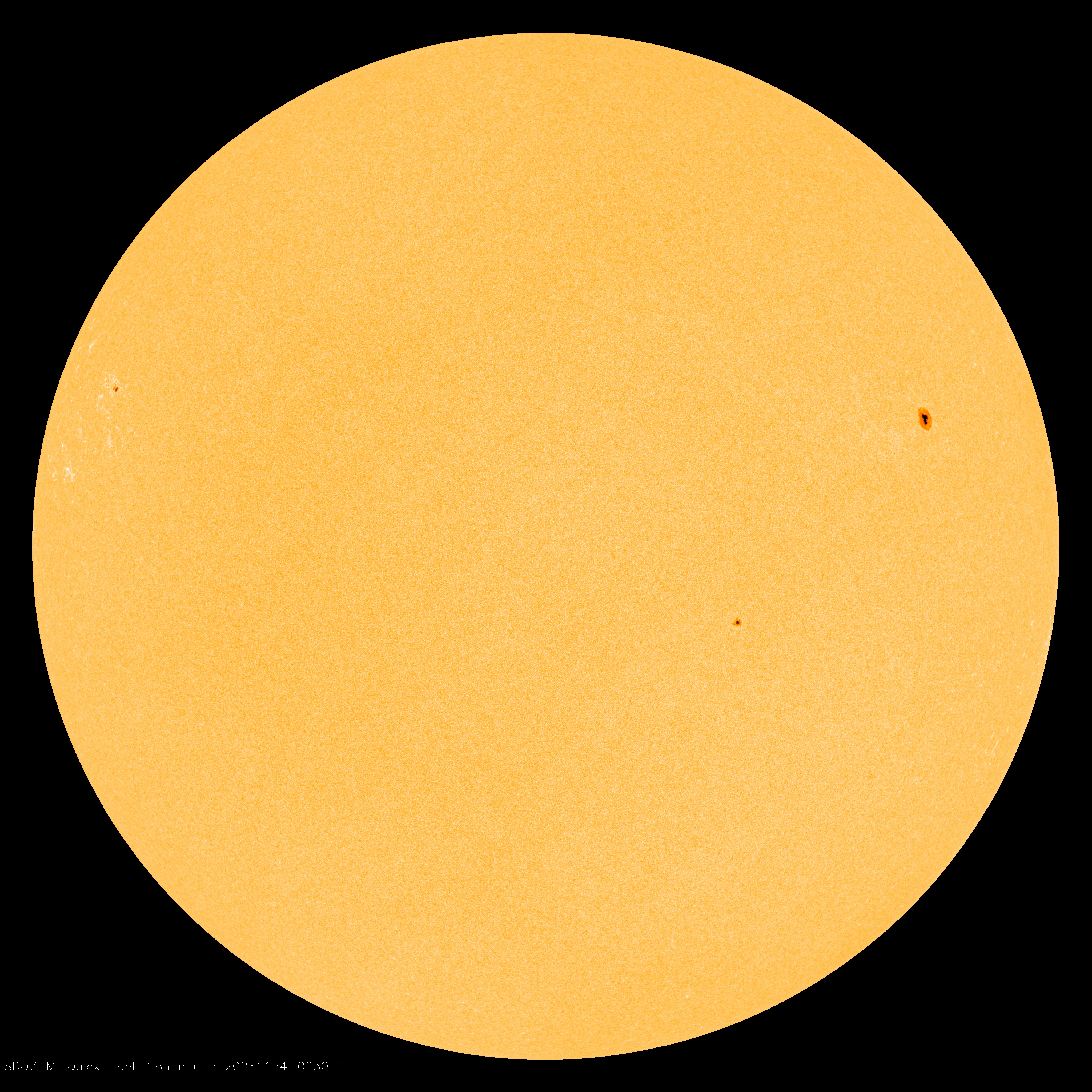
THE SUN IS FLATLINING: The sun's X-ray output is flatlining as sunspots fade away. Solar flares are unlikely through Thanksgiving. Holiday air travelers can fly without worrying about radiation storms.
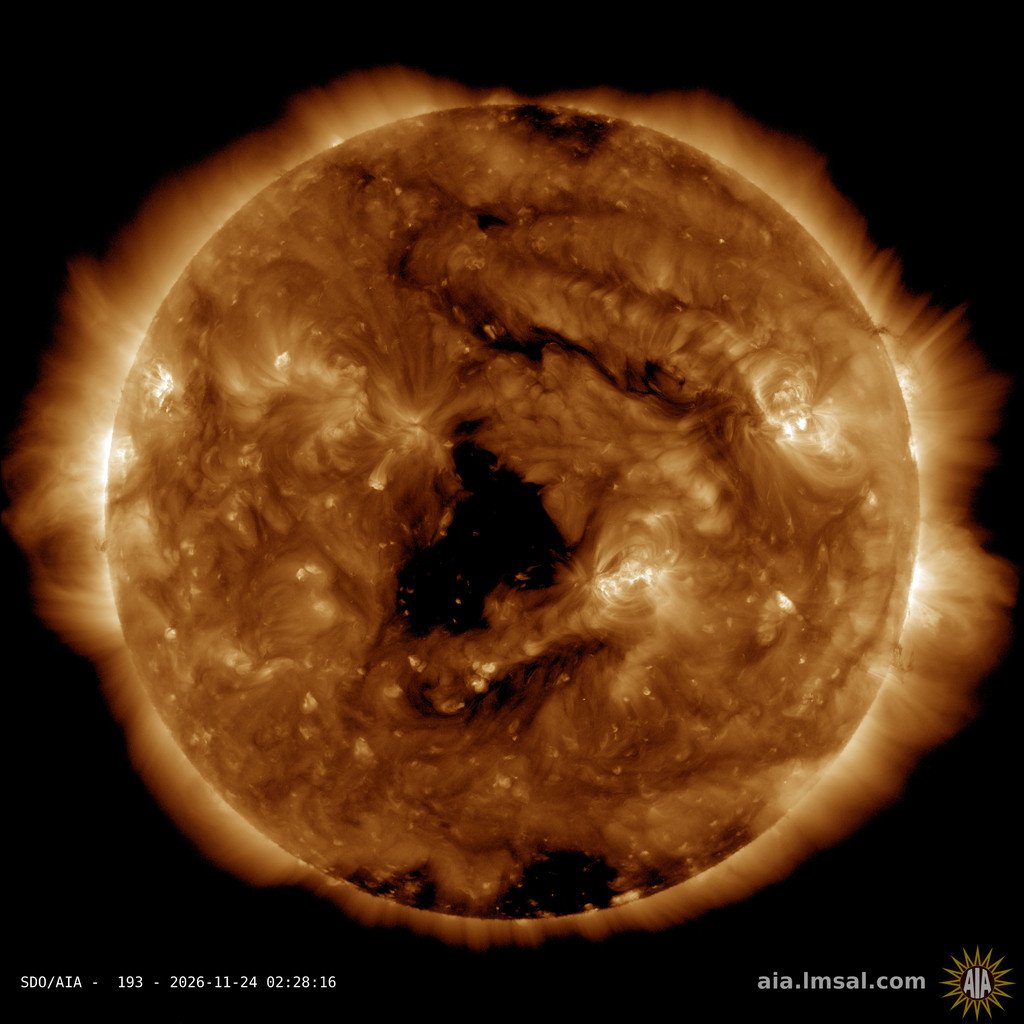
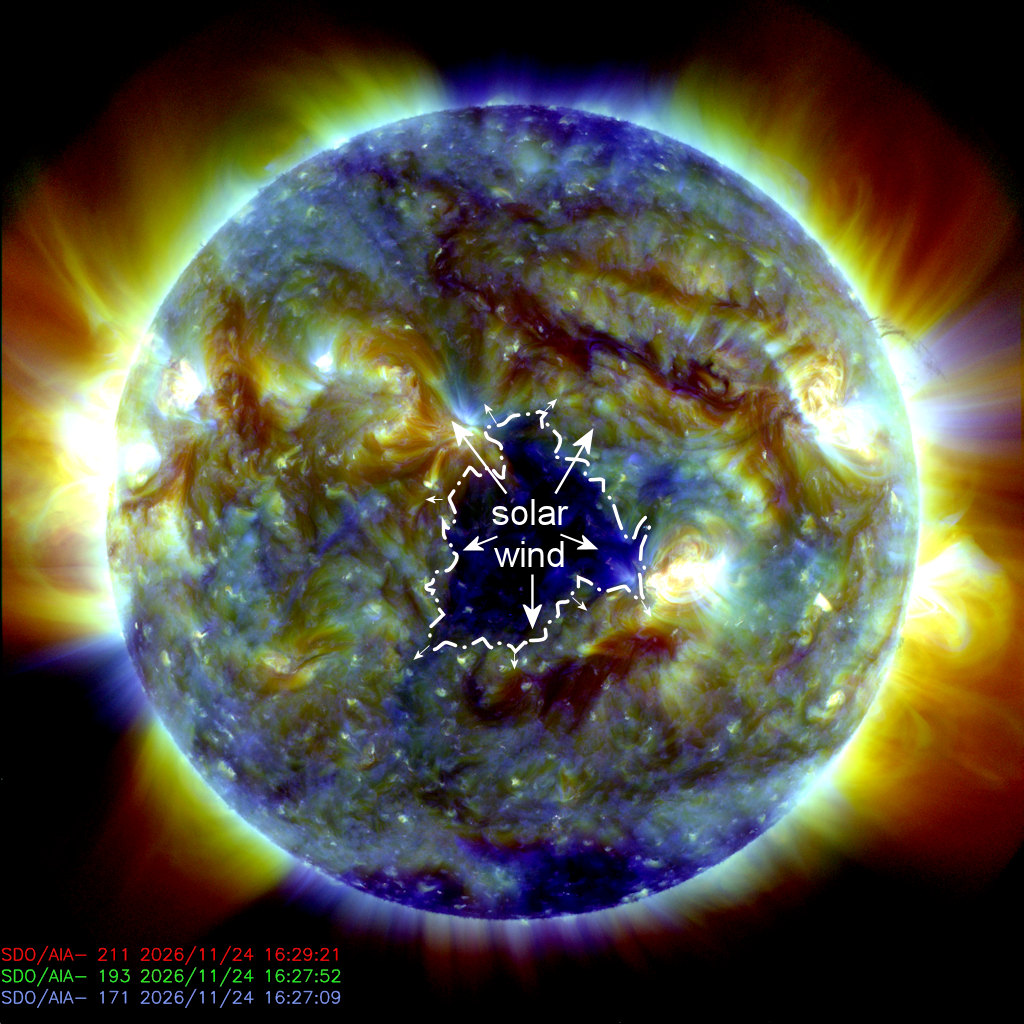
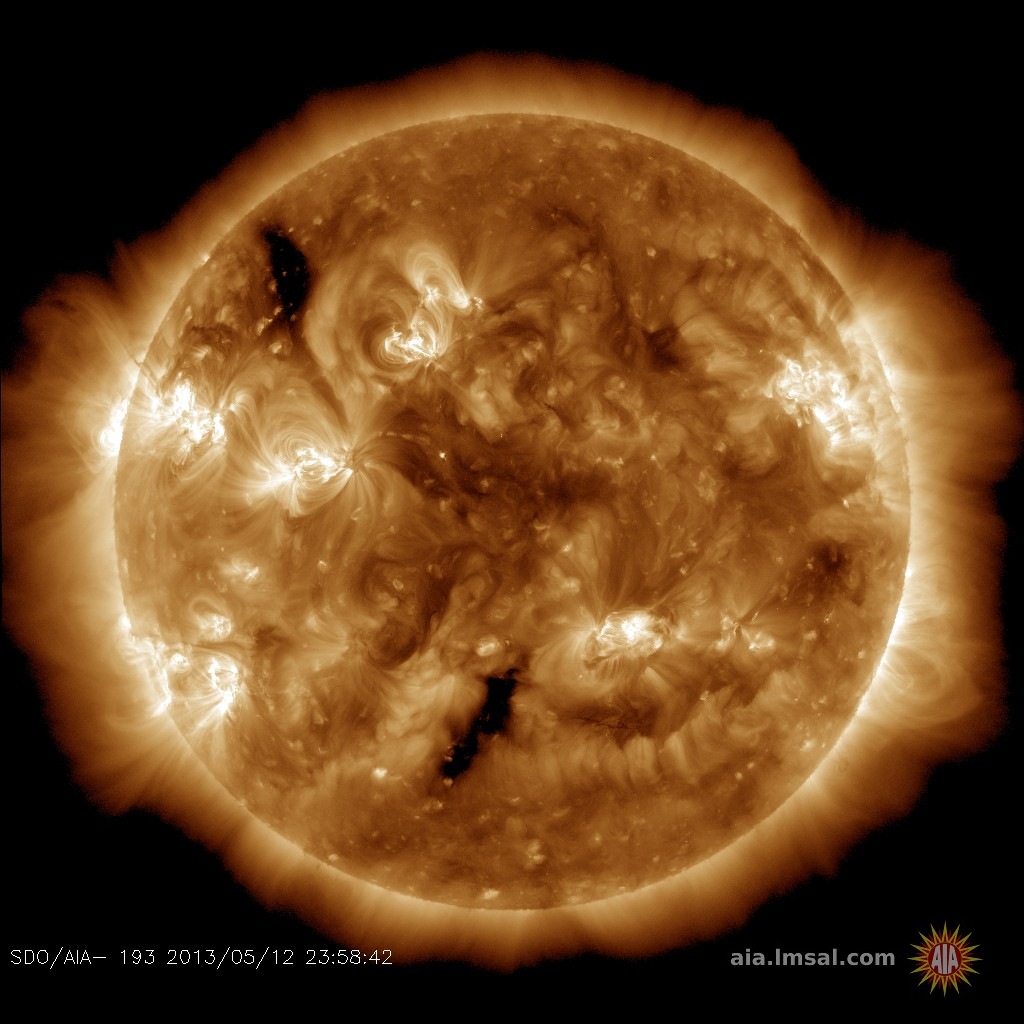
A HOLE IN THE SUN'S ATMOSPHERE: A hole has opened in the sun's atmosphere, and it is spewing solar wind directly toward Earth. NASA's Solar Dynamics Observatory took this extreme ultraviolet picture of the structure on Nov. 24th:
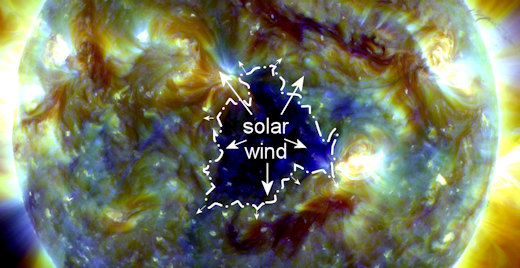
This is a "coronal hole"--a vast region where the sun's magnetic fields have peeled back, allowing solar wind to escape. It looks dark because the glowing plasma normally contained there has escaped. It is heading our way.
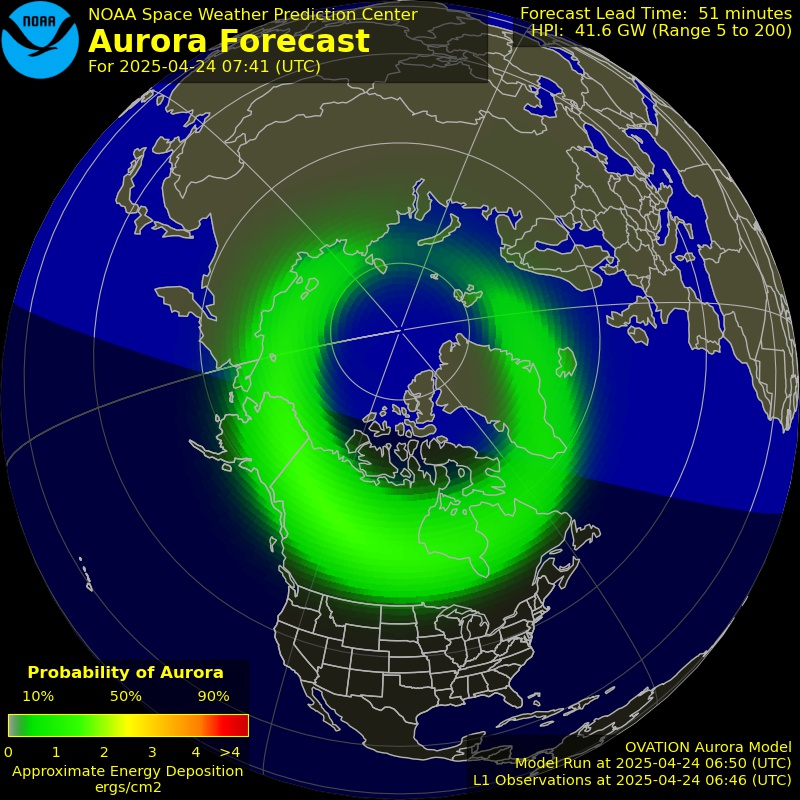
NOAA forecasters are predicting a G1-class geomagnetic storm when the solar wind arrives. ETA: Nov. 27th. Stay tuned for high-latitude auroras. Aurora alerts: SMS Text
TODAY'S FULL MOON IS A FLOOD MOON: There's a full Moon today. Headlines are calling it a "supermoon." A better name would be "Flood Moon." It is one of the closest Full Moons of the year, raising record-setting King Tides in the western USA.
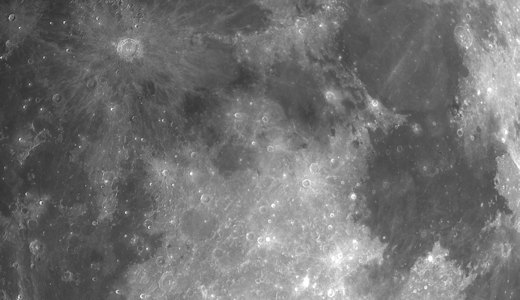
The Moon is getting big in the windshield. See all 43 megapixels from Dave Wilson
The technical term is "perigee Moon." The Moon's orbit is an ellipse, with one side (perigee) 50,000 km closer to Earth than the other (apogee). Today's Moon is only 30 hours from perigee, which gives it extra tide-raising power.
The King tides in California will be some of the biggest in decades. The San Francisco Chronicle is calling them "Monster King Tides," warning residents of coastal communities not to travel around Thanksgiving when roadways could fill with feet of water. San Francisco International Airport may be inundated with seawater sloshing over sea walls 8 to 10 feet tall.
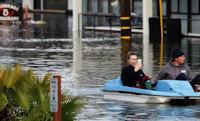 California is hit extra hard because El Niño in the Pacific has raised coastal sea levels by about 1 foot--on top of 8 inches already present in some areas due to long-term climate change. The Moon will add to these totals, setting the stage for severe coastal erosion.
Now for the good news: Perigee Moons are extra big and beautiful. This one will be 6.5% wider and 13.5% brighter than an average full Moon. Go outside at sunset to see the swollen orb rising in the east.
Observing tip: You might want to wear galoshes.
Realtime Space Weather Photo Gallery
Free: Space Weather Newsletter
BACKYARD ASTRONOMY ALERTS FOR CHRISTMAS: We're really proud of our new Backyard Astronomy Alert service, and we hope you'll consider buying a gift subscription for Christmas. Someone you know will love it! It comes with a beautiful gift hard (physical or digital) delivered on the date of your choice.

Backyard Astronomy Alerts is a unique service. It helps you see comets, meteors, rocket launches, auroras and space station flybys--including the strangely red-colored Chinese space station.
Text messages and companion emails deliver sky maps and observing tips while the event is happening. It's a real time service that tells you to Look Up Now. The immediacy is exciting.
PS. This is a gift you can also give yourself.
Far Out Gifts: Earth to Sky Store
All sales support hands-on STEM education
Realtime Aurora Photo Gallery
Free: Spaceweather.com Newsletter
Every night, a network
of
NASA
all-sky cameras scans the skies above the United
States for meteoritic fireballs. Automated software
maintained by NASA's Meteoroid Environment Office
calculates their orbits, velocity, penetration depth
in Earth's atmosphere and many other characteristics.
Daily results are presented here on Spaceweather.com.
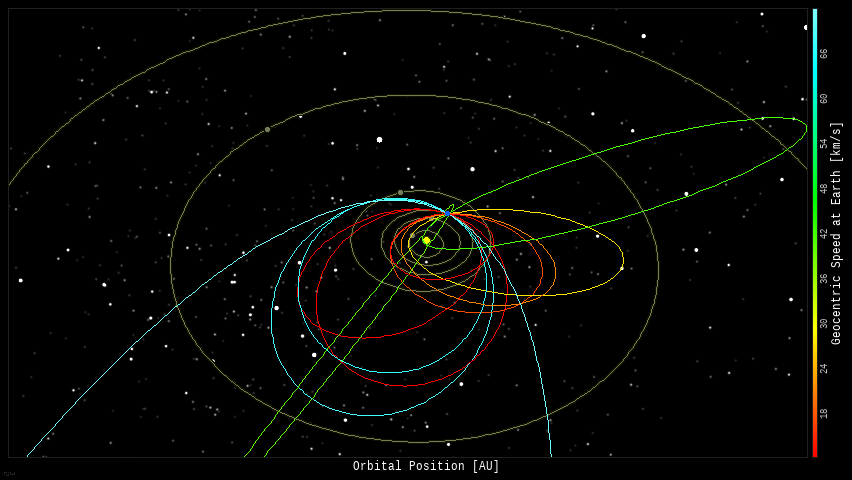
On November 24, 2026, the network reported 11 fireballs.
(5 sporadics, 3 Leonids, 1 Northern Taurid, 1 gamma Taurid, 1 November omega Orionid)
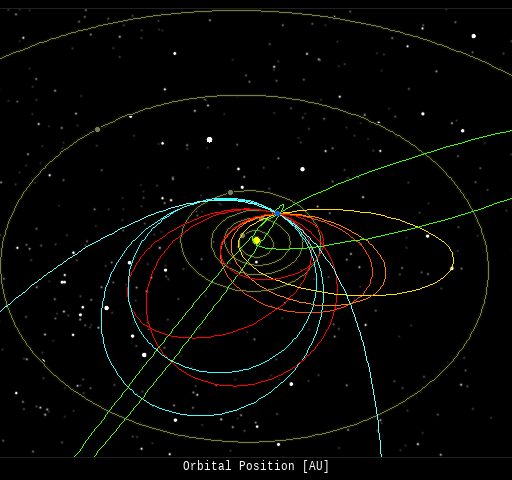
In this diagram of the inner solar system, all of the fireball orbits intersect at a single point--Earth. The orbits are color-coded by velocity, from slow (red) to fast (blue).
[Larger image] [movies]
Potentially Hazardous Asteroids (
PHAs)
are space rocks larger than approximately 100m that
can come closer to Earth than 0.05 AU. None of the
known PHAs is on a collision course with our planet,
although astronomers are finding
new
ones all the time.
On November 24, 2026 there were 2349 potentially hazardous asteroids.
 |
Recent
& Upcoming Earth-asteroid encounters:
| Asteroid |
Date(UT) |
Miss Distance |
Velocity (km/s) |
Diameter (m) |
| 2018 NE1 |
2026-Nov-19 |
16.7 LD |
13.3 |
74 |
| 2007 WK3 |
2026-Nov-19 |
14.3 LD |
7.8 |
20 |
| 2026 WN1 |
2026-Nov-19 |
3.7 LD |
5.1 |
8 |
| 2026 VA11 |
2026-Nov-19 |
8.8 LD |
8.9 |
13 |
| 2026 WK2 |
2026-Nov-19 |
7.1 LD |
5.8 |
8 |
| 2026 WR1 |
2026-Nov-19 |
6.2 LD |
8.4 |
21 |
| 2026 TB84 |
2026-Nov-19 |
12.1 LD |
9.9 |
68 |
| 2026 WQ1 |
2026-Nov-20 |
12.2 LD |
12.7 |
17 |
| 2026 VD6 |
2026-Nov-20 |
10.5 LD |
9.4 |
17 |
| 2026 WO1 |
2026-Nov-21 |
15.2 LD |
7.1 |
10 |
| 2026 VN11 |
2026-Nov-21 |
5.2 LD |
7.1 |
42 |
| 2026 WB2 |
2026-Nov-21 |
1.6 LD |
26 |
8 |
| 2026 WB1 |
2026-Nov-21 |
1.9 LD |
14 |
9 |
| 2026 VD9 |
2026-Nov-21 |
10.2 LD |
4.7 |
32 |
| 2026 VY15 |
2026-Nov-21 |
9.6 LD |
13.3 |
29 |
| 2026 WA1 |
2026-Nov-21 |
1.2 LD |
13.7 |
5 |
| 2026 WJ |
2026-Nov-22 |
1.7 LD |
9.2 |
13 |
| 2026 WC1 |
2026-Nov-22 |
5.9 LD |
19.7 |
16 |
| 2026 WF |
2026-Nov-23 |
6.7 LD |
10.9 |
20 |
| 2026 VF18 |
2026-Nov-23 |
10.5 LD |
7.5 |
16 |
| 2026 WD |
2026-Nov-23 |
4.5 LD |
13.9 |
15 |
| 2026 VV11 |
2026-Nov-25 |
16.2 LD |
8.7 |
41 |
| 2026 VQ5 |
2026-Nov-25 |
5.2 LD |
11.7 |
59 |
| 2026 VQ19 |
2026-Nov-26 |
4 LD |
6.8 |
31 |
| 2026 WX1 |
2026-Nov-26 |
13.9 LD |
8.7 |
11 |
| 2026 WU1 |
2026-Nov-27 |
12.6 LD |
12.4 |
40 |
| 2025 CP1 |
2026-Nov-30 |
12.9 LD |
10.8 |
6 |
| 2026 WK1 |
2026-Dec-03 |
5.3 LD |
6.3 |
25 |
| 2019 XF2 |
2026-Dec-04 |
3.1 LD |
10.2 |
14 |
| 2023 XH3 |
2026-Dec-06 |
18.7 LD |
16.5 |
14 |
| 2020 XC3 |
2026-Dec-08 |
14.5 LD |
14.3 |
110 |
| 2026 WG |
2026-Dec-08 |
11.5 LD |
6.3 |
29 |
| 2016 NV |
2026-Dec-08 |
14.3 LD |
10.4 |
379 |
| 2010 VQ |
2026-Dec-12 |
4.6 LD |
4.3 |
10 |
| 2025 XN6 |
2026-Dec-12 |
6.9 LD |
12.2 |
5 |
| 2026 QQ8 |
2026-Dec-13 |
3.5 LD |
0.8 |
2 |
| 2026 LZ1 |
2026-Dec-14 |
14.4 LD |
11.2 |
36 |
| 2025 YN |
2026-Dec-18 |
18.3 LD |
13.1 |
21 |
| 2018 FQ4 |
2026-Dec-19 |
16.7 LD |
10.4 |
14 |
| 2021 PF7 |
2026-Dec-26 |
15.5 LD |
7.7 |
10 |
| 2019 AY3 |
2027-Jan-04 |
20 LD |
20 |
61 |
| 2023 FP1 |
2027-Jan-05 |
10.4 LD |
2.7 |
17 |
| 2014 BP |
2027-Jan-13 |
8.7 LD |
10.4 |
34 |
| 2024 RR14 |
2027-Jan-13 |
8.4 LD |
8 |
140 |
| 2025 BL |
2027-Jan-16 |
15.9 LD |
6.5 |
27 |
| 2025 AK3 |
2027-Jan-17 |
6.5 LD |
7 |
21 |
| 2023 TX |
2027-Jan-17 |
12.9 LD |
7.7 |
4 |
| 2020 BY |
2027-Jan-22 |
5.5 LD |
16.2 |
45 |
| 2015 DG200 |
2027-Jan-22 |
3.7 LD |
20 |
124 |
Notes: LD means
"Lunar Distance." 1 LD = 384,401 km, the distance
between Earth and the Moon. 1 LD also equals 0.00256
AU.
| |
Cosmic Rays in the Atmosphere |
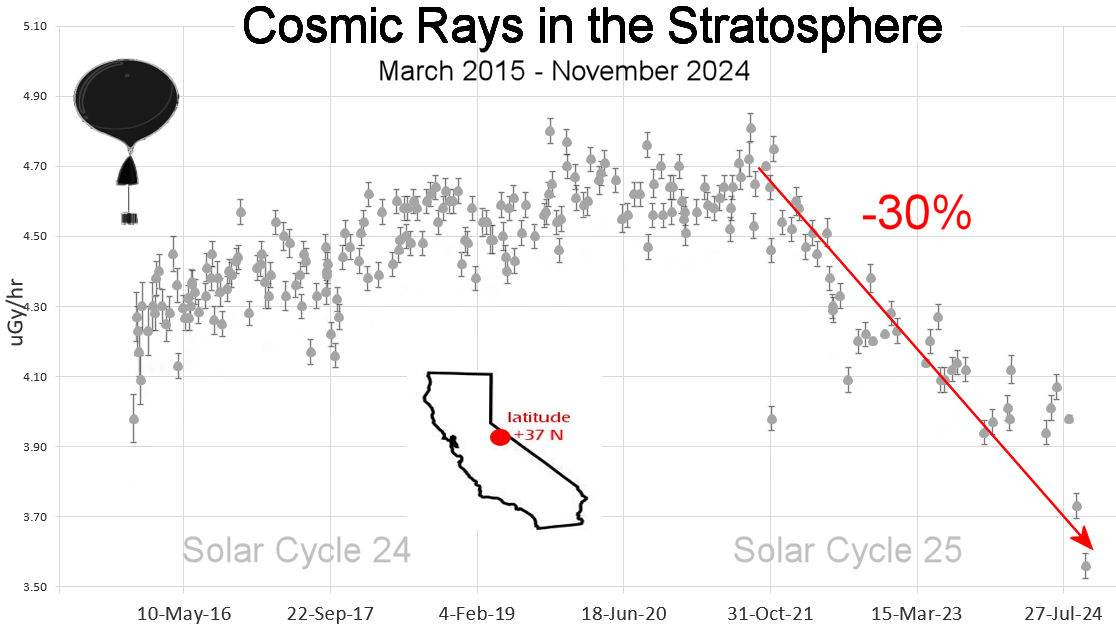
SPACE WEATHER BALLOON DATA: Almost once a week, Spaceweather.com and the students of Earth to Sky Calculus fly space weather balloons to the stratosphere over California. These balloons are equipped with sensors that detect secondary cosmic rays, a form of radiation from space that can penetrate all the way down to Earth's surface. Our monitoring program has been underway without interruption for 10 years, resulting in a unique dataset of in situ atmospheric measurements.
Latest results (Nov. 2024): Atmospheric radiation is sharply decreasing in 2024. Our latest measurements in November registered a 10-year low:
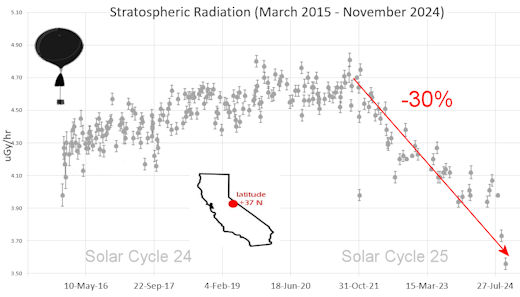
What's going on? Ironically, the radiation drop is caused by increasing solar activity. Solar Cycle 25 has roared to life faster than forecasters expected. The sun's strengthening and increasingly tangled magnetic field repels cosmic rays from deep space. In addition, solar coronal mass ejections (CMEs) sweep aside cosmic rays, causing sharp reductions called "Forbush Decreases." The two effects blend together to bring daily radiation levels down.
.Who cares? Cosmic rays are a surprisingly "down to Earth" form of space weather. They can alter the chemistry of the atmosphere, trigger lightning, and penetrate commercial airplanes. According to a study from the Harvard T.H. Chan school of public health, crews of aircraft have higher rates of cancer than the general population. The researchers listed cosmic rays, irregular sleep habits, and chemical contaminants as leading risk factors. A number of controversial studies (#1, #2, #3, #4) go even further, linking cosmic rays with cardiac arrhythmias and sudden cardiac death.
Technical notes: The radiation sensors onboard our helium balloons detect X-rays and gamma-rays in the energy range 10 keV to 20 MeV. These energies span the range of medical X-ray machines and airport security scanners.
Data points in the graph labeled "Stratospheric Radiation" correspond to the peak of the Regener-Pfotzer maximum, which lies about 67,000 feet above central California. When cosmic rays crash into Earth's atmosphere, they produce a spray of secondary particles that is most intense at the entrance to the stratosphere. Physicists Eric Regener and Georg Pfotzer discovered the maximum using balloons in the 1930s and it is what we are measuring today.
| |
The
official U.S. government space weather bureau |
| |
The
first place to look for information about sundogs,
pillars, rainbows and related phenomena. |
| |
Researchers
call it a "Hubble for the sun." SDO
is the most advanced solar observatory ever. |
| |
3D
views of the sun from NASA's Solar and Terrestrial
Relations Observatory |
| |
Realtime
and archival images of the Sun from SOHO. |
| |
information about sunspots based on the latest NOAA/USAF Active Region Summary |
| |
current counts of failed and deployed Starlink satellites from Jonathan's Space Page. See also, all satellite statistics. |
| |
Authoritative predictions of space junk and satellite re-entries |
| |
from
the NOAA Space Environment Center |
| |
fun to read, but should be taken with a grain of salt! Forecasts looking ahead more than a few days are often wrong. |
| |
from the NOAA Space Environment Center |
| |
the
underlying science of space weather |
 |
Got a chipped or cracked windshield that prevents you from seeing space weather events while driving? Get windshield replacement from SR Windows & Glass with free mobile auto glass service anywhere in the Phoenix area. |
| |
These links help Spaceweather.com stay online. Thank you to our supporters! |
|
|
| |
|
|
|