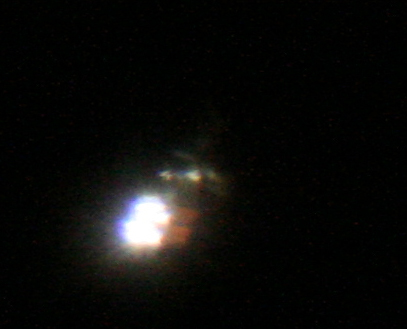
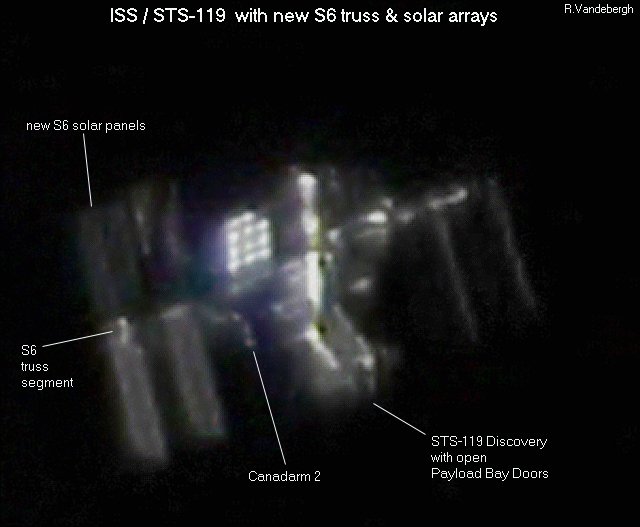
| ISS DODGES MORE DEBRIS: On Sunday, March 22nd, space shuttle Discovery used its steering jets to move the International Space Station (ISS) out of the way of a speeding 4-inch piece of space junk, a metal fragment from a spent Chinese rocket engine. Without the maneuver, the object would have made a close approach to the ISS during today's spacewalk. This is the second time this month that the ISS has taken evasive action to avoid orbital debris. SPACE STATION FLARES: Everyone knows the ISS is bright. But this bright? On March 21st when the space station flew over the Netherlands, its luminosity surged to super-Venus levels. "I estimated it to be at least visual magnitude -5," reports Marco Langbroek of Leiden. "Leo Barhorst observing 35 km northeast of me estimated at least -6." These numbers mean the ISS was four times brighter than Venus and more than 60 times brighter than Sirius, the brightest star in the sky. Dutch astronomer Quintus Oostendorp observed the flare through his backyard telescope. This snapshot shows what happened: 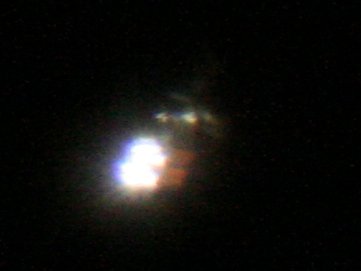
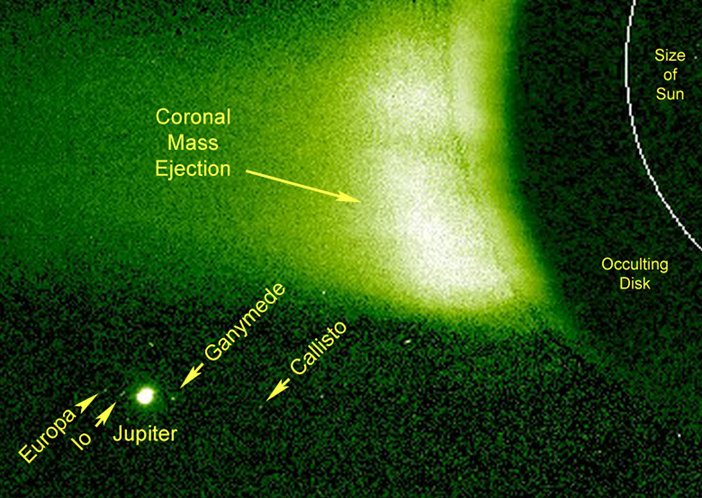
No, it is not an explosion. The bright flash is sunlight glinting off the station's enormous solar arrays. On March 20th, astronauts unfurled a new pair of arrays on the space station's starboard side, adding 8000 sq. feet of light-catching surface area to the station's profile. The extra area increases both the chances and the luminosity of ISS flares. "It was a spectacular sight!" says Oostendorp. When will the ISS flare over your backyard? Check the Simple Satellite Tracker for flybys. more images: from Pawel Warchal of Cracow, Poland; from Ralf Vandebergh of the Netherlands; from Janusz Krysiak of Koluszki, Poland; from Martin Wagner of Sonnenbuehl, Germany; from Rob Carew of Melbourne Australia; more movies: from Dirk Ewers of Germany (DivX required); from Dave Gallant of Thunder Bay, Ontario, Canada; from Mike Tyrrell of Northwich, Cheshire, UK; NEAR THE EDGE OF THE SUN: Imagine looking up at noon and seeing a planet with four moons just 0.1o from the edge of the blinding sun. Impossible? NASA's STEREO-B spacecraft did it last week. Click on the image below to launch a movie of Jupiter and the Galilean satellites in close "solar conjunction." 
5 MB Quicktime movie | labeled still frame | Zoom in on Jupiter
During the 30-hour movie, Io, Europa, Ganymede and Callisto circle Jupiter as a massive CME billows overhead. STEREO-B recorded the action on March 15th and 16th using an occulting disk to block the solar glare. This arrangment allowed STEREO's cameras to photograph moons of Jupiter eight thousand billion (8x10¹²) times dimmer than the adjacent sun. STEREO's coronagraph (occulting disk+camera) is designed to monitor faint but powerful activity in the sun's outer atmosphere. The CME is a good example. With a limiting magnitude of +6.5, it can also see stars, planets, moons and comets so close to the edge of the sun, it seems impossible. In fact, it happens all the time. Browse the STEREO gallery for examples.
March 2009 Aurora Gallery
[previous Marches: 2008, 2007, 2006, 2005, 2004, 2003, 2002]
Comet Lulin Photo Gallery
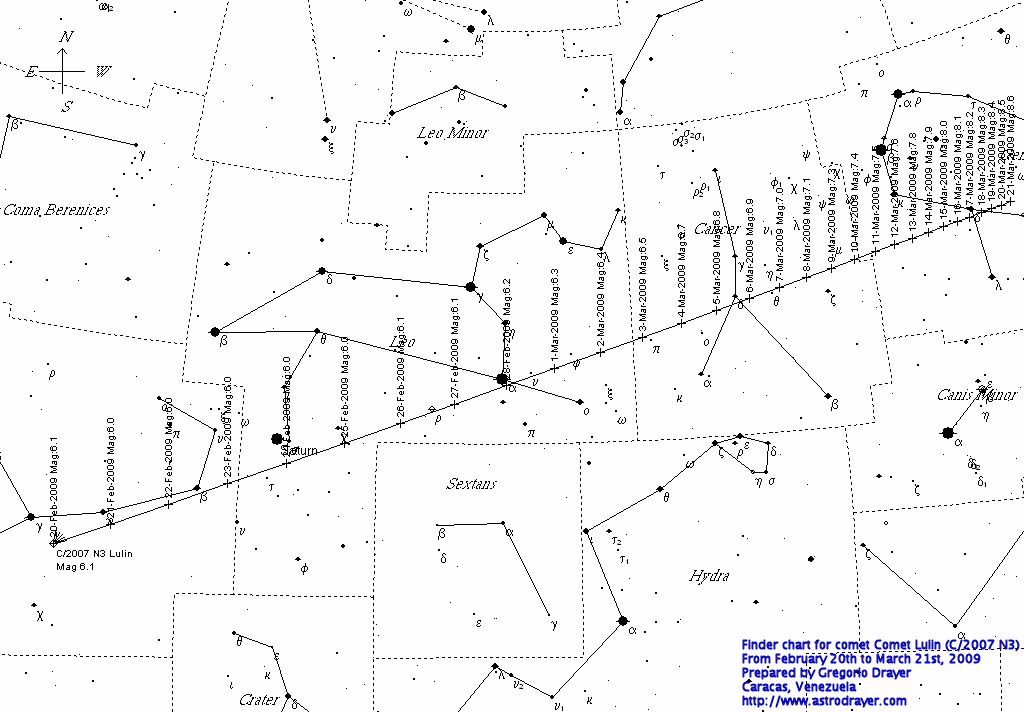
[Comet Hunter Telescope: review] [Comet Lulin finder chart]
Explore the Sunspot Cycle |