AI writing is everywhere -- except here. This website is written by Dr. Tony Phillips, a carbon-based lifeform with 30 yrs of forecasting experience. Our guarantee: If you find a mistake, it was made by a real human being.
|
|
|
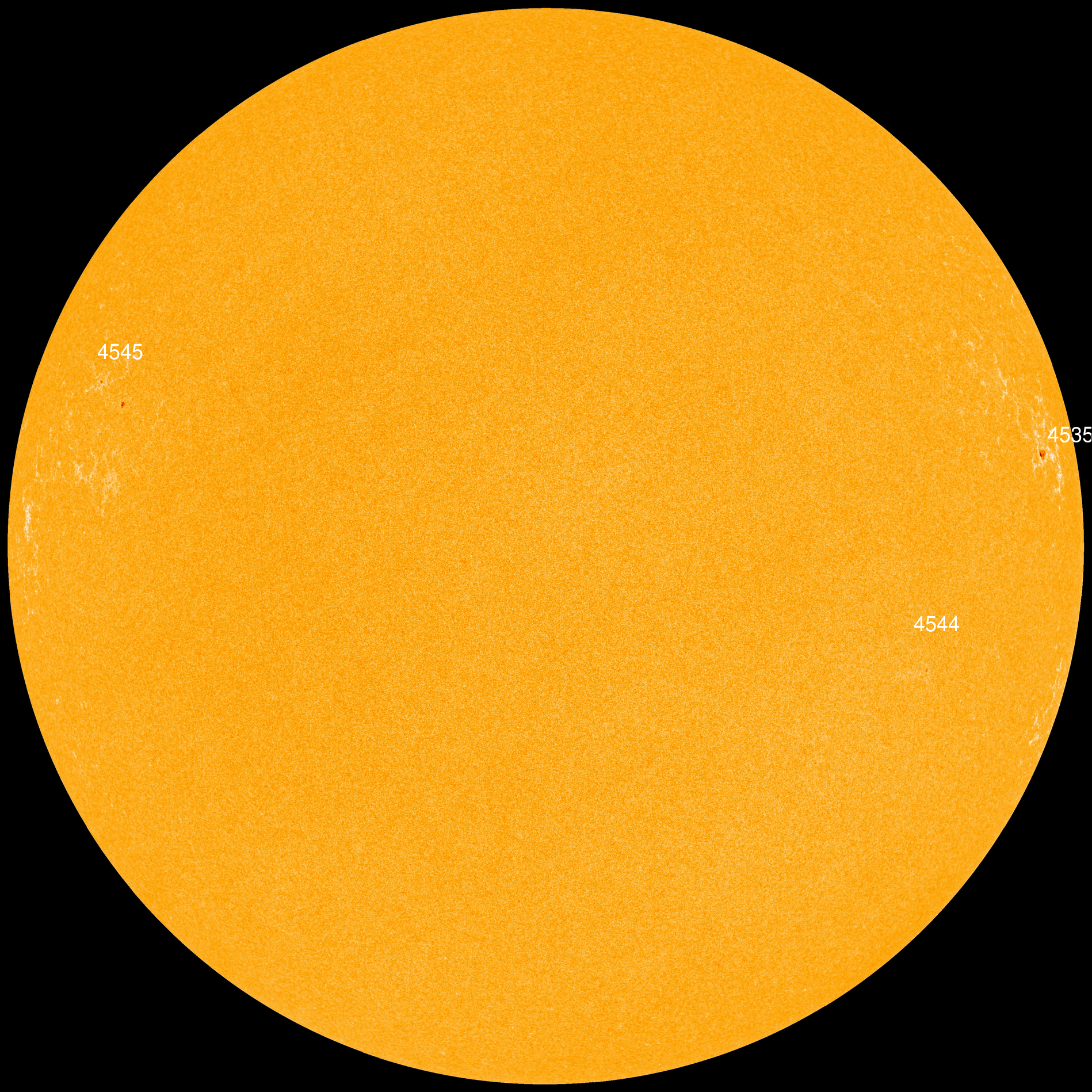
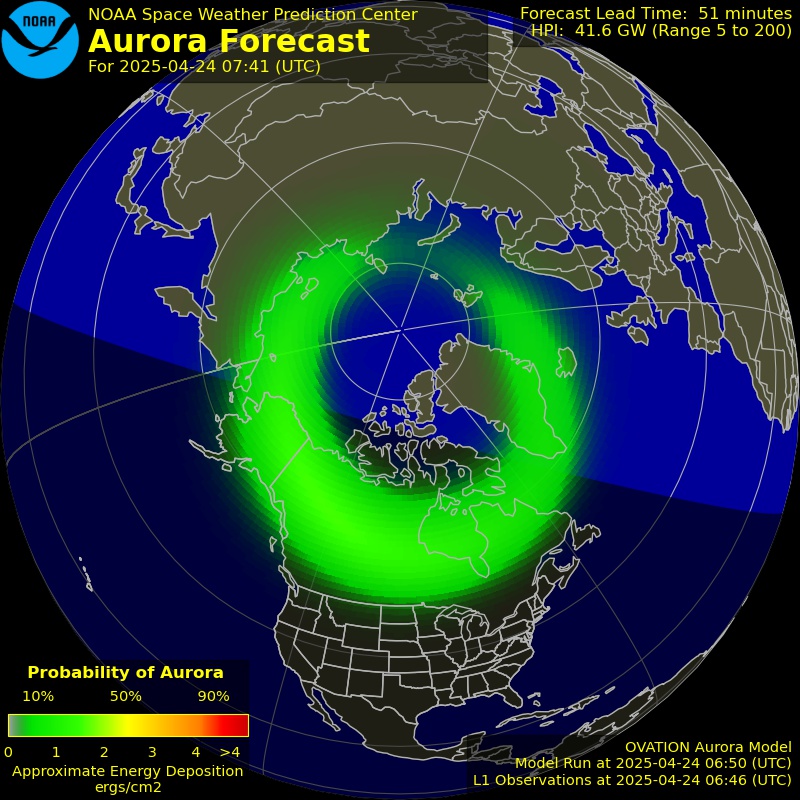
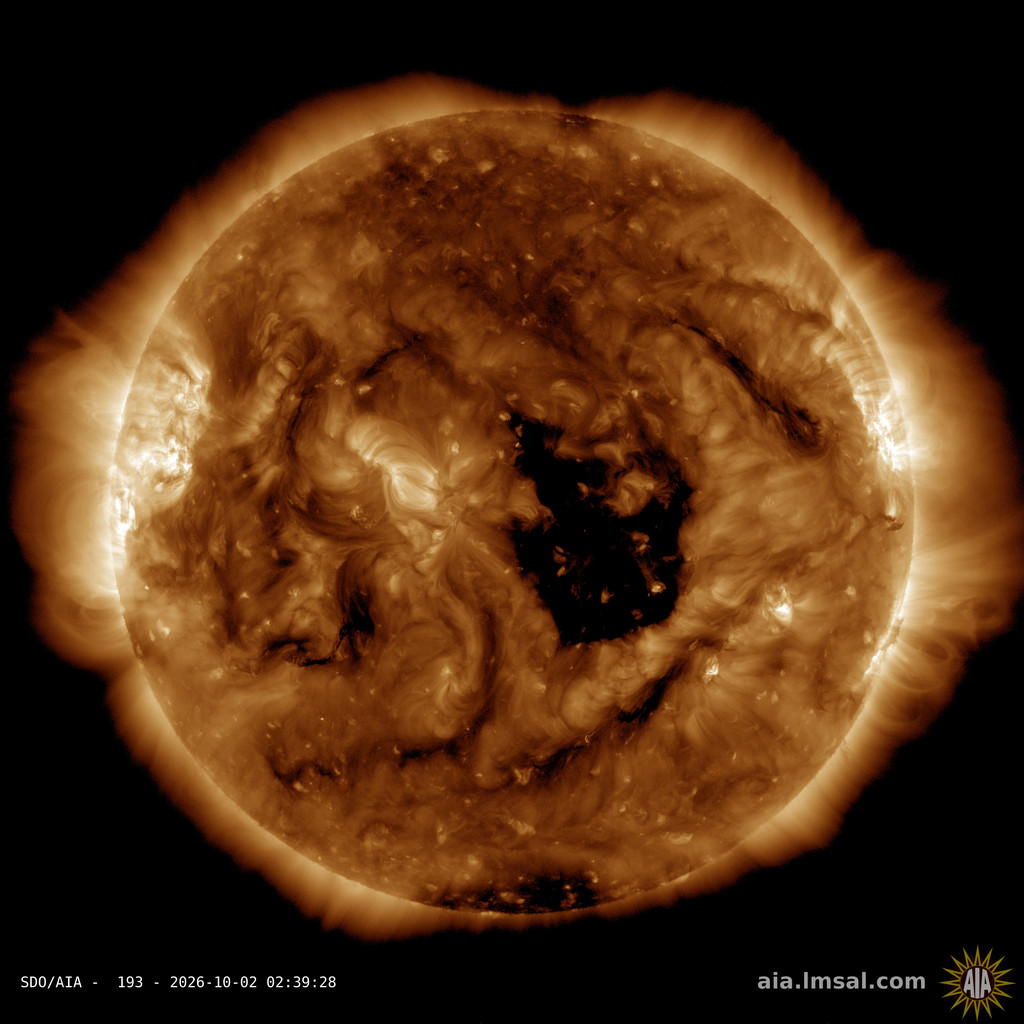
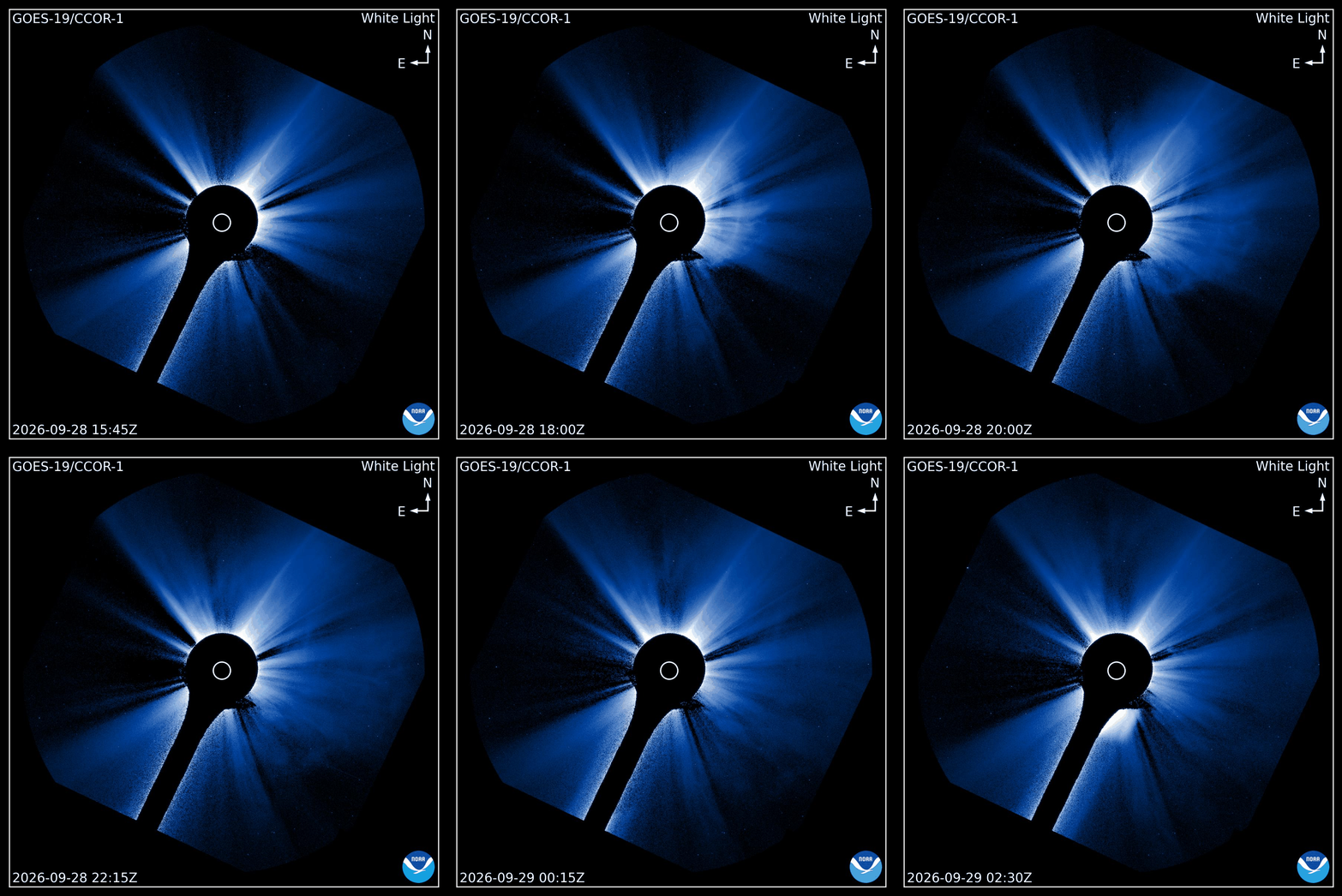
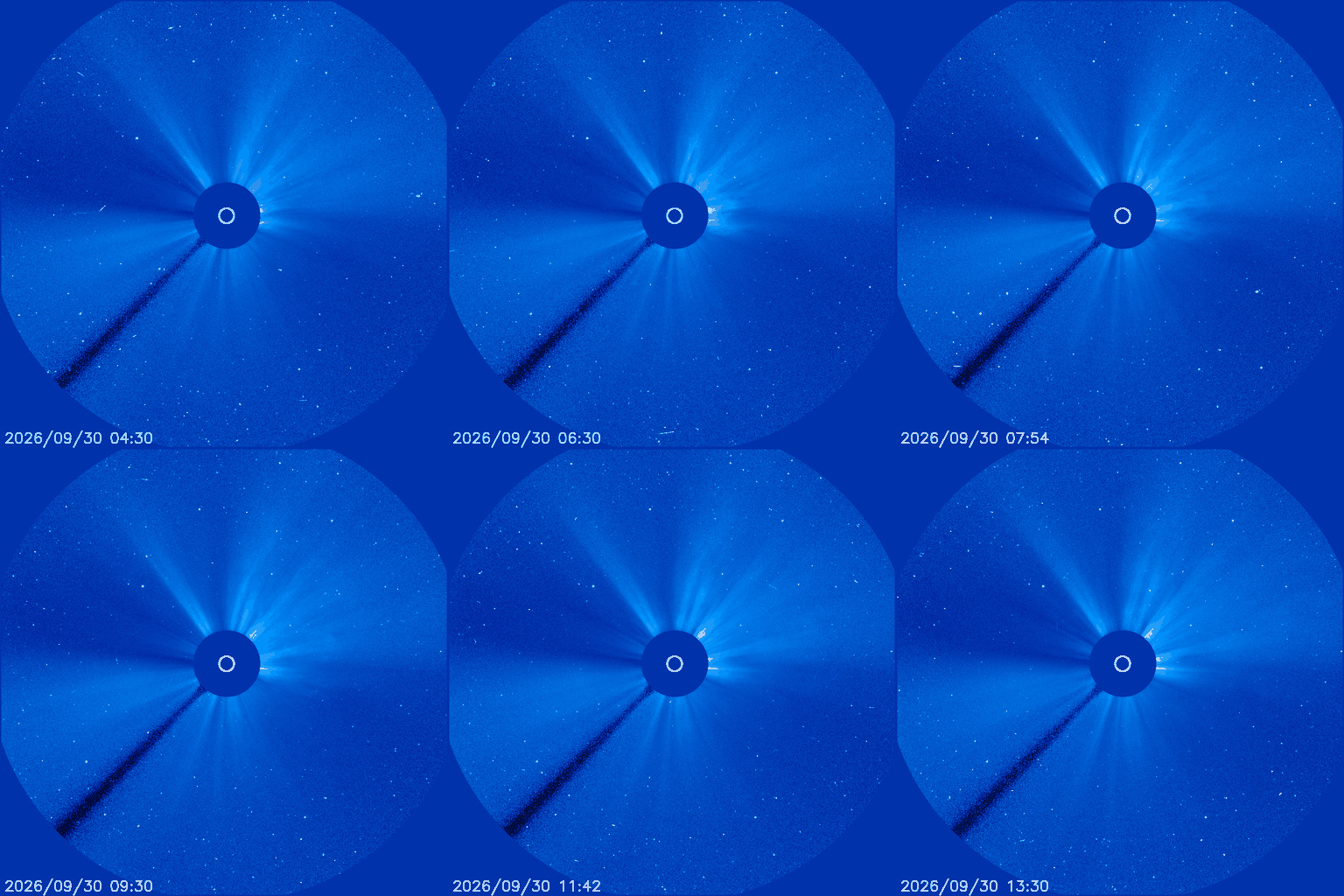
GEOMAGNETIC STORM WATCH: A G1 geomagnetic storm watch is in effect as two CMEs approach Earth. The first CME is expected to graze Earth on Oct. 2nd, while the second CME follows with a near-miss on Oct. 4th. High-latitude auroras are possible on both dates. CME Impact Alerts: SMS Text
SPACE WEATHER STOPPED AN ENGLISH TRAIN: Research into the origins of space weather has led scholars to a strange place: An express train in England. Date: Oct. 18, 1848.
A new paper published in the peer-reviewed journal Space Weather examines a curious 16-minute delay almost 180 years ago. At the Exeter platform in the county of Devon, passengers sat motionless from 10:05 pm to 10:21 pm because signalers couldn't confirm that the track ahead was clear.

A sunspot was to blame. Just as the train was scheduled to leave the station, a geomagnetic storm interfered with the telegraph system. Electric currents surged through the wires, and the needles signalers used to check the line swung wildly.
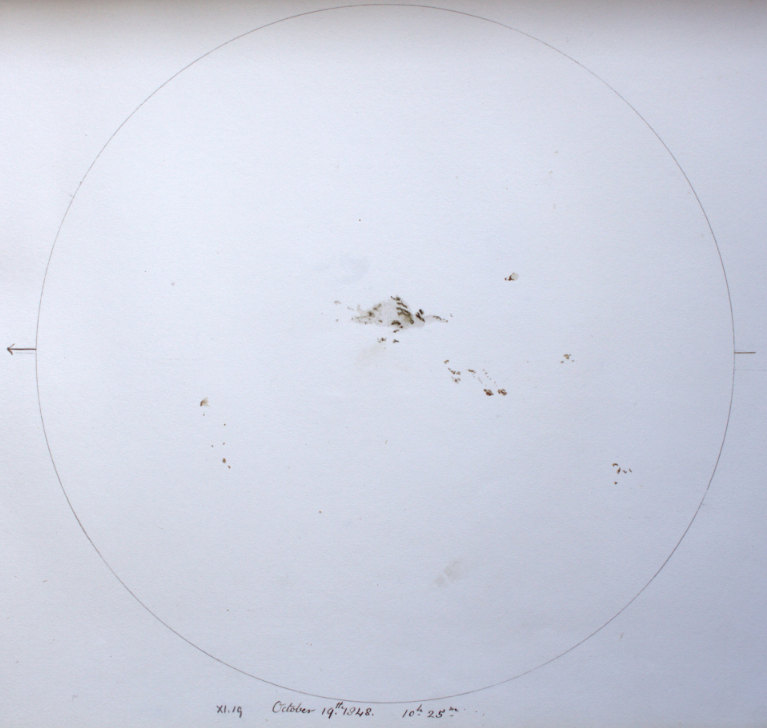
The next morning, British clergyman Temple Chevallier sketched a huge sunspot group facing Earth. A month later, when the same sunspot group came around again, auroras lit up the skies of Italy. On Nov. 17, 1848, telegraph instruments between Florence and Pisa jammed just as they had done in Exeter.
All of this took place 11 years before the Carrington Event--a September 1859 solar super-storm sometimes called "the birth of space weather." Solar flares were discovered during the Carrington Event when Richard Carrington saw the bloom of a flare on his solar projection screen.
Before you memorize 1848, however, consider the previous year. On March 19, 1847, railway engineer William Barlow noticed something strange on the Midland Railway near Derby, England. "A brilliant aurora was seen," he reported to the Royal Society, "and during the whole time, strong alternating deflections occurred on all [our telegraph] instruments."
The authors of the new paper believe that is the first documented case of the sun interfering with human tech. The "Barlow Event," anyone?
Read the full paper here: https://doi.org/10.1029/2026SW005239
Realtime Space Weather Photo Gallery
Free: Space Weather Newsletter
THE EASTER ISLAND CHRISTMAS ORNAMENT: You can't buy this on Amazon. Only the Earth to Sky Store has the Easter Island Christmas Ornament from space. Here it is floating at the top of Earth's atmosphere on July 16, 2026:
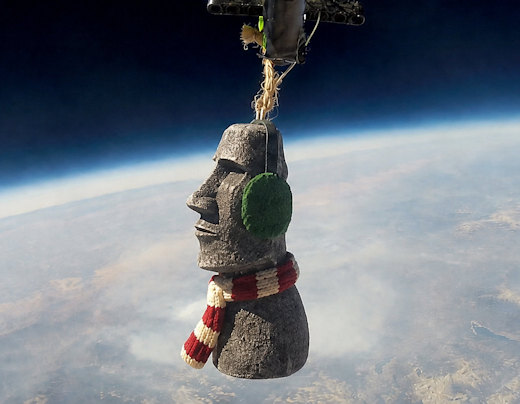
You can have it for $98.95. Modeled after the iconic stone heads of Easter Island, known as Moai, this ornament adds an element of mystery to any Christmas Tree. For 3 hours, it floated through the stratosphere onboard a cosmic ray research balloon, then parachuted back to Earth, landing near Telescope Peak in Death Valley National Park.
The ornament comes with a full-color gift card showing the Moai in flight. The interior of the card tells the story of its journey to the edge of space and back again.
Far Out Gifts: Earth to Sky Store
All sales support hands-on STEM education
Realtime Aurora Photo Gallery
Free: Spaceweather.com Newsletter
Every night, a network
of
NASA
all-sky cameras scans the skies above the United
States for meteoritic fireballs. Automated software
maintained by NASA's Meteoroid Environment Office
calculates their orbits, velocity, penetration depth
in Earth's atmosphere and many other characteristics.
Daily results are presented here on Spaceweather.com.
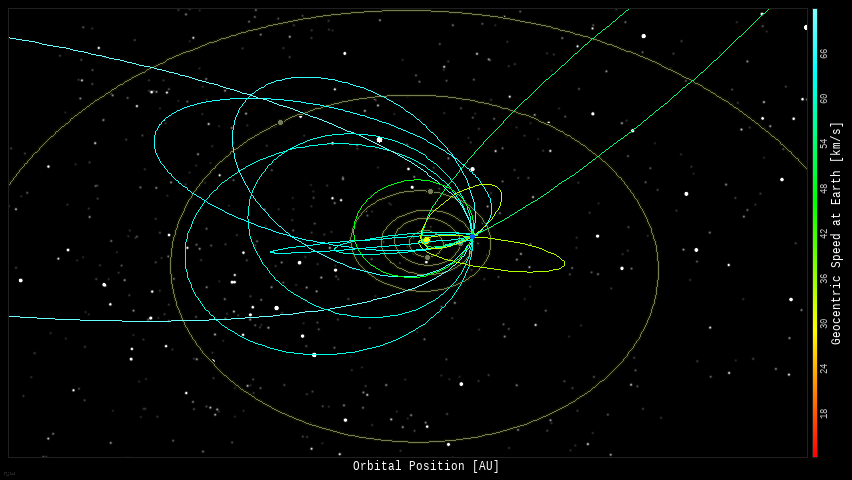
On October 2, 2026, the network reported 12 fireballs.
(11 sporadics, 1 Daytime Sextantid)
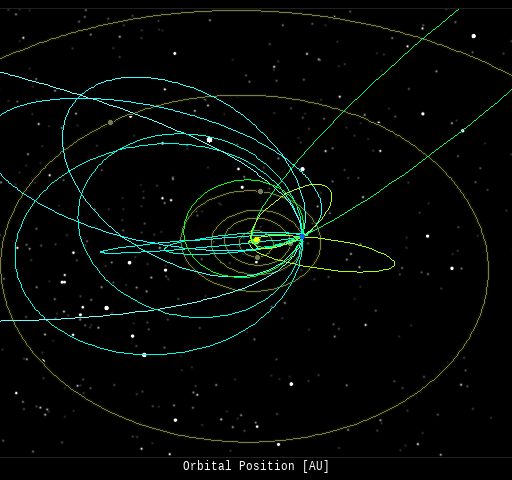
In this diagram of the inner solar system, all of the fireball orbits intersect at a single point--Earth. The orbits are color-coded by velocity, from slow (red) to fast (blue).
[Larger image] [movies]
Potentially Hazardous Asteroids (
PHAs)
are space rocks larger than approximately 100m that
can come closer to Earth than 0.05 AU. None of the
known PHAs is on a collision course with our planet,
although astronomers are finding
new
ones all the time.
On October 2, 2026 there were 2349 potentially hazardous asteroids.
 |
Recent
& Upcoming Earth-asteroid encounters:
| Asteroid |
Date(UT) |
Miss Distance |
Velocity (km/s) |
Diameter (m) |
| 2026 RN15 |
2026-Sep-27 |
8.4 LD |
6.5 |
21 |
| 2026 SC13 |
2026-Sep-28 |
7.7 LD |
12.4 |
112 |
| 2026 SA8 |
2026-Sep-28 |
1 LD |
6.6 |
7 |
| 2026 SL7 |
2026-Sep-28 |
17.7 LD |
26.9 |
47 |
| 2026 SX2 |
2026-Sep-28 |
4.1 LD |
7.7 |
13 |
| 2026 SB12 |
2026-Sep-30 |
10.1 LD |
10.3 |
28 |
| 2026 RS |
2026-Sep-30 |
11.2 LD |
6 |
25 |
| 2026 SG12 |
2026-Sep-30 |
14.7 LD |
11.7 |
55 |
| 2026 RX38 |
2026-Sep-30 |
10 LD |
14.3 |
33 |
| 2018 SP2 |
2026-Sep-30 |
5 LD |
14.3 |
39 |
| 2026 TE |
2026-Oct-01 |
4.9 LD |
8 |
16 |
| 2026 TD |
2026-Oct-02 |
1.7 LD |
11.3 |
14 |
| 2019 AS2 |
2026-Oct-02 |
4.5 LD |
7.3 |
49 |
| 2026 RP39 |
2026-Oct-03 |
6.1 LD |
6.1 |
20 |
| 2026 TA |
2026-Oct-03 |
2.3 LD |
19 |
20 |
| 2024 SH7 |
2026-Oct-04 |
10.5 LD |
10.8 |
12 |
| 2026 TF |
2026-Oct-04 |
5.2 LD |
9.1 |
19 |
| 2026 SA17 |
2026-Oct-05 |
10.1 LD |
11.3 |
20 |
| 2024 TD16 |
2026-Oct-07 |
14.2 LD |
11.8 |
17 |
| 2015 TS238 |
2026-Oct-08 |
4.7 LD |
15.8 |
30 |
| 2019 SD8 |
2026-Oct-10 |
18.7 LD |
9.5 |
12 |
| 2022 UP6 |
2026-Oct-15 |
2.6 LD |
9 |
8 |
| 2000 SZ162 |
2026-Oct-16 |
19.9 LD |
5.7 |
12 |
| 2020 FN3 |
2026-Oct-20 |
12.4 LD |
5.8 |
45 |
| 2017 UX7 |
2026-Oct-22 |
17 LD |
10.3 |
27 |
| 2018 GS1 |
2026-Oct-28 |
11.1 LD |
9.3 |
108 |
| 2022 UV21 |
2026-Oct-29 |
14.8 LD |
9.6 |
13 |
| 2025 UK9 |
2026-Oct-31 |
0.8 LD |
7.8 |
4 |
| 524522 |
2026-Nov-02 |
15.7 LD |
8.7 |
277 |
| 2021 VC4 |
2026-Nov-03 |
6 LD |
11.2 |
15 |
| 2017 WJ2 |
2026-Nov-05 |
15.6 LD |
11.8 |
118 |
| 2016 VZ1 |
2026-Nov-05 |
20 LD |
13.5 |
21 |
| 2001 KF54 |
2026-Nov-06 |
18.9 LD |
16.4 |
391 |
| 2025 UF5 |
2026-Nov-09 |
18.9 LD |
1.9 |
10 |
| 2015 VH65 |
2026-Nov-10 |
9.7 LD |
8 |
10 |
| 2012 YD7 |
2026-Nov-10 |
18.6 LD |
7.5 |
49 |
| 2023 VF3 |
2026-Nov-11 |
8.5 LD |
8.8 |
19 |
| 2022 MP2 |
2026-Nov-13 |
19.8 LD |
3.8 |
23 |
| 2025 VG5 |
2026-Nov-13 |
18.2 LD |
4.9 |
16 |
| 2023 VE6 |
2026-Nov-17 |
18.4 LD |
10.1 |
13 |
| 2019 WT1 |
2026-Nov-18 |
19.7 LD |
9.7 |
16 |
| 2018 NE1 |
2026-Nov-19 |
16.7 LD |
13.3 |
74 |
| 2025 CP1 |
2026-Nov-30 |
12.9 LD |
10.8 |
6 |
Notes: LD means
"Lunar Distance." 1 LD = 384,401 km, the distance
between Earth and the Moon. 1 LD also equals 0.00256
AU.
| |
Cosmic Rays in the Atmosphere |
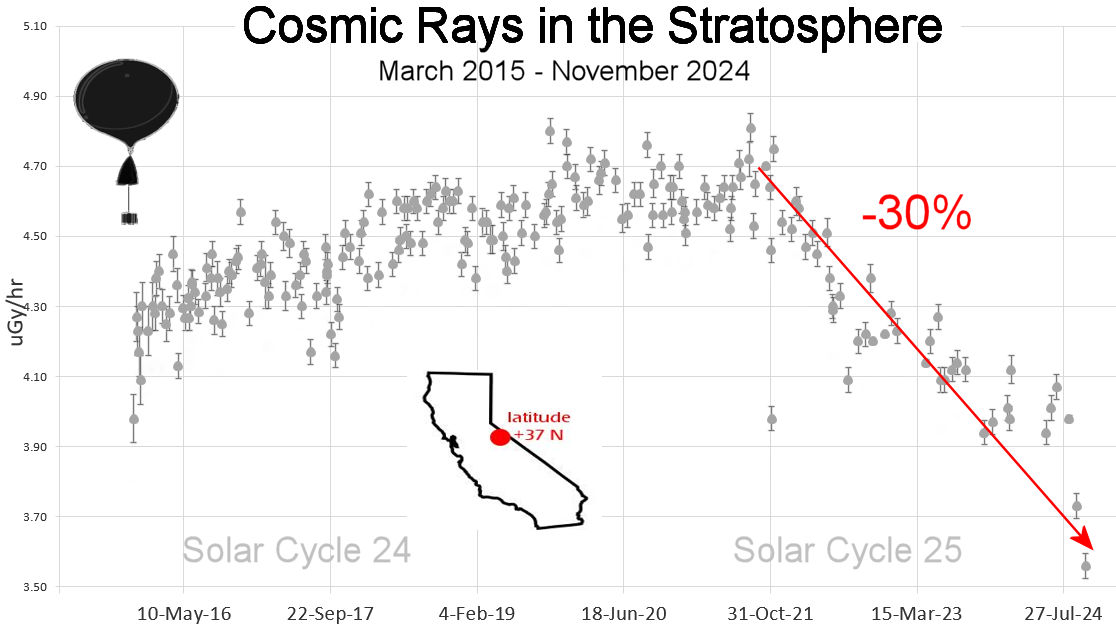
SPACE WEATHER BALLOON DATA: Almost once a week, Spaceweather.com and the students of Earth to Sky Calculus fly space weather balloons to the stratosphere over California. These balloons are equipped with sensors that detect secondary cosmic rays, a form of radiation from space that can penetrate all the way down to Earth's surface. Our monitoring program has been underway without interruption for 10 years, resulting in a unique dataset of in situ atmospheric measurements.
Latest results (Nov. 2024): Atmospheric radiation is sharply decreasing in 2024. Our latest measurements in November registered a 10-year low:
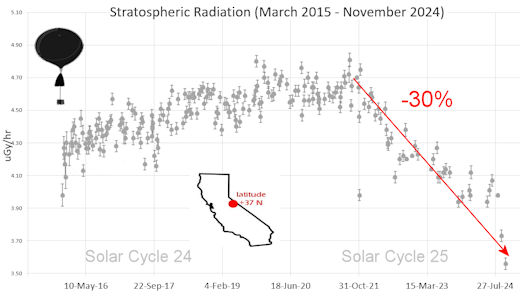
What's going on? Ironically, the radiation drop is caused by increasing solar activity. Solar Cycle 25 has roared to life faster than forecasters expected. The sun's strengthening and increasingly tangled magnetic field repels cosmic rays from deep space. In addition, solar coronal mass ejections (CMEs) sweep aside cosmic rays, causing sharp reductions called "Forbush Decreases." The two effects blend together to bring daily radiation levels down.
.Who cares? Cosmic rays are a surprisingly "down to Earth" form of space weather. They can alter the chemistry of the atmosphere, trigger lightning, and penetrate commercial airplanes. According to a study from the Harvard T.H. Chan school of public health, crews of aircraft have higher rates of cancer than the general population. The researchers listed cosmic rays, irregular sleep habits, and chemical contaminants as leading risk factors. A number of controversial studies (#1, #2, #3, #4) go even further, linking cosmic rays with cardiac arrhythmias and sudden cardiac death.
Technical notes: The radiation sensors onboard our helium balloons detect X-rays and gamma-rays in the energy range 10 keV to 20 MeV. These energies span the range of medical X-ray machines and airport security scanners.
Data points in the graph labeled "Stratospheric Radiation" correspond to the peak of the Regener-Pfotzer maximum, which lies about 67,000 feet above central California. When cosmic rays crash into Earth's atmosphere, they produce a spray of secondary particles that is most intense at the entrance to the stratosphere. Physicists Eric Regener and Georg Pfotzer discovered the maximum using balloons in the 1930s and it is what we are measuring today.
| |
The
official U.S. government space weather bureau |
| |
The
first place to look for information about sundogs,
pillars, rainbows and related phenomena. |
| |
Researchers
call it a "Hubble for the sun." SDO
is the most advanced solar observatory ever. |
| |
3D
views of the sun from NASA's Solar and Terrestrial
Relations Observatory |
| |
Realtime
and archival images of the Sun from SOHO. |
| |
information about sunspots based on the latest NOAA/USAF Active Region Summary |
| |
current counts of failed and deployed Starlink satellites from Jonathan's Space Page. See also, all satellite statistics. |
| |
Authoritative predictions of space junk and satellite re-entries |
| |
from
the NOAA Space Environment Center |
| |
fun to read, but should be taken with a grain of salt! Forecasts looking ahead more than a few days are often wrong. |
| |
from the NOAA Space Environment Center |
| |
the
underlying science of space weather |
 |
Got a chipped or cracked windshield that prevents you from seeing space weather events while driving? Get windshield replacement from SR Windows & Glass with free mobile auto glass service anywhere in the Phoenix area. |
| |
These links help Spaceweather.com stay online. Thank you to our supporters! |
|
|
| |
|
|
|