AI writing is everywhere -- except here. This website is written by Dr. Tony Phillips, a carbon-based lifeform with 30 yrs of forecasting experience. Our guarantee: If you find a mistake, it was made by a real human being. | | |
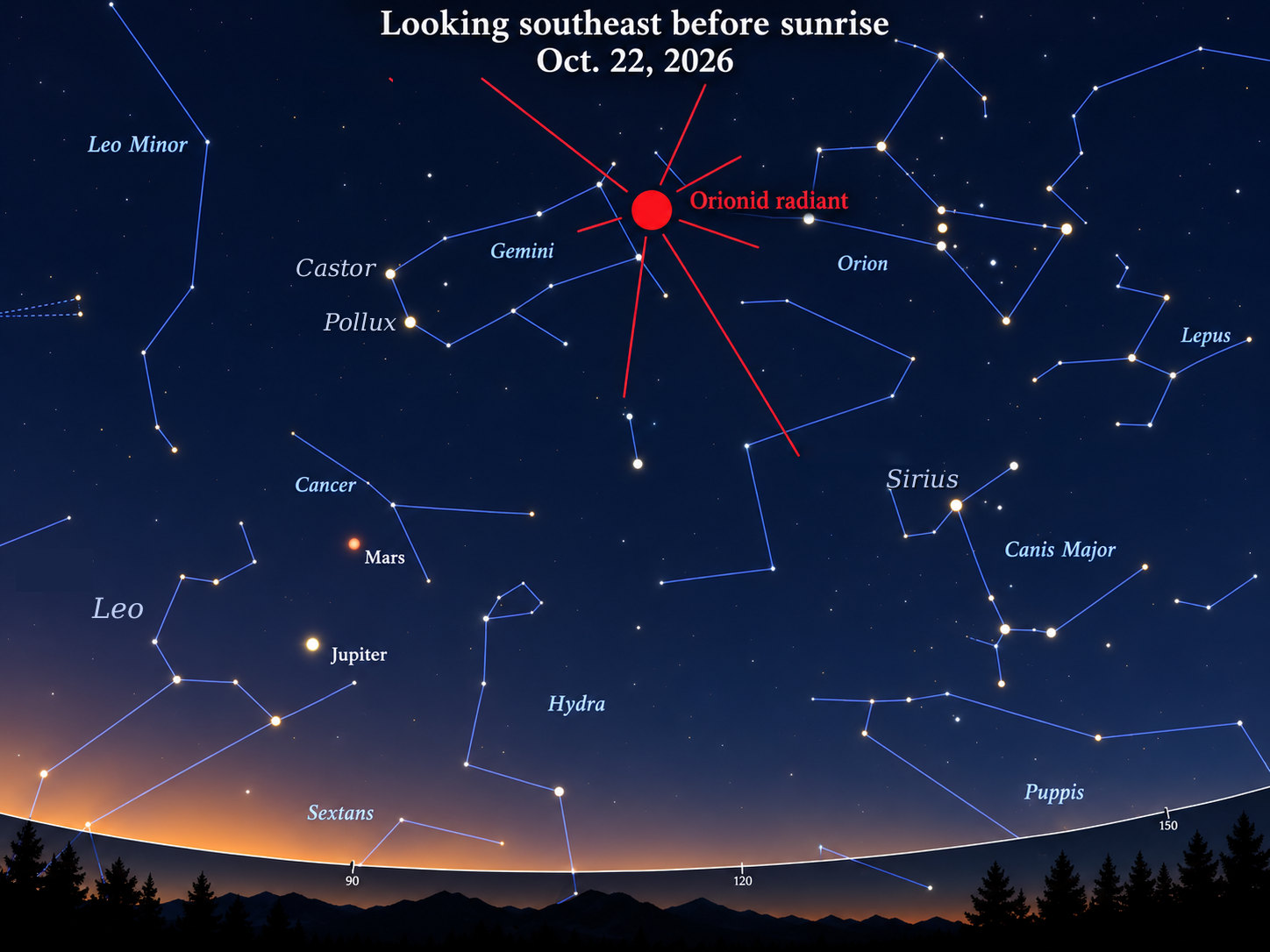
ORIONID UPDATE: Last night, NASA's all sky fireball network detected only 7 Orionid meteors--little more than half the background rate of random meteors. This suggests one of two possibilities: #1, either the 2026 Orionids are unusually weak or #2, the peak hasn't happened yet. If you wake up early on Friday, Oct. 23th, check the predawn sky in case the answer is #2. [sky map] [meteor alerts]
SPACE WARFARE VISIBLE IN BACKYARD TELESCOPES: On Monday, we asked the question "Can you see space warfare in your own eyepiece?" On Tuesday, we learned the answer: "Yes." Using 14-inch optics, a Swiss company named "s2a systems" has successfully recorded a military encounter in low-Earth orbit.
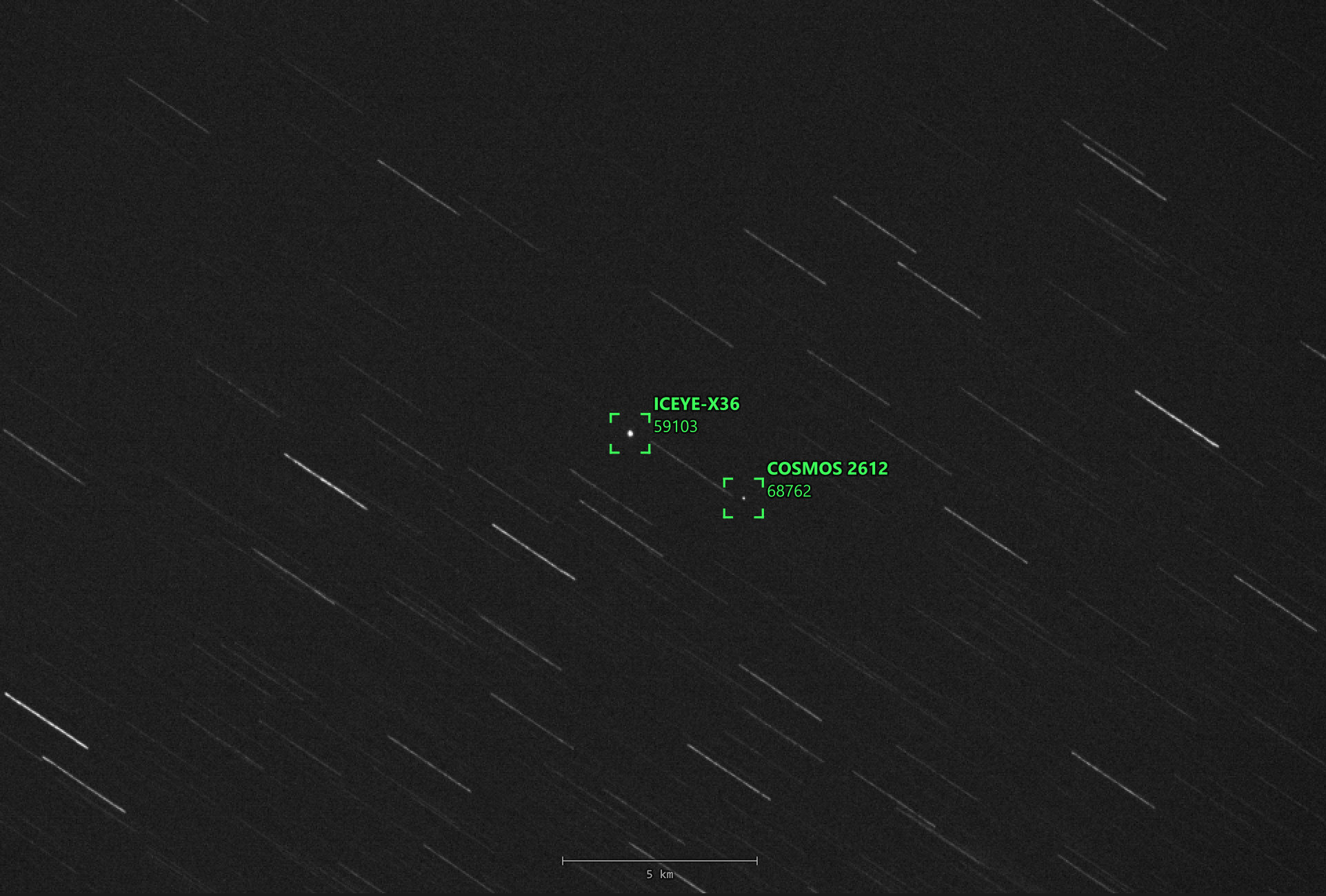
This Oct 18th movie shows Russia's Cosmos 2612 just after it flew extremely close to ICEYE-X36, a surveillance satellite supplying images to Ukraine:
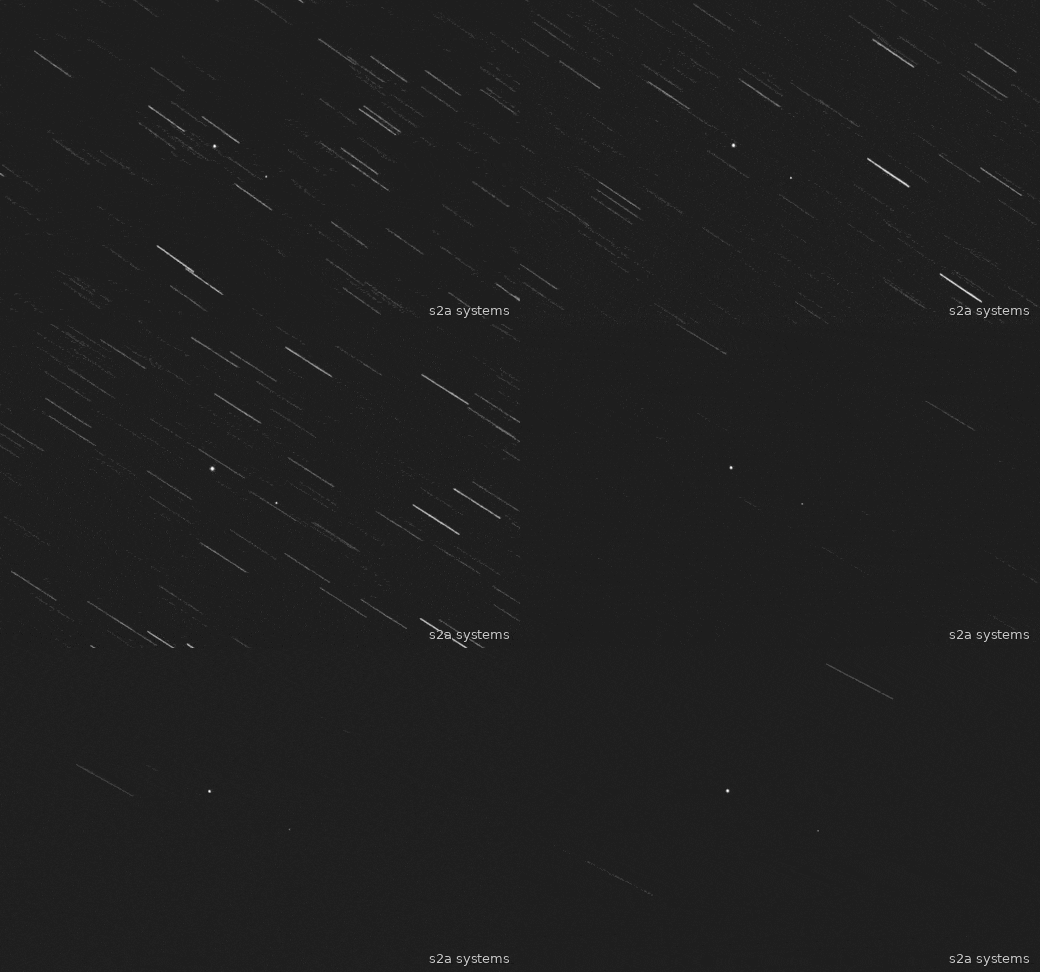
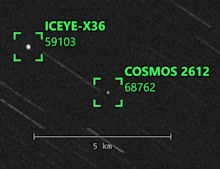
ICEYE-X36 is the brighter of the two dots. It belongs to a Finnish-American company, and uses synthetic aperture radar to form intelligence-grade images of the Earth below. Cosmos 2612 is the dimmer object. We know only that it is a Russian military satellite. Its mission has never been announced and its specs have never been published.
On Oct. 18th, Cosmos 2612 approached ICEYE-X36 within a few hundred meters. s2a systems caught them a few hours later when the distance had increased to 4.9 km.
Satellite analyst Jonathan McDowell, recently retired from Harvard, said: “To my knowledge, this is the first LEO (low Earth orbit) rendezvous of two active satellites."
 Only Russia knows what Cosmos 2612 was doing. It may have been a harmless inspection--or a dry run for something else. In 2020, another Russian satellite, Cosmos 2543, released a high-speed object that looked a lot like an anti-satellite weapon.
"[The two satellites] are currently 480 km apart, but Cosmos 2612 is still maneuvering," reports Marco Langbroek, Lecturer in optical Space Situational Awareness at Delft University of Technology. "This might suggest it is not done with ICEYE-X36 yet."
Amateur astronomers can monitor developments. ICEYE-X36 shines like a 7th-magnitude star, while its Russian stalker is ~4 magnitudes dimmer. Right now, the two satellites are making a series of pre-dawn passes over South America, Australia and New Zealand. If you see them, submit your images here.
Realtime Space Weather Photo Gallery
Free: Space Weather Newsletter
WORLD SERIES SPACE BASEBALL: The Milwaukee Brewers are in the World series. Here's a great gift for a fan: The Brewers World Series Space Baseball. It flew to the edge of space on Oct. 16, 2026, the day after they swept the L.A. Dodgers:
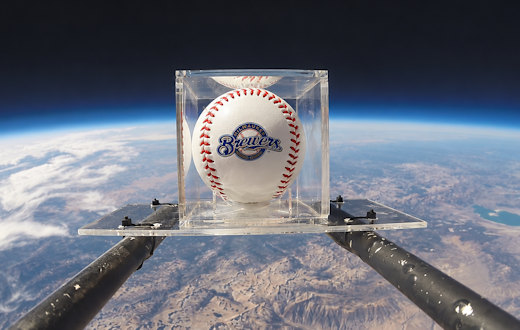
You can have it for $109.95. Launched onboard a cosmic ray research balloon, it flew 115,344 feet high--a real home run. It comes in the same acrylic cube that protected it during three hours at the top of Earth's atmosphere. You will also receive a greeting card showing the baseball in flight.
The students of Earth to Sky Calculus are selling space baseballs to pay the helium bill for their cosmic ray ballooning program. And don't worry -- Tampa's baseball is coming soon!
Far Out Gifts: Earth to Sky Store
All sales support hands-on STEM education
Realtime Aurora Photo Gallery
Free: Spaceweather.com Newsletter
Every night, a network of
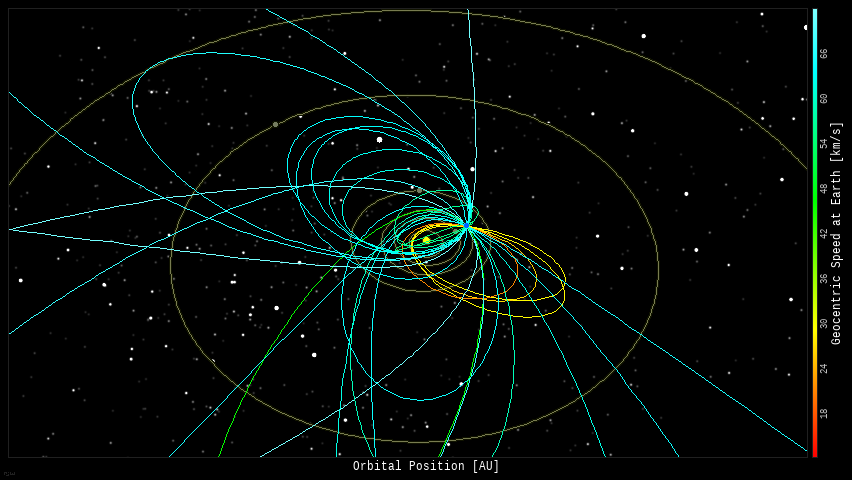
NASA all-sky cameras scans the skies above the United States for meteoritic fireballs. Automated software maintained by NASA's Meteoroid Environment Office calculates their orbits, velocity, penetration depth in Earth's atmosphere and many other characteristics. Daily results are presented here on Spaceweather.com.
On October 22, 2026, the network reported 25 fireballs.
(12 sporadics, 7 Orionids, 3 Southern Taurids, 2 Leonis Minorids, 1 epsilon Geminids)
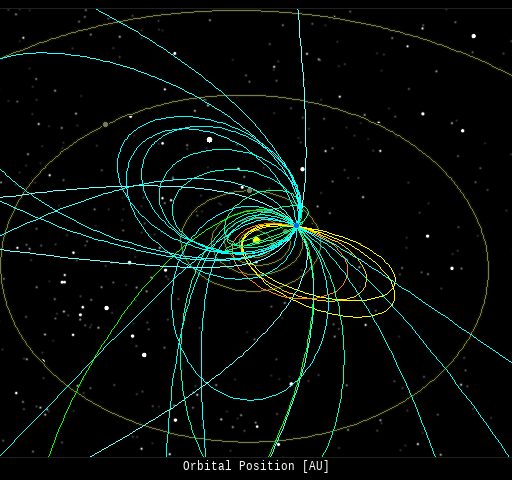
In this diagram of the inner solar system, all of the fireball orbits intersect at a single point--Earth. The orbits are color-coded by velocity, from slow (red) to fast (blue). [Larger image] [movies]
Potentially Hazardous Asteroids (
PHAs) are space rocks larger than approximately 100m that can come closer to Earth than 0.05 AU. None of the known PHAs is on a collision course with our planet, although astronomers are finding
new ones all the time.
On October 22, 2026 there were 2349 potentially hazardous asteroids.
 |
Recent & Upcoming Earth-asteroid encounters: | Asteroid | Date(UT) | Miss Distance | Velocity (km/s) | Diameter (m) |
| 2026 UP | 2026-Oct-17 | 0.6 LD | 9.5 | 5 |
| 2026 UE1 | 2026-Oct-17 | 4.6 LD | 12.3 | 12 |
| 2026 TC94 | 2026-Oct-18 | 6.6 LD | 10.5 | 15 |
| 2026 UL | 2026-Oct-18 | 1.8 LD | 12.9 | 39 |
| 2026 TS | 2026-Oct-18 | 2.4 LD | 10.3 | 55 |
| 2026 UF | 2026-Oct-18 | 6.8 LD | 7.6 | 35 |
| 2026 UO | 2026-Oct-18 | 3.7 LD | 9.6 | 20 |
| 2026 UN | 2026-Oct-18 | 5 LD | 10.9 | 36 |
| 2026 TN67 | 2026-Oct-18 | 16.6 LD | 6.9 | 28 |
| 2026 UK | 2026-Oct-19 | 7.6 LD | 15.1 | 33 |
| 2026 UQ | 2026-Oct-19 | 5.6 LD | 5.4 | 10 |
| 2026 TD2 | 2026-Oct-20 | 7.3 LD | 12.3 | 43 |
| 2026 TP | 2026-Oct-20 | 12.1 LD | 9.9 | 51 |
| 2020 FN3 | 2026-Oct-20 | 12.4 LD | 5.8 | 45 |
| 2026 TM67 | 2026-Oct-20 | 11.7 LD | 14.3 | 55 |
| 2026 TV8 | 2026-Oct-21 | 4.8 LD | 9.2 | 25 |
| 2026 TU1 | 2026-Oct-22 | 12.9 LD | 7.9 | 25 |
| 2026 TX84 | 2026-Oct-22 | 10.6 LD | 7.4 | 23 |
| 2026 TK77 | 2026-Oct-22 | 9.7 LD | 6.2 | 15 |
| 2017 UX7 | 2026-Oct-22 | 17 LD | 10.3 | 27 |
| 2026 TV86 | 2026-Oct-23 | 5.6 LD | 5.7 | 18 |
| 2026 TR35 | 2026-Oct-23 | 15 LD | 20.9 | 55 |
| 2026 UA1 | 2026-Oct-23 | 0.6 LD | 9.5 | 9 |
| 2026 TT3 | 2026-Oct-24 | 12.8 LD | 12.8 | 47 |
| 2026 UE | 2026-Oct-25 | 5.2 LD | 15.9 | 25 |
| 2026 TB8 | 2026-Oct-25 | 7.1 LD | 7.8 | 60 |
| 2026 SQ31 | 2026-Oct-25 | 6.1 LD | 7.8 | 63 |
| 2026 TB94 | 2026-Oct-27 | 5.1 LD | 11.6 | 27 |
| 2018 GS1 | 2026-Oct-28 | 11.1 LD | 9.3 | 108 |
| 2026 UB1 | 2026-Oct-28 | 9.6 LD | 18.8 | 41 |
| 2022 UV21 | 2026-Oct-29 | 14.8 LD | 9.6 | 13 |
| 2026 UD | 2026-Oct-30 | 11.7 LD | 7.7 | 26 |
| 2025 UK9 | 2026-Oct-31 | 0.8 LD | 7.8 | 4 |
| 524522 | 2026-Nov-02 | 15.7 LD | 8.7 | 277 |
| 2021 VC4 | 2026-Nov-03 | 6 LD | 11.2 | 15 |
| 2017 WJ2 | 2026-Nov-05 | 15.6 LD | 11.8 | 118 |
| 2016 VZ1 | 2026-Nov-05 | 20 LD | 13.5 | 21 |
| 2001 KF54 | 2026-Nov-06 | 18.9 LD | 16.4 | 391 |
| 2026 UX | 2026-Nov-07 | 19.8 LD | 9.7 | 33 |
| 2025 UF5 | 2026-Nov-09 | 18.9 LD | 1.9 | 10 |
| 2015 VH65 | 2026-Nov-10 | 9.7 LD | 8 | 10 |
| 2012 YD7 | 2026-Nov-10 | 18.6 LD | 7.5 | 49 |
| 2023 VF3 | 2026-Nov-11 | 8.5 LD | 8.8 | 19 |
| 2022 MP2 | 2026-Nov-13 | 19.8 LD | 3.8 | 23 |
| 2025 VG5 | 2026-Nov-13 | 18.2 LD | 4.9 | 16 |
| 2026 UY | 2026-Nov-14 | 19.6 LD | 4.3 | 67 |
| 2023 VE6 | 2026-Nov-17 | 18.4 LD | 10.1 | 13 |
| 2019 WT1 | 2026-Nov-18 | 19.7 LD | 9.7 | 16 |
| 2018 NE1 | 2026-Nov-19 | 16.7 LD | 13.3 | 74 |
| 2026 TB84 | 2026-Nov-19 | 12.1 LD | 9.9 | 68 |
| 2025 CP1 | 2026-Nov-30 | 12.9 LD | 10.8 | 6 |
| 2019 XF2 | 2026-Dec-04 | 3.1 LD | 10.2 | 14 |
| 2023 XH3 | 2026-Dec-06 | 18.7 LD | 16.5 | 14 |
| 2020 XC3 | 2026-Dec-08 | 14.5 LD | 14.3 | 110 |
| 2016 NV | 2026-Dec-08 | 14.3 LD | 10.4 | 379 |
| 2010 VQ | 2026-Dec-12 | 4.6 LD | 4.3 | 10 |
| 2025 XN6 | 2026-Dec-12 | 6.9 LD | 12.2 | 5 |
| 2026 LZ1 | 2026-Dec-14 | 14.4 LD | 11.2 | 36 |
| 2025 YN | 2026-Dec-18 | 18.3 LD | 13.1 | 21 |
| 2018 FQ4 | 2026-Dec-19 | 16.7 LD | 10.4 | 14 |
Notes: LD means "Lunar Distance." 1 LD = 384,401 km, the distance between Earth and the Moon. 1 LD also equals 0.00256 AU. | | Cosmic Rays in the Atmosphere |
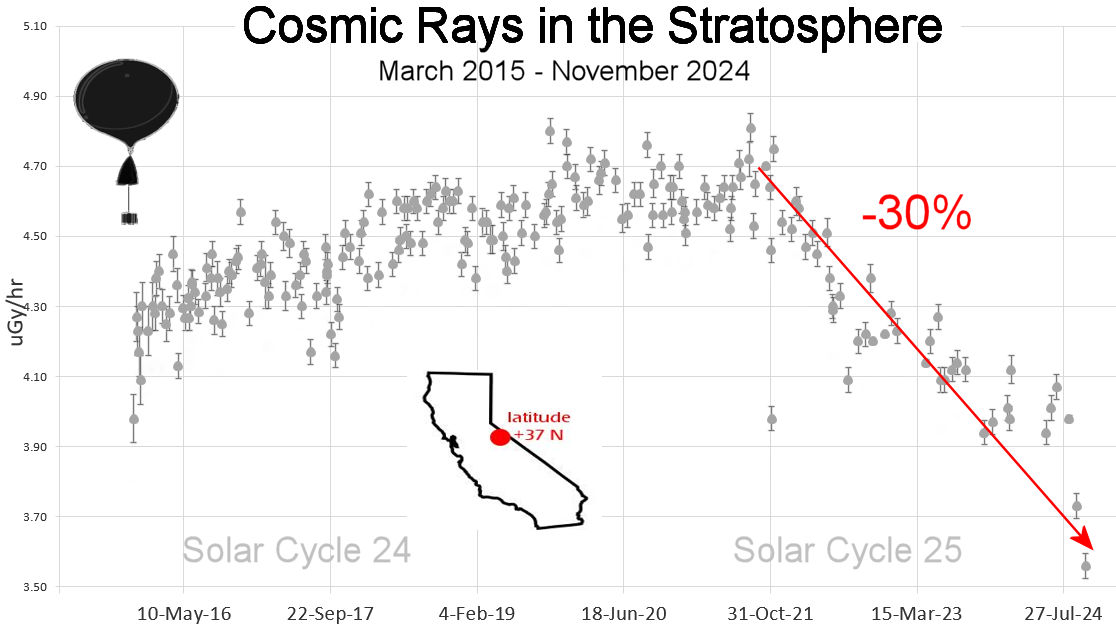
SPACE WEATHER BALLOON DATA: Almost once a week, Spaceweather.com and the students of Earth to Sky Calculus fly space weather balloons to the stratosphere over California. These balloons are equipped with sensors that detect secondary cosmic rays, a form of radiation from space that can penetrate all the way down to Earth's surface. Our monitoring program has been underway without interruption for 10 years, resulting in a unique dataset of in situ atmospheric measurements.
Latest results (Nov. 2024): Atmospheric radiation is sharply decreasing in 2024. Our latest measurements in November registered a 10-year low:
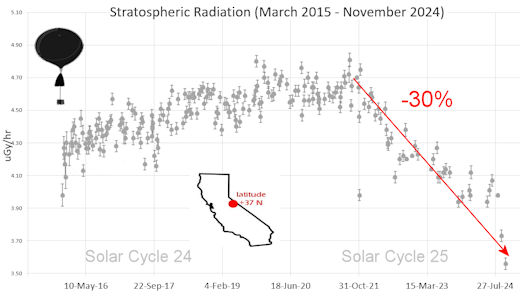
What's going on? Ironically, the radiation drop is caused by increasing solar activity. Solar Cycle 25 has roared to life faster than forecasters expected. The sun's strengthening and increasingly tangled magnetic field repels cosmic rays from deep space. In addition, solar coronal mass ejections (CMEs) sweep aside cosmic rays, causing sharp reductions called "Forbush Decreases." The two effects blend together to bring daily radiation levels down.
.Who cares? Cosmic rays are a surprisingly "down to Earth" form of space weather. They can alter the chemistry of the atmosphere, trigger lightning, and penetrate commercial airplanes. According to a study from the Harvard T.H. Chan school of public health, crews of aircraft have higher rates of cancer than the general population. The researchers listed cosmic rays, irregular sleep habits, and chemical contaminants as leading risk factors. A number of controversial studies (#1, #2, #3, #4) go even further, linking cosmic rays with cardiac arrhythmias and sudden cardiac death.
Technical notes: The radiation sensors onboard our helium balloons detect X-rays and gamma-rays in the energy range 10 keV to 20 MeV. These energies span the range of medical X-ray machines and airport security scanners.
Data points in the graph labeled "Stratospheric Radiation" correspond to the peak of the Regener-Pfotzer maximum, which lies about 67,000 feet above central California. When cosmic rays crash into Earth's atmosphere, they produce a spray of secondary particles that is most intense at the entrance to the stratosphere. Physicists Eric Regener and Georg Pfotzer discovered the maximum using balloons in the 1930s and it is what we are measuring today.
| | The official U.S. government space weather bureau |
| | The first place to look for information about sundogs, pillars, rainbows and related phenomena. |
| | Researchers call it a "Hubble for the sun." SDO is the most advanced solar observatory ever. |
| | 3D views of the sun from NASA's Solar and Terrestrial Relations Observatory |
| | Realtime and archival images of the Sun from SOHO. |
| | information about sunspots based on the latest NOAA/USAF Active Region Summary |
| | current counts of failed and deployed Starlink satellites from Jonathan's Space Page. See also, all satellite statistics. |
| | Authoritative predictions of space junk and satellite re-entries |
| | from the NOAA Space Environment Center |
| | fun to read, but should be taken with a grain of salt! Forecasts looking ahead more than a few days are often wrong. |
| | from the NOAA Space Environment Center |
| | the underlying science of space weather |
 | Got a chipped or cracked windshield that prevents you from seeing space weather events while driving? Get windshield replacement from SR Windows & Glass with free mobile auto glass service anywhere in the Phoenix area. |
| | These links help Spaceweather.com stay online. Thank you to our supporters! |
| | | | | | |