SpaceWeather.com
Sunday, Sep. 27, 2026
Original Site
STARSHIP 14 WILL ORBIT EARTH: SpaceX's most powerful rocket is about to orbit Earth for the first time. Starship Flight 14 is scheduled to blast off from Texas on Monday morning, Sept. 28th, at 7:15 CDT. If all goes as planned, the upper stage will circle Earth six times at an altitude near 275 km during a 10-hour flight, then splash down in the Pacific Ocean west of Chile. The live webcast begins 30 minutes before liftoff.
SATURN IS EXPERIENCING THE OPPOSITION EFFECT: On Oct. 4th, Saturn will be at opposition--directly opposite the sun in the sky. Opposition does something marvelous to Saturn's rings. It causes them to brighten dramatically.
The phenomenon is called "The Opposition Effect," and Maximilian-Vlad Teodorescu of Magurele, Romania, caught it in action:
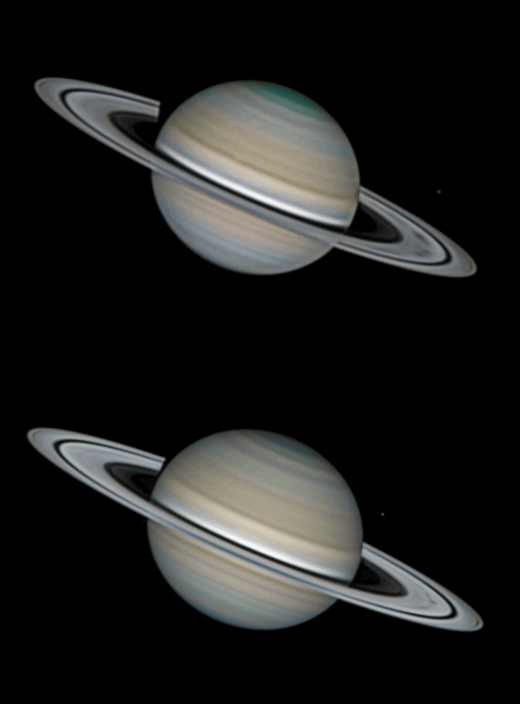
"The animation is made out of two images, one from August 20, the other from September 19," explains Teodorescu. "The rings are clearly brightening ahead of next week's opposition."
Saturn's rings are made of countless chunks of ice, each casting a shadow on its neighbors. When the sun, Earth, and Saturn line up at opposition, every ice chunk hides its own shadow. Saturn's cloudy globe doesn't do this because it has no shadows to hide.
The Opposition Effect surges in the final days before opposition. In 2005, the Hubble Space Telescope found that Saturn's rings gained as much brightness in the last few days as they had in the previous few months. Much of that last-minute jump comes from sunlight bouncing straight back off the ice.
So get ready for a beautiful view. At opposition, Saturn rises at sunset and stays up all night long. The rings are an easy target for backyard telescopes.
Realtime Space Weather Photo Gallery
Free: Space Weather Newsletter
THE ALIEN MIND SCULPTURE: The brains of octopuses are so different from ours, they're often called "alien minds." That makes the Alien Mind Sculpture more than a blown-glass paperweight -- it’s a fascinating conversation piece inspired by one of nature’s strangest and smartest creatures. Bonus: It has been to space:
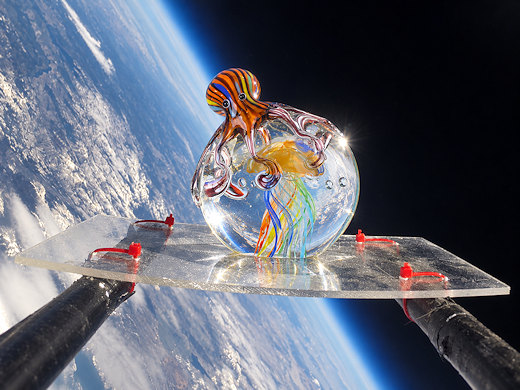
You can have it for $149.95. On July 30, 2026, the students of Earth to Sky Calculus launched this sculpture onboard a cosmic ray research balloon. For 3 hours, it floated more than 105,000 feet above the Sierra Nevada mountains of central California while cosmic ray sensors inside the payload gathered data for our radiation monitoring program.
It comes with a full-color gift card showing the octopus floating at the top of Earth's atmosphere. The interior of the card tells the story of the flight and where it landed.
Far Out Gifts: Earth to Sky Store
All sales support hands-on STEM education
Realtime Aurora Photo Gallery
Free: Spaceweather.com Newsletter
Pick the date, select Top News or Conditions, and hit View.
EXITING THE SOLAR WIND STREAM: Earth is exiting a stream of solar wind that sparked bright auroras on Sept. 24-25. More auroras are possible this weekend, but they might be hard to see through the glow of the Harvest Moon.
THE BEST HARVEST MOON IN FIVE YEARS: There's something special about tonight's full Moon. It's a Harvest Moon--closer to the autumnal equinox than any other full Moon of the past 5 years.
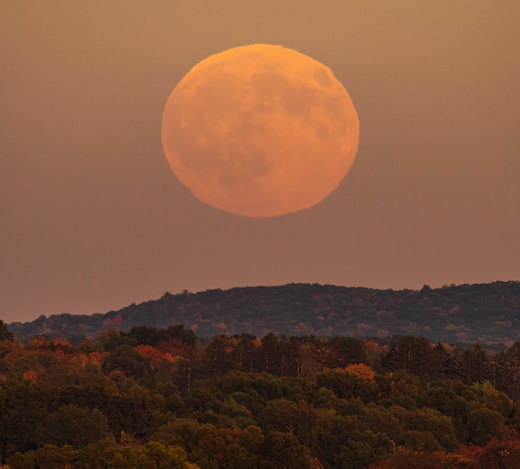
Above: The Harvest Moon of 2025 over Gardiner, NY. Credit: James Perez-Rogers
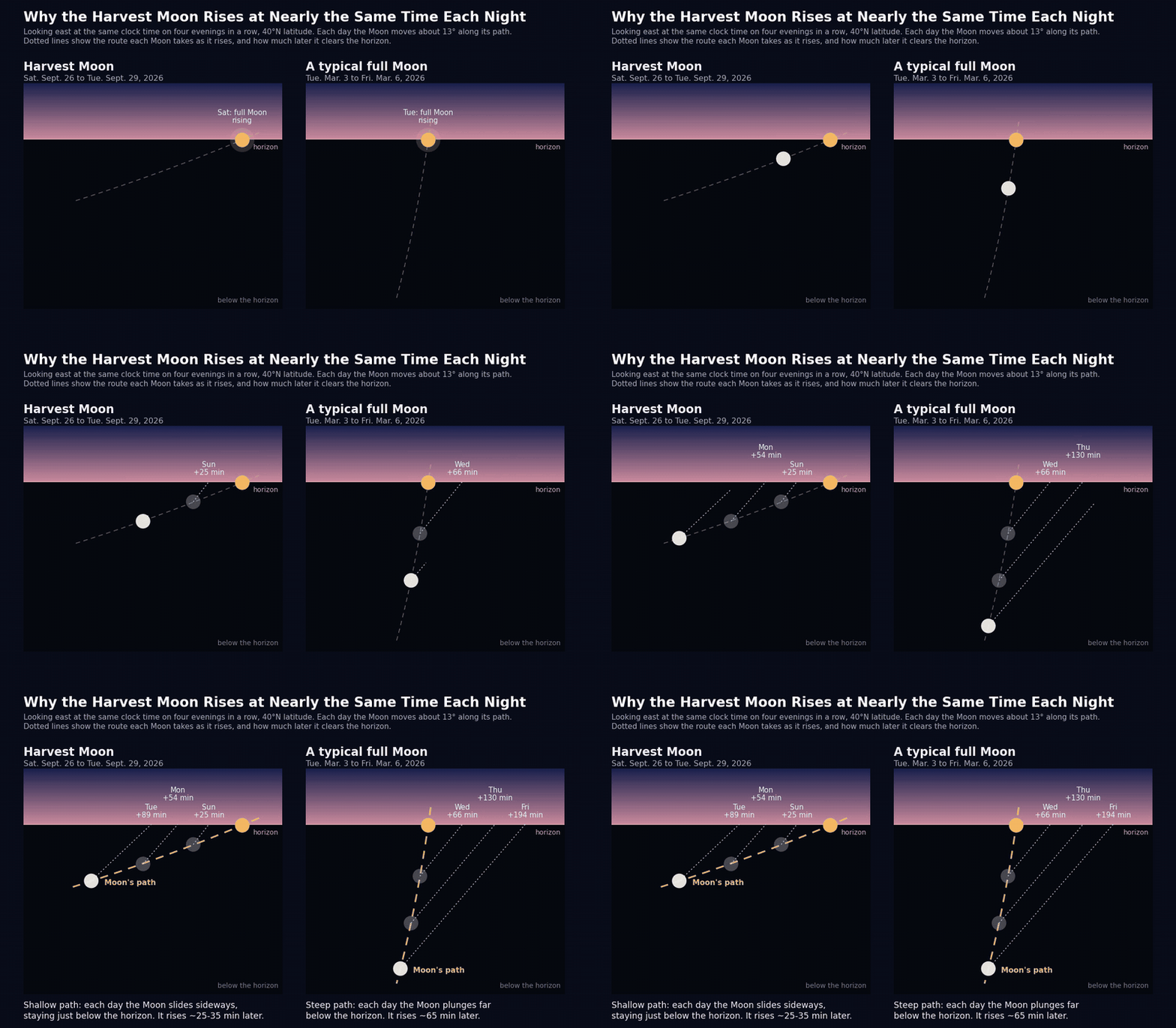
The equinox gives the Harvest Moon a special power: It rises near sunset for several nights in a row. Most full Moons don't do this. Before electric lights, farmers relied on this phenomenon. The bright Moon rising at dusk on consecutive nights gave them extra hours to bring in the autumn crops. Indeed, that's how the Harvest Moon got its name.
Harvest Moons have special colors, too. Rising at dusk, they are bathed in twilight hues while the lunar disk is often amber and swollen by the Moon Illusion.
This year's Harvest Moon on Sept. 26th is extra Harvest-y. It's closer to the equinox than usual: only 3.7 days later. The Harvest Moon can land as far as 15 days from the equinox. In the last decade, only 2018 (2.0 days) and 2021 (1.8 days) came closer than 2026.
Go outside at sunset, face east, and enjoy the Harvest Moonlight.
Realtime Space Weather Photo Gallery
Free: Space Weather Newsletter
THE ALIEN MIND SCULPTURE: The brains of octopuses are so different from ours, they're often called "alien minds." That makes the Alien Mind Sculpture more than a blown-glass paperweight -- it’s a fascinating conversation piece inspired by one of nature’s strangest and smartest creatures. Bonus: It has been to space:
You can have it for $149.95. On July 30, 2026, the students of Earth to Sky Calculus launched this sculpture onboard a cosmic ray research balloon. For 3 hours, it floated more than 105,000 feet above the Sierra Nevada mountains of central California while cosmic ray sensors inside the payload gathered data for our radiation monitoring program.
It comes with a full-color gift card showing the octopus floating at the top of Earth's atmosphere. The interior of the card tells the story of the flight and where it landed.
Far Out Gifts: Earth to Sky Store
All sales support hands-on STEM education
Realtime Aurora Photo Gallery
Free: Spaceweather.com Newsletter