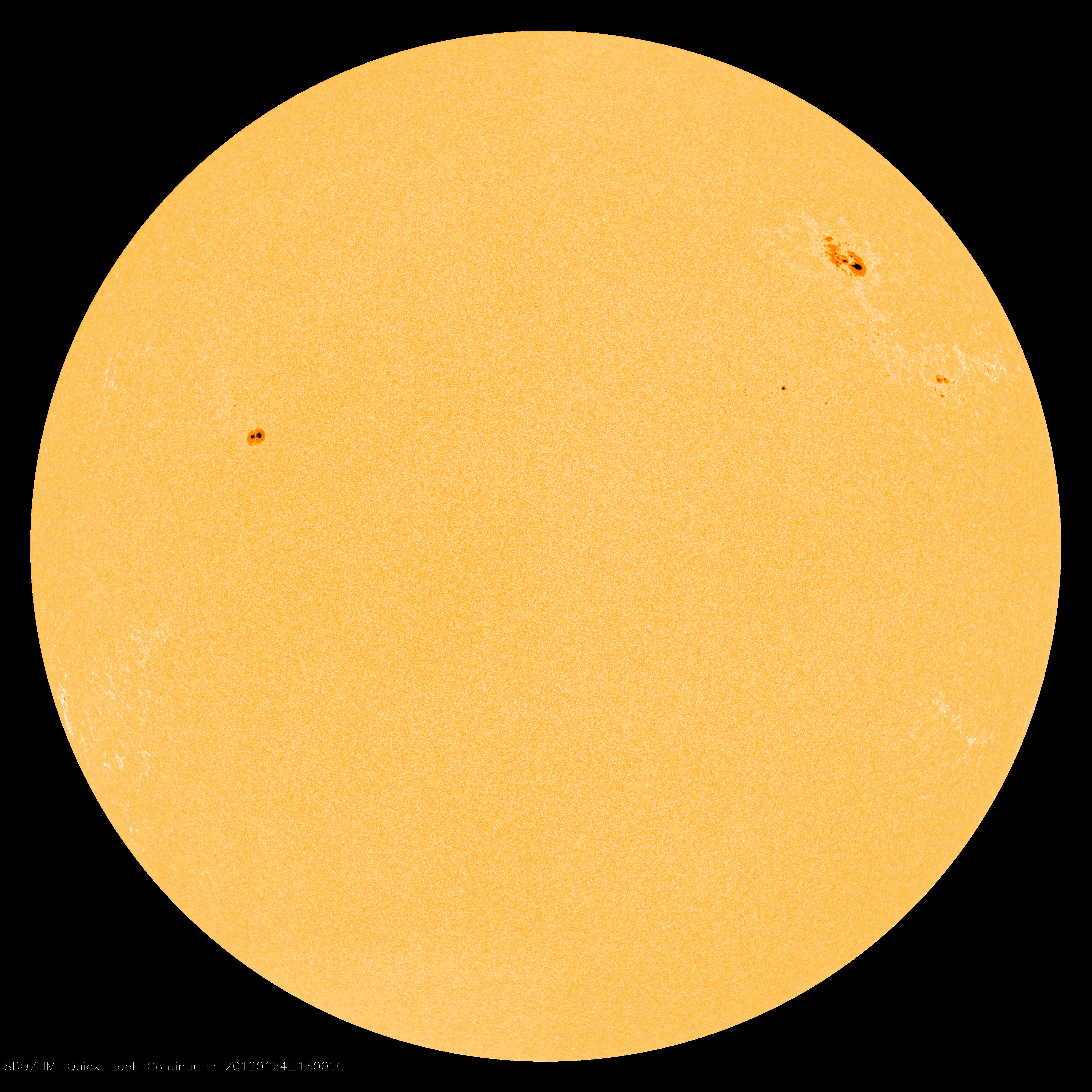
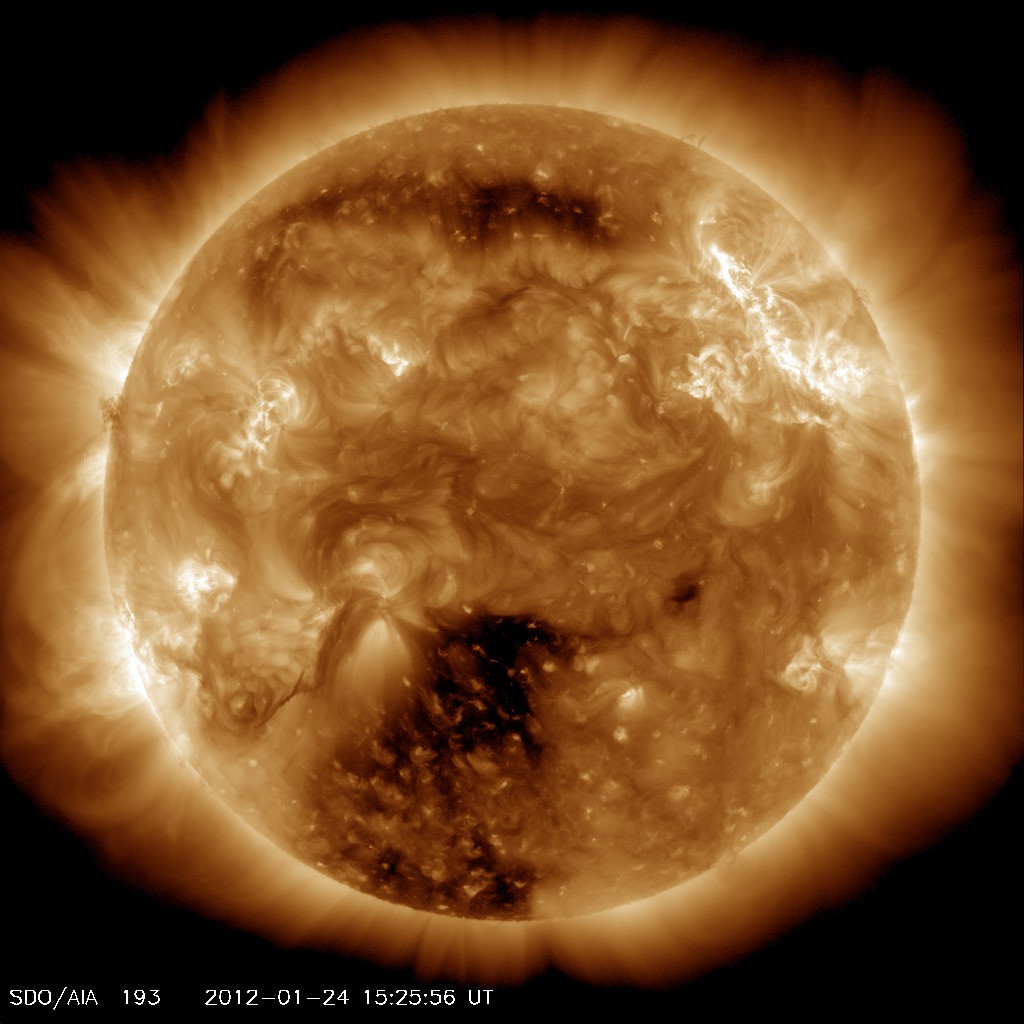
Metallic photos of the sun by renowned photographer Greg Piepol bring together the best of art and science. Buy one or a whole set. They make a stellar gift. | | |
CME IMPACT: As expected, a CME hit Earth's magnetic field on Jan. 24th at approximately 1500 UT (10 am EST). A G1-class geomagnetic storm is in progress now, producing bright auroras around the Arctic Circle. Sky watchers in Canada, Alaska, and states along the US-Canadian border should be alert for Northern Lights after nightfall. Tip: The hours around local midnight are often best for aurora sightings. Aurora alerts: text, voice.
In Lofoton, Norway, the CME's arrival produced a surge in ground currents outside the laboratory of Rob Stammes:
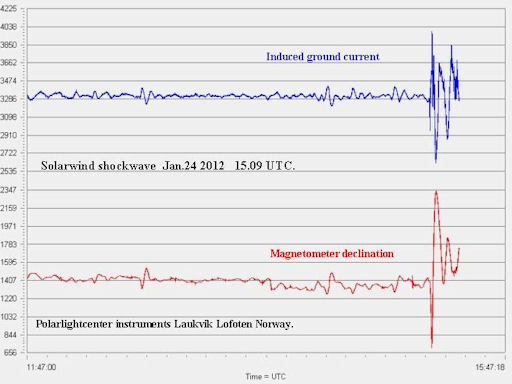
"The expected CME arrived and showed up on my instruments at 15.10 UTC--a fantastic shockwave followed by a magnetic storm," says Stammes. "This could be a happy day for many aurora watchers."
Indeed, the first auroras, post-impact, have been sighted in northern Europe. Antti Pietikäinen sends this picture from Muonio in the Finnish Lapland:

"We went out with snowmobiles to wait for the incoming storm," says Pietikäinen. "The show started slowly, but after 15mins the landscape was green! This was the first time for Thomas (pictured above) to see the Northern Lights. He was very happy."
more images: from Hinrich Baesemann of Tromso, Norway; from Ashton Seth Reimer of Longyearbyen, Norway; from Gordon Watt of Alford, Aberdeenshire, UK ; from Antti Pietikäinen of Muonio, Lapland, Finland; from B.Art Braafhart of Salla, Finnish-Lapland; from Pickles of Karlstad, Sweden; from Jens Buchmann of Kiruna, Sweden; from Alister Chapman of Karasjok, Norway;
January 2012 Aurora Gallery
[previous Januaries: 2010, 2009, 2008, 2007, 2005, 2004]
Comet Lovejoy Gallery
[previous comets: McNaught, Holmes, Lulin, Tuttle, Ikeya-Zhang]
Potentially Hazardous Asteroids (
PHAs) are space rocks larger than approximately 100m that can come closer to Earth than 0.05 AU. None of the known PHAs is on a collision course with our planet, although astronomers are finding
new ones all the time.
On January 24, 2012 there were 1272 potentially hazardous asteroids.
Notes: LD means "Lunar Distance." 1 LD = 384,401 km, the distance between Earth and the Moon. 1 LD also equals 0.00256 AU. MAG is the visual magnitude of the asteroid on the date of closest approach. | | The official U.S. government space weather bureau |
| | The first place to look for information about sundogs, pillars, rainbows and related phenomena. |
| | Researchers call it a "Hubble for the sun." SDO is the most advanced solar observatory ever. |
| | 3D views of the sun from NASA's Solar and Terrestrial Relations Observatory |
| | Realtime and archival images of the Sun from SOHO. |
| | from the NOAA Space Environment Center |
| | the underlying science of space weather |