'BULLET HOLE' IN ISS SOLAR PANEL: Space station commander Chris Hadfield has photographed a hole in one of the ISS solar panels. "Bullet hole - a small stone from the universe went through our solar array," he tweeted from orbit. "Glad it missed the hull." Look for the puncture in this image straight from the ISS.
DOUBLE FLARE THREAT: Two sunspots now facing Earth pose a threat for geoeffective flares. AR1731 has a 'beta-gamma' magnetic field that habore energy for M-class flares, while AR1730 has a 'beta-gamma-delta' magnetic field capable of unleashing even stronger X-class flares. NASA's Solar Dynamics Observatory recorded the growth of these sunspots over the past 48 hours:

NOAA forecasters estimate a 5% chance of X-flares today, April 30th. Normally, X-flares are common around the peak of the solar cycle, yet there has not been a single X-flare all year. Perhaps we're overdue; stay tuned! Solar flare alerts: text, voice.
SPACE WEATHER BALLOON POPS: Last week, we reported on a group of high school students in Bishop, CA, who are launching "space weather balloons" to the edge of space to study the effect of solar flares on Earth's ozone layer. This is what it looks like when a space weather balloon pops:

A camera atop the balloon's payload recorded the explosion at 60 frames per second, allowing the student researchers to create a slow-motion movie of the balloon tearing itself to ribbons. This was their 22nd flight to the stratosphere since 2010, so they've seen this happen many times: another movie highlights some of the best explosions so far.
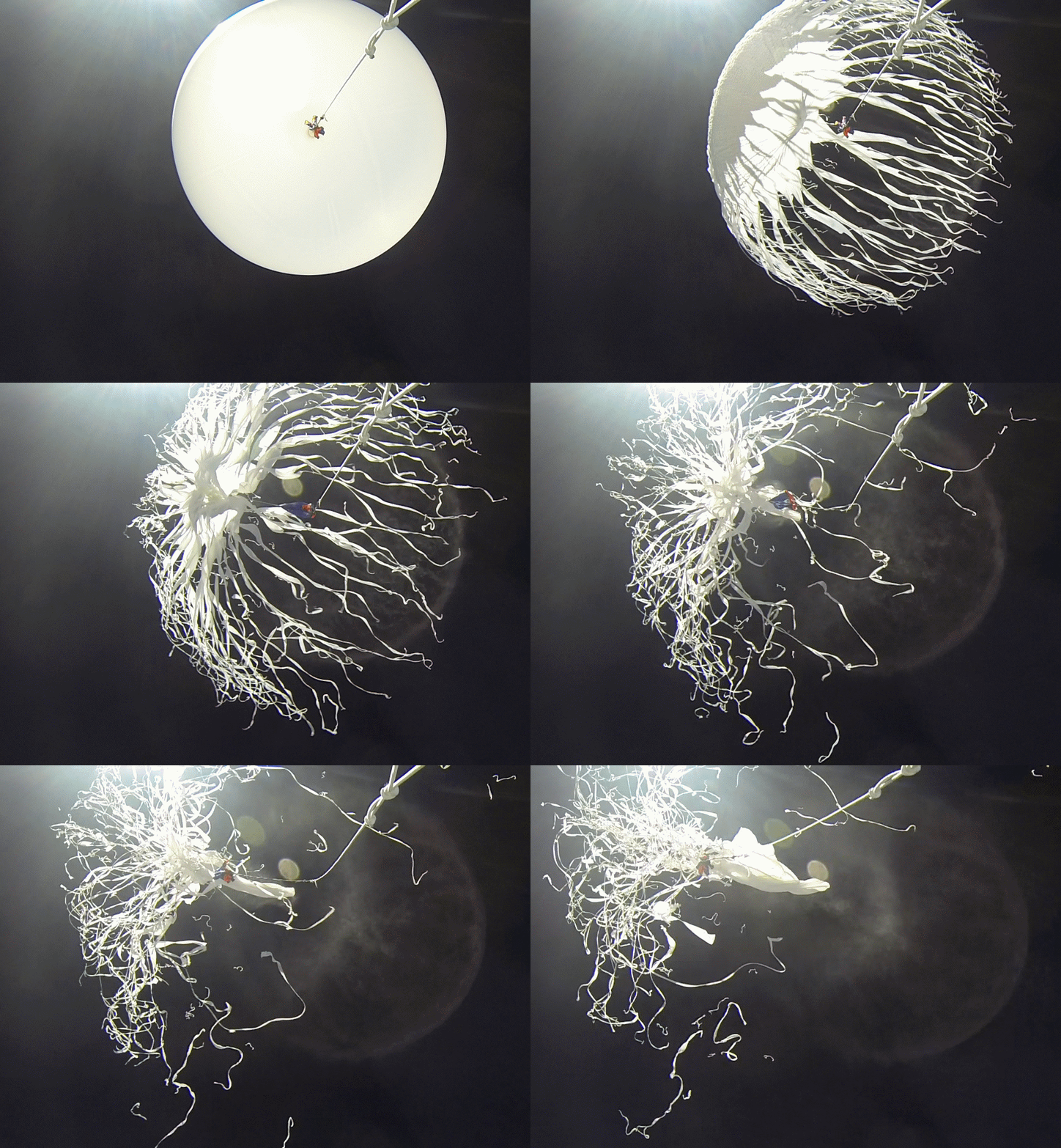
The popping of the balloon is an intentional part of the mission profile. It happens at an altitude of approximately 120,000 feet above Earth's surface, well inside the ozone layer that the students wish to study. The payload then parachutes back to Earth, where students find it (often in exotic places such as Death Valley) using GPS trackers.
The name of the group is "Earth to Sky Calculus." Check their Facebook page for more information about the space weather balloon program and other activities.
Realtime Space Weather Photo Gallery
Realtime Noctilucent Cloud Photo Gallery
[previous years: 2003, 2004, 2005, 2006, 2007, 2008, 2009, 2011]