CHANCE OF FLARES: Will May begin with a solar flare? Two sunspots (AR1730 and AR1731) have 'delta-class' magnetic fields that harbor energy for strong eruptions. NOAA forecasters put the odds of an M-class solar flare today at 40%. Solar flare alerts: text, voice.
FARSIDE ERUPTION: Actually, May did begin with a solar flare--on the farside of the sun. An active region located behind the sun's eastern limb erupted during the early hours of May 1st, hurling a plume of red-hot debris into space:

Coronagraph images from NASA's twin STEREO probes confirm that a CME emerged from the blast site. Earth was not in the line of fire. Next week, however, we might be as the sun's rotation turns the active region toward our planet. Stay tuned for updates. Solar flare alerts: text, voice.
Note: iPhone and iPad users can track events on the farside of the sun using NASA's 3D Sun app. Download it now!
SPACE WEATHER BALLOON POPS: Last week, we reported on a group of high school students in Bishop, CA, who are launching "space weather balloons" to the edge of space to study the effect of solar flares on Earth's ozone layer. This is what it looks like when a space weather balloon pops:

A camera atop the balloon's payload recorded the explosion at 60 frames per second, allowing the student researchers to create a slow-motion movie of the balloon tearing itself to ribbons. This was their 22nd flight to the stratosphere since 2010, so they've seen this happen many times: another movie highlights some of the best explosions so far.
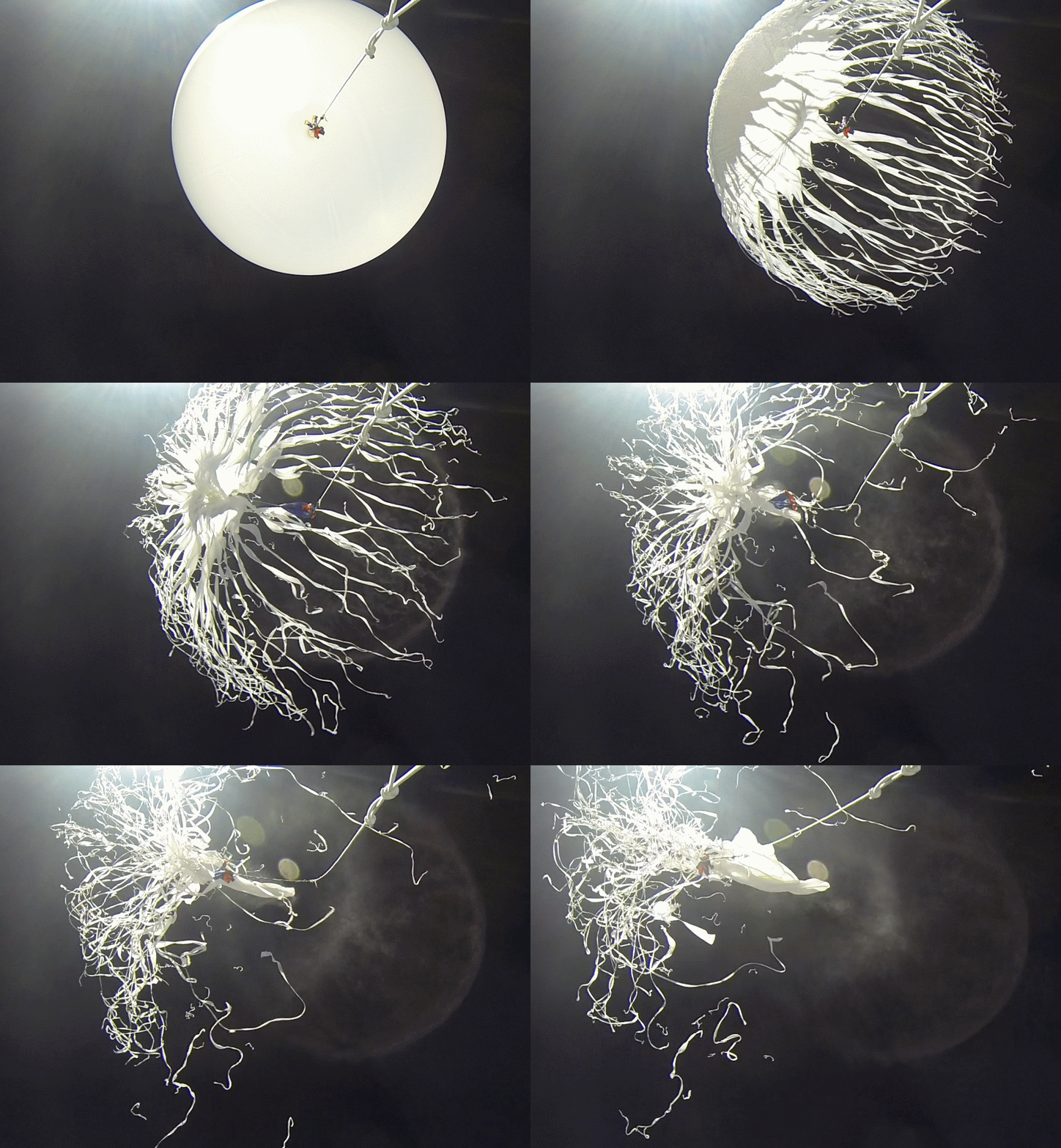
The popping of the balloon is an intentional part of the mission profile. It happens at an altitude of approximately 120,000 feet above Earth's surface, well inside the ozone layer that the students wish to study. The payload then parachutes back to Earth, where students find it (often in exotic places such as Death Valley) using GPS trackers.
The name of the group is "Earth to Sky Calculus." Check their Facebook page for more information about the space weather balloon program and other activities.
Realtime Space Weather Photo Gallery
Realtime Noctilucent Cloud Photo Gallery
[previous years: 2003, 2004, 2005, 2006, 2007, 2008, 2009, 2011]