PERSEID METEOR SHOWER: New research by NASA's Meteoroid Environment Office shows that one meteor shower produces more fireballs than any other--the Perseids. This year's Perseid peak is just around the corner on August 12-13. Get ready for fireballs.
ERUPTING MAGNETIC FILAMENTS: During the late hours of July 26th, two filaments of magnetism erupted on the sun. The first to blow was this loop on the sun's southwestern limb:

A second filament connecting sunspots AR1800 and AR1805 erupted shortly thereafter. Both blasts are captured in this movie, recorded by NASA's Solar Dynamics Observatory.
The explosions hurled coronal mass ejections (CMEs) into space: movie. One of them (the one propelled by the filament connecting AR1800 and AR1805) might be heading in the general direction of Earth. An analysis the CME's trajectory is in progress as more imagery becomes available. Aurora alerts: text, voice.

Realtime Space Weather Photo Gallery
NACREOUS CLOUDS OVER TIERRA DEL FUEGO: On July 24th, about an hour after sunset, Gerardo Connon of Rio Grande city in Tierra del Fuego, Argentina, walked outside and witnessed a rare display of nacreous clouds. The colorful apparition was as bright as the street lights in the city below:
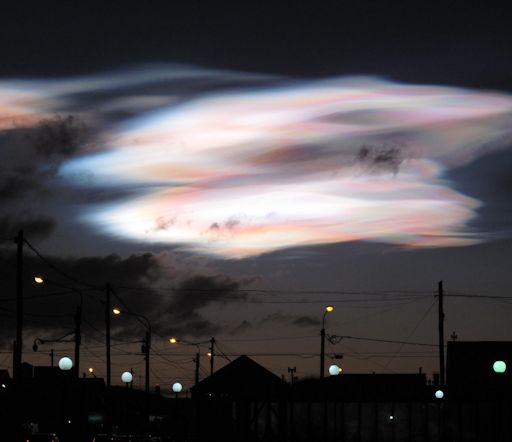
These clouds, also known as "mother of pearl clouds," form in the stratosphere far above the usual realm of weather. They are seldom seen, but when they are, the reports usually come from high-northern parts of our planet. This apparition over Tierra del Fuego was unusual indeed.
Atmospheric optics expert Les Cowley explains the special conditions required to create such a cloud: "Take an unusually cold lower stratosphere (15-25km high), use some gravity waves generated by high winds and storms in the troposphere to stir in some water vapour, and -- voilà! You get these clouds made of tiny ice crystals shining after sunset with unforgettably bright iridescent colors."
"The very special conditions make nacreous clouds a rare, high-latitude phenomenon. Scandinavia, Iceland and northern Canada are favourite places to see them. Sightings in the southern hemisphere are even more rare because there is so little land far enough south except for Antarctica."
Realtime Noctilucent Cloud Photo Gallery
[previous years: 2003, 2004, 2005, 2006, 2007, 2008, 2009, 2011]