PERSEIDS SLOWLY SUBSIDING: The Perseid meteor shower, which peaked on August 12-13 with as many as 120 meteors per hour, is slowly subsiding as Earth exits the debris stream of parent comet 109P/Swift-Tuttle. Sky watchers should nevertheless remain alert for meteors tonight between midnight and sunrise. It will take several days for the Perseid rate to drop to zero. [photo gallery] [meteor radar]
INCREASING CHANCE OF FLARES: Two new sunspots are growing rapidly in the sun's southern hemisphere. One of them, AR1817, is directly facing Earth and poses a threat for X-class solar flares. A movie from NASA's Solar Dynamics Observatory shows the sunspot's development over the past 48 hours:

AR1817 has a 'beta-gamma-delta' magnetic field that harbors energy for strong eruptions. NOAA forecasters estimate a 30% chance of M-class flares and a 5% chance of X-class flares on August 13th. Solar flare alerts: text, voice.
Realtime Space Weather Photo Gallery
PERSEID METEOR SHOWER (CONTINUED): According to NASA's Meteoroid Environment Office, the Perseid meteor shower produces more fireballs than any other annual shower. Last night, Mike Lewinski of Embudo, New Mexico, photographed "the brightest fireball I've ever seen." It was an impressive Perseid, even though he caught only half of it:
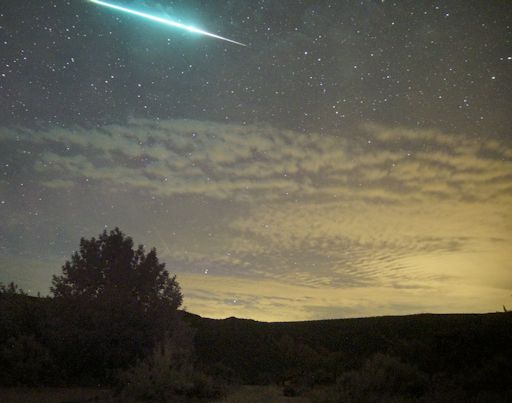
"It was so bright, it illuminated the clouds below," says Lewinski.
NASA's All-Sky Fireball Network, which monitors the sky over the southern USA, has recorded more than 100 Perseid fireballs on Aug. 10-12. Astronomer Bill Cooke of the Meteoroid Environment Office plotted their orbits in this diagram of the inner solar system:

The purple orbit traces the path of the parent comet, 109P/Swift-Tuttle. It nicely matches the orbits of the Perseids, color-coded green. Earth is marked by a blue dot where all the curves intersect.
Realtime Noctilucent Cloud Photo Gallery
[previous years: 2003, 2004, 2005, 2006, 2007, 2008, 2009, 2011]