DAYTIME METEOR OUTBURST: Peter Brown of the University of Western Ontario reports an ourburst of Daytime Craterid meteors on August 28th. "The Canadian Meteor Orbit Radar is detecting about 20 meteors per hour (ZHR)," he says. "This is the first time in five years this has happened." The source of the shower is Comet Boattini (C/2007 W1). Because the comet's debris stream comes close to Earth, Jupiter and Saturn, it experiences gravitational perturbations which make the shower highly variable. Try listening to the Daytime Craterids on Space Weather Radio.
SUMMER LIGHTS: "Last night, the sky exploded into an inferno of vivid colours!" reports Oskar Pettersson of Luleå, Sweden. "It was the Northern Lights!" Pettersson saw the display after he walked out of a movie theatre, then rushed home to grab his camera for this shot:
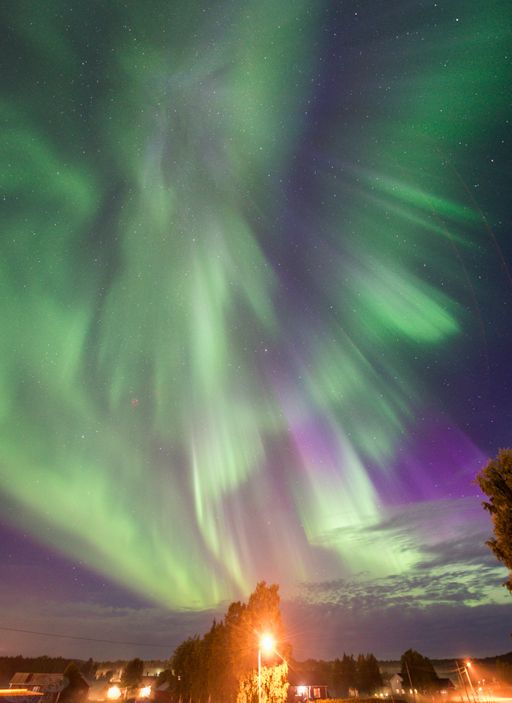
"Aurora season has started with a bang, and now I'm really looking forward to seeing the rest of it!" he says.
The display began when the interplanetary magnetic field (IMF) around Earth tilted south. This opened a crack in Earth's magnetosphere. Solar wind flowed in and ignited the auroras. This disturbance is subsiding now but it is not over. NOAA forecasters estimate a 20% chance of polar geomagnetic storms on August 28th. Aurora alerts: text, voice.
SPACE WEATHER RADIO UPDATE: As a result of indiscriminate "sequester" budget cuts, the USAF Space Surveillance Radar will be shut down at the end of September. Readers have asked what this means for Space Weather Radio. For years we have broadcast Space Surveillance Radar echoes from meteors passing over the facility. Anticipating the shutdown, our radio engineer Stan Nelson is changing frequencies. "I have erected a new 50 MHz 4-element beam antenna for the Digital TV carrier of 54.310 MHz and have it feeding the receiver at SpaceWeatherRadio.com," he explains. The echoes we hear now will be TV signals bouncing off the ionized trails of meteors. "I will be experimenting with the direction and signal strength over the next couple of days, so stay tuned."
NORTHERN CORONAL HOLE: Magnetic fields in the sun's northern hemisphere have opened up, creating a hole in the sun's upper atmosphere. This August 27th image from NASA's Solar Dynamics Observatory shows how solar wind is streaming out of the coronal hole:

The solar wind stream is heading for Earth, due to arrive on August 30-31. Its impact will not be a major event. Nevertheless, it could spark geomagnetic storms and auroras at high latitudes. This is good news around the Arctic Circle where the midnight sun is setting. Darkening skies will allow auroras to be seen for the first time in months. Browse the aurora gallery for a preview.
Realtime Space Weather Photo Gallery
Realtime Noctilucent Cloud Photo Gallery
[previous years: 2003, 2004, 2005, 2006, 2007, 2008, 2009, 2011]