CHANCE OF STORMS: NOAA Forecasters estimate a 20% chance of polar geomagnetic storms on October 15th when a minor CME (movie) is expected to hit Earth's magnetic field. The cloud of plasma was hurled in our direction by an M1-class eruption from sunspot AR1865. High-latitude sky watchers should be alert for auroras. Aurora alerts: text, voice.

SCROLL DOWN FOR FIREBALLS: There's something new on Spaceweather.com. Scroll down the page and look for the "All Sky Fireball Network." Every night (even during a government shutdown) NASA scans the skies for meteoritic fireballs. Every morning, we'll be presenting their results from the night before. The data include orbits, velocity, penetration depth in Earth's atmosphere and more.
MORSE CODE BEAMED INTO SPACE: When NASA's Juno spacecraft flew past Earth on Oct. 9th, ham radio operators around the world took part in a global effort to communicate with the spacecraft. Organized by the Juno mission team and JPL, the hams slowly tapped out "Hi" in Morse code: 
 . In New Mexico, amateur radio astronomer Thomas Ashcraft was observing the heavens with his own shortwave radio telescope when he heard the transmissions:
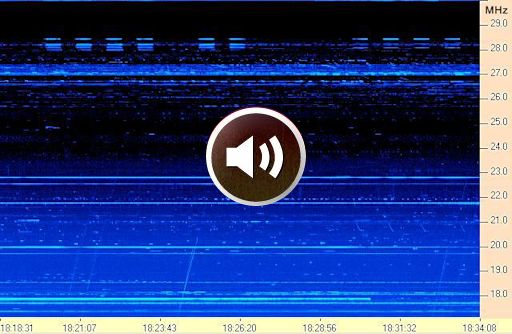
"The patterned keying from amateur radio operators was noted clearly on my radio telescope," says Ashcraft. "In the dynamic spectrum, shown above, it is the series of horizontal 'dots' just above 28 MHz." Listening to this seven minute extract of the signal pattern sent to Juno takes patience, so Ashcraft sped up the recording by 10 times. "Here it is," he says.
Juno listened for the message using its onboard WAVES instrument, a radio and plasma wave sensor designed to study magnetic storms at Jupiter. Did Juno actually hear anything? The Juno mission team wrote this on the event's home page: "Thank you amateur radio operators. This activity is now concluded. The Juno team hopes to share the results with you soon."
Realtime Space Weather Photo Gallery
HOW TO FIND COMET ISON: How do you find Comet ISON? Wake up before dawn, face east, and follow the "double star." Rising about three hours before the sun, red Mars and blue-white Regulus have converged to form a bright pair separated by only 1o. Martin Gembec photographed the duo from the Czech Republic before daybreak on Oct. 14th.
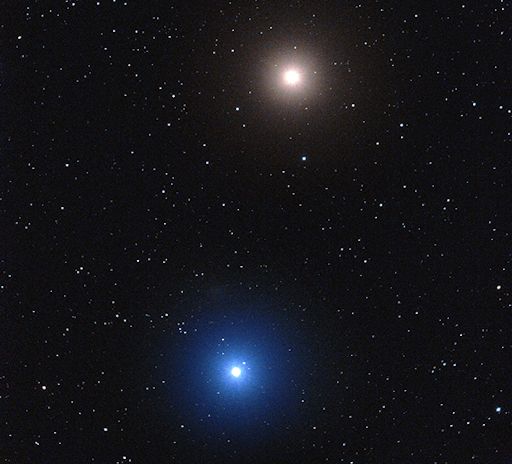
To find Comet ISON, take a look at the full-sized image. The comet is just above Mars.
On Nov. 28th, Comet ISON could become spectacularly bright when it flies through the atmosphere of the sun. At the moment, though, it is still far away (near Mars) and faint. Visibility requires a telescope. Amateur astronomers, if you have a GOTO telescope, enter these coordinates, or just find the "double star" and draw a line between Regulus and Mars. It leads to ISON. Sky map: Oct. 15.

Realtime Comet ISON Photo Gallery
ACTIVE SUNSPOT: The CME due to hit Earth on Oct 15th was hurled toward our planet by Earth-facing sunspot AR1865. The sunspot has an unstable 'beta-gamma-delta' magnetic field that is crackling with M- and C-class solar flares. Click to view a sampling of activity on Oct 14th:

The movie, recorded by NASA's Solar Dynamics Observatory, spans 7 hours and contains a pair of relatively minor UV flares. Stronger eruptions could be in the offing. NOAA forecasters estimate a 40% chance of M-class flares and a 10% chance of X-flares on Oct. 14th. Solar flare alerts: text, voice.