SCROLL DOWN FOR FIREBALLS: There's something new on Spaceweather.com. Scroll down the page and look for the "All Sky Fireball Network." Every night NASA scans the skies for meteoritic fireballs. Every morning, we'll be presenting their results from the night before. The data include orbits, velocity, penetration depth in Earth's atmosphere and more.
CRACKLING SUNSPOT: Sunspot AR1865 is crackling with C- and M-class solar flares, at least one every few hours. NASA's Solar Dynamics Observatory captured the extreme UV flash from this M1-flare at 23:36 UT on Oct. 15th:
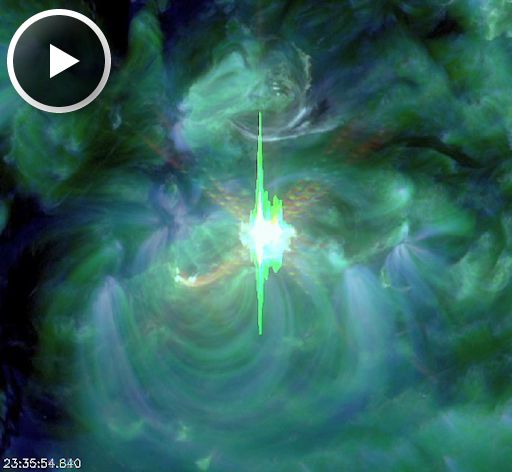
The UV pulse from this flare caused a minor wave of ionization in Earth's upper atmosphere over the Pacific side of our planet, but otherwise no effects.
Stronger flares could be in the offing. The sunspot has an unstable 'beta-gamma-delta' magnetic field that harbors energy for X-class eruptions. By crackling, however, the active region might be "blowing off steam" that prevents a really big blast. NOAA forecasters estimate a mere 1% chance of X-class flares in the next 24 hours. Solar flare alerts: text, voice.
Realtime Space Weather Photo Gallery
NORTHERN LIGHTS: A CME hit Earth's magnetic field on Oct. 15th @ 10:00 UT, jolting a magnetic field already shaken by a gusty solar wind stream. The combination sparked bright auroras around the Arctic Circle. Oskar Pettersson photographed this display above Luleå, Sweden:
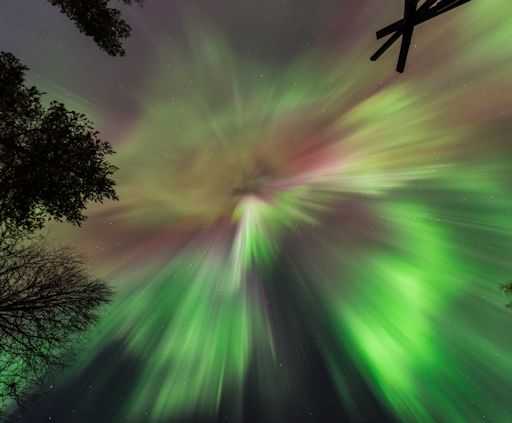
"Auroras were covering much of the sky with vivid colors in green, purple and red," says Pettersson. "They were some of the best I've seen this season."
Another CME is approaching Earth. NOAA forecasters expect a weak impact on Oct. 16 with a 30% chance of polar magnetic storms on Oct. 17th. More auroras are possible at high latitudes. Aurora alerts: text, voice.
COLORFUL CONJUNCTION: If you're awake at 5 am, go outside and face east. About halfway up the sky, the red planet Mars and the blue star Regulus are side by side, forming a 1st-magnitude "double star" in the pre-dawn sky. David Marshall photographed the colorful duo on the morning of Oct. 16th from Christ Church, Barbados:

Look carefully to the left of red Mars. The "duo" is actually a trio: Comet ISON is there, too. "Comet ISON, Mars and Regulus are quite a photogenic threesome!" says Marshall.
While Mars and Regulus are easily seen with the unaided eye, Comet ISON requires optics. The comet is far away, near the orbit of Mars, and glows like an 11th magnitude star. Marshall was able to photograph it by stacking 44 one-minute exposures from his Canon 7D digital camera.
Backyard telescopes reveal the comet much faster than a digital camera. Amateur astronomers, if you have a GOTO telescope, enter these coordinates. And while you're there, look up to enjoy the colorful conjunction. It's a nice way to begin the day.
Realtime Comet ISON Photo Gallery