CHANCE OF STORMS: Earth's magnetic field is about to receive a glancing blow from three CMEs observed leaving the Sun between Oct. 20th and 22nd. Forecast models suggest that the three clouds merged en route to Earth, and their combined impact could trigger a mild polar geomagnetic storm on Oct. 24-25. High-latitude sky watchers should be alert for auroras. Aurora alerts: text, voice.
SOLAR FLARE! Solar activity is high. On October 24th at 00:30 UT, Earth-facing sunspot AR1877 erupted, producing a powerful M9-class solar flare. NASA's Solar Dynamics Observatory recorded the blast:
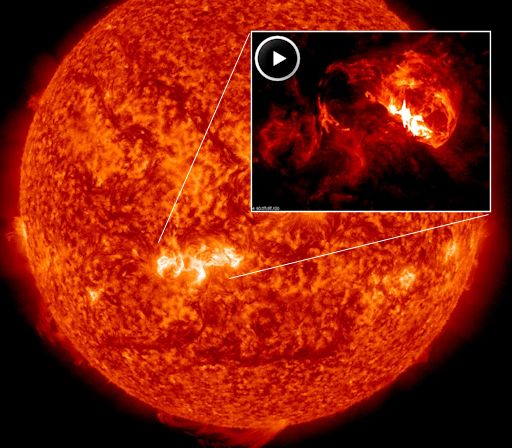
Update #1: The eruption hurled a faint CME into space and it appears to be heading toward Earth. The arrival time is not yet known.
Update #2: NASA's Solar Dynamics Observatory has released a full-disk movie of the explosion. Play it.
More flares are in the offing. Two large sunspots, AR1875 and AR1877, have 'beta-gamma-delta' magnetic fields that harbor energy for strong eruptions. NOAA forecasters estimate a 40% chance of M-flares and a 5% chance of X-flares during the next 24 hours. Solar flare alerts: text, voice.
Realtime Space Weather Photo Gallery
COMET EXPLOSION: Almost 450 million km from Earth, Comet C/2012 X1 (LINEAR) has exploded. Amateur astronomers are reporting a 100-fold increase in the comet's brightness compared to predictions, and the comet's atmosphere or "coma" now resembles that of exploding Comet 17P/Holmes in 2007. Using a remotely-controlled 0.5 meter telescope in New Mexico, European observers Ernesto Guido, Martino Nicolini and Nick Howes took this picture of the spherical explosion on Oct 21st:
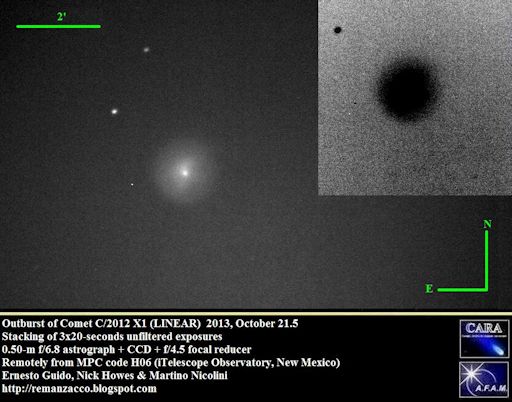
"The predicted magnitude of the comet on Oct. 20th was about +14," says Guido. "Now it is close to +8.5." This is below the threshold for naked-eye visibility, but bright enough for backyard telescopes equipped with digital cameras.
Prompted by the reports of Guido et al, Romanian amateur astronomer Maximilian Teodorescu observed the comet on Oct. 22nd, confirming its brightness and spherical structure. "It looked exactly like Comet Holmes back in 2007," says Teodorescu.
Located in the constellation Coma Berenices, Comet LINEAR X1 rises in the east about an hour before the sun. The low altitude of the comet in morning twilight is a challenge. "I could not see the comet through the eyepiece of my 4.5 inch refracting telescope," adds Teodorescu, "but the camera detected it easily enough."
The outburst does not necessarily signal a disintegration of the comet. Possibly, a local vein or cavern of deep ice in the comet's nucleus has been exposed to sunlight. Rapid evaporation of fragile ices could account for the comet's bigger- and brighter-than-expected atmosphere. Monitoring in the nights ahead might reveal clues to what happened ... and when. Resources: 3D orbit, ephemeris, sky map.

SOLAR TSUNAMI AND RADIO BURST: Sunspot AR1875 erupted on Oct. 22nd (21:20 UT), producing an impulsive M4-class solar flare and a loud burst of shortwave radio static. Amateur radio astronomer Thomas Ashcraft of New Mexico was listening at the time of the eruption. "I knew this flare was a strong one by the force of the radio shock front," he says. "It nearly lifted me out of my chair!" Click on the image to hear what emerged from the loudspeaker of his radio telescope:
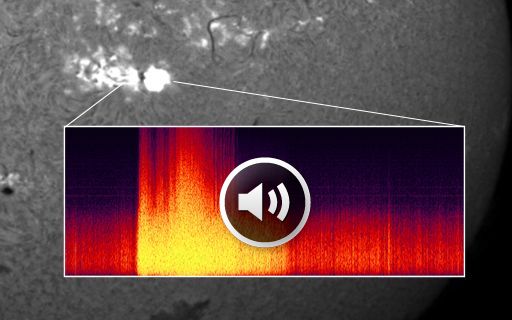
Advice: Listen to the sound file using stereo headphones. The two channels correspond to two radio frequencies--21 and 28 MHz.
At the time of the flare, Ashcraft was also monitoring the sun using an "H-alpha" solar telescope tuned to the red glow of solar hydrogen. The telescope recorded a tsunami of plasma emerging from the blast site. "It's the shadowy wave that races away to the right of the sunspot," Ashcraft points out.
The tsunami was the source of the radio emission. Shock waves at the leading edge of the tsunami cause plasma instabilities in the sun's atmosphere. Those instabilities, in turn, generate shortwave radio emissions. Ashcraft is a regular listener of the sun and he classifies the Oct. 22nd outburst as "one of the strongest radio blasts of the solar cycle so far. Hopefully it bodes well for future activity." Solar flare alerts: text, voice.
Realtime Space Weather Photo Gallery
Realtime Comet ISON Photo Gallery