CHANCE OF FLARES: Sunspot AR1884 has a complex magnetic field that harbors energy for strong eruptions, and it is almost directly facing Earth. NOAA forecasters estimate a 50% chance of M-class solar flares and a 10% chance of X-flares on Oct. 31st. Solar flare alerts: text, voice.
SPOOKY AURORAS: High-latitude sky watchers should be alert for auroras on Halloween. A CME is expected to hit Earth's magnetic field on Oct. 31st, possibly sparking polar geomagnetic storms. In northern Norway, the show got started early with this display on Oct. 30th:
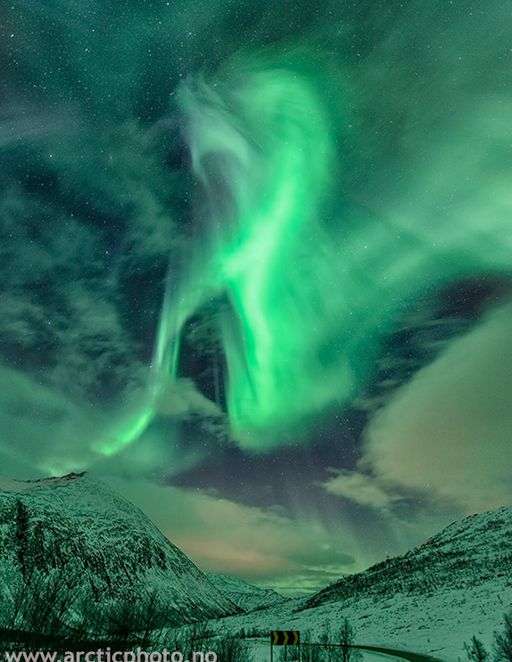
"We witnessed a very powerful outburst of auroras with bright colours," says photographer Bjørn Jørgensen of Tromsø. And that was before the CME arrived...
As Oct. 31st begins, indicators still suggest a CME is approaching Earth. NOAA forecasters expect a G1-class geomagnetic storm when it arrives. Watch for the shock here. Aurora alerts: text, voice.
SPACE WEATHER BALLOON UPDATE: Members of the Earth to Sky Calculus science club have recovered the space weather balloon they launched on Oct. 27th. The payload, which landed in a remote area of California's Inyo Mountains, carried two high-energy radiation sensors into the stratosphere. These pictures show the erupting balloon and one of the sensors at the apex of the flight, 27 km (90,500 feet) above Earth's surface:

The reading on the LCD screen shows a dose rate of 3.7 uSv/hour, more than 20 times higher than radiation levels at the launch site. Another independent sensor was contained inside a thermally insulated capsule. Working together, the two sensors measured a complete profile of ionizing radiation from 2.8 km to 27 km above Earth's surface.
This experiment was prompted by a recent NASA report concerning the effects of space weather on aviation. Like astronauts, ordinary air travelers can be exposed to significant doses of radiation when the sun is active. The Oct. 27th flight showed that it is possible to count x-rays, gamma-rays, alpha particles and beta particles using relatively inexpensive equipment. Such data can be used to check and improve research models of radiation percolating through Earth's atmosphere.
Another balloon flight could be in the offing. Solar activity is high, and a new fusillade of X-flares could trigger a radiation storm around Earth. If so, the student scientists plan to send their sensors back to the stratosphere for another look. Solar flare alerts: text, voice.
Realtime Space Weather Photo Gallery
Realtime Comet ISON Photo Gallery