WHAT DOES DEEP SPACE SOUND LIKE? As Voyager 1 recedes from the solar system, researchers are hoping the spacecraft will beam back tones from plasma waves, a form of "interstellar music" that reveals conditions in the realm of the stars. Find out what deep space sounds like in a new video from Science@NASA.
M6-CLASS FLARE: Sunspot AR1884 is directly facing Earth, and it has a mixed-polarity magnetic field that harbors energy for strong eruptions. On Nov. 1st at 1953 UT the active region unleashed a brief but intense M6-class solar flare. NASA's Solar Dynamics Observatory recorded the extreme ultraviolet flash:

Although the flare was aimed directly at Earth, its effect on our planet was minimal--mainly because the duration was so short (less than 1 minute). A brief blackout of HF radio signals might have occured on the daylit side of Earth, while low-frequency navigation signals could have been disrupted for ~tens of minutes. Any such disruptions have since subsided.
Sunspot AR1884 poses a threat for longer and stronger flares this weekend. NOAA forecasters estimate a 40% chance of M-class flares and a 5% chance of X-class flares on Nov. 2nd and 3rd. Auro alerts: text, voice.
GREEN SPOOKTACLE: As expected, a coronal mass ejection (CME) hit Earth's magnetic field during the early hours of Oct. 31st, Halloween. The impact, however, was not strong enough to spark a geomagnetic storm or widespread auroras. Instead, unexpectedly, auroras appeared before the impact. Observing from Troms, Norway, Chris and Becki Nation photographed this spooky scene on Oct. 30th:
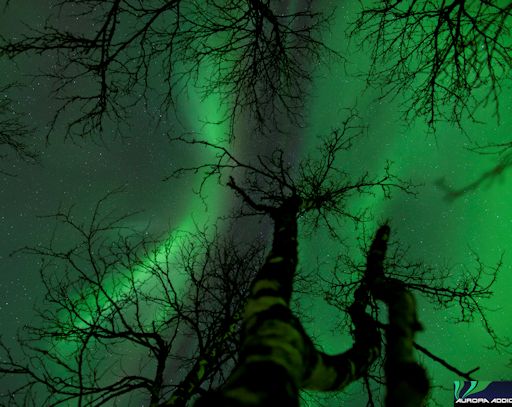
"AMAZING display last night!" says Chris. "We had a 360 degree light show. It was absolutely breathtaking and we didn't know which way to point the camera."
Becki adds, "we are a family of 6 utter Aurora Addicts: Chris, Becki, Aurora 10, Oceanna 8, Lyrica 3 and Caspian 1. We are currently planning a 4 month road trip in our camper van to Lapland this season from our home in the south of the UK. Things are about to get very green."
But not right away. The geomagnetic field is expected to be mostly quiet for the next 3 days (Nov. 1 - 3). A CME from active sunspot AR1884 could change that forecast, however, so stay tuned. Aurora alerts: text, voice.
SPACE WEATHER BALLOON UPDATE: Members of the Earth to Sky Calculus science club have recovered the space weather balloon they launched on Oct. 27th. The payload, which landed in a remote area of California's Inyo Mountains, carried two high-energy radiation sensors into the stratosphere. These pictures show the erupting balloon and one of the sensors at the apex of the flight, 27 km (90,500 feet) above Earth's surface:

The reading on the LCD screen shows a dose rate of 3.7 uSv/hour, more than 20 times higher than radiation levels at the launch site. Another independent sensor was contained inside a thermally insulated capsule. Working together, the two sensors measured a complete profile of ionizing radiation from 2.8 km to 27 km above Earth's surface.
This experiment was prompted by a recent NASA report concerning the effects of space weather on aviation. Like astronauts, ordinary air travelers can be exposed to significant doses of radiation when the sun is active. The Oct. 27th flight showed that it is possible to count x-rays, gamma-rays, alpha particles and beta particles using relatively inexpensive equipment. Such data can be used to check and improve research models of radiation percolating through Earth's atmosphere.
Another balloon flight could be in the offing. Solar activity is high, and a new fusillade of X-flares could trigger a radiation storm around Earth. If so, the student scientists plan to send their sensors back to the stratosphere for another look. Solar flare alerts: text, voice.
Realtime Space Weather Photo Gallery
Realtime Comet ISON Photo Gallery