BIG SUNSPOT FACES EARTH: AR1890, one of the biggest sunspots of the current solar cycle, has turned almost directly toward Earth. This raises the possibility of geoeffective eruptions in the days ahead. NOAA forecasters estimate a 45% chance of M-class flares and a 10% chance of X-flares on Nov. 7th. Solar flare alerts: text, voice.
RACING TOWARD THE SUN: Comet ISON is now inside the orbit of Earth and racing toward the sun. Last night, astronomer Alberto Quijano Vodniza of Pasto, Colombia, recorded the comet moving through space at 103,000 mph (46 km/s). Click to set the scene in motion:
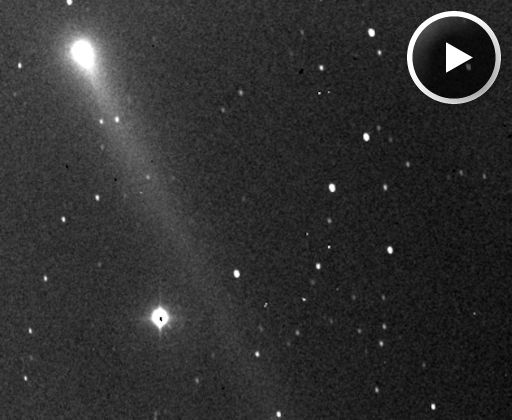
"The movie shows the comet's motion over 27 minutes," says Vodniza. Watch it again. "We also caught a satellite."
On Nov. 28th, Comet ISON will fly through the sun's atmosphere little more than a million kilometers above the sun's fiery surface. This raises a question: Is Comet ISON racing toward its doom? Astronomer Matthew Knight of the Lowell Observatory thinks the comet might withstand the heat:
"At its closest point to the Sun, the equilibrium temperature approaches 5000 degrees Fahrenheit, hot enough to cause much of the dust and rock on ISON’s surface to vaporize," says Knight. "While it may seem incredible that anything can survive this inferno, the rate at which ISON will likely lose mass is relatively small compared to how big it likely is. Assuming that the comet's nucleus is bigger than about 200 meters in radius (current estimates suggest it is 500-2000 m in radius), it will likely survive. It helps that the comet is moving very fast, about 400 km/s at perihelion, so it will not remain long at such extreme temperatures."
If Comet ISON does survive its encounter with the sun, it could put on a good show for backyard astronomers in the northern hemisphere in December. The next few weeks will tell the tale. Stay tuned!
Realtime Comet ISON Photo Gallery
SOLAR FLARE CAUSES RARE 'MAGNETIC CROCHET': On Nov. 5th at 22:12 UT, the magnetic canopy of sunspot AR1890 erupted, producing a brief but intense X3-class solar flare. NASA's Solar Dynamics Observatory recorded the extreme ultraviolet flash:

Radiation from the flare caused a surge in the ionization of Earth's upper atmosphere--and this led to a rare magnetic crochet. Alexander Avtanski observed the effect using a homemade magnetometer in San Jose, California. A magnetic crochet is a disturbance in Earth's magnetic field caused by electrical currents flowing in air 60 km to 100 km above our heads. Unlike geomagnetic disturbances that arrive with CMEs days after a flare, a magnetic crochet occurs while the flare is in progress. They tend to occur during fast impulsive flares like this one.
More eruptions are in the offing. NOAA forecasters estimate a 45% chance of M-class solar flares and a 10% chance of X-flares on Nov. 7th. Solar flare alerts: text, voice.
Realtime Space Weather Photo Gallery
Realtime Comet ISON Photo Gallery