AN ASTEROID WITH SIX TAILS: The Hubble Space Telescope has spotted a strange asteroid with six comet-like tails. (Extra: Amateurs have spotted it, too.) Researchers think the asteroid, named P/2013 P5, is spewing jets of dust as it rapidly rotates to the breaking point. Get the full story from Science@NASA.
ANOTHER X-FLARE: Big sunspot AR1890 is crackling with strong flares. The latest, which peaked on Nov. 8th at 04:32 UT, registered X1 on the Richter Scale of Flares. (Note: Earlier, we underestimated the intensity of this flare as M8.) NASA's Solar Dynamics Observatory recorded a flash of extreme UV radiation from the blast site:

This sunspot has a signature: It tends to produce very brief flares. The X1-flare was no exception as it lasted barely a minute. Brevity mitigates Earth-effects, so this intense flare was not strongly geoeffective--at least, not at first. The explosion also hurled a CME into space: movie. The cloud could deliver a glancing blow to Earth's magnetic field on Nov. 10-11, possibly sparking polar geomagnetic storms.

More eruptions are in the offing. NOAA forecasters estimate a 60% chance of M-class solar flares and a 20% chance of X-flares on Nov. 8th. Solar flare alerts: text, voice.
Realtime Space Weather Photo Gallery
RACING TOWARD THE SUN: Comet ISON is now inside the orbit of Earth and racing toward the sun. On Nov. 6th, astronomer Alberto Quijano Vodniza of Pasto, Colombia, recorded the comet moving through space at 103,000 mph (46 km/s). Click to set the scene in motion:
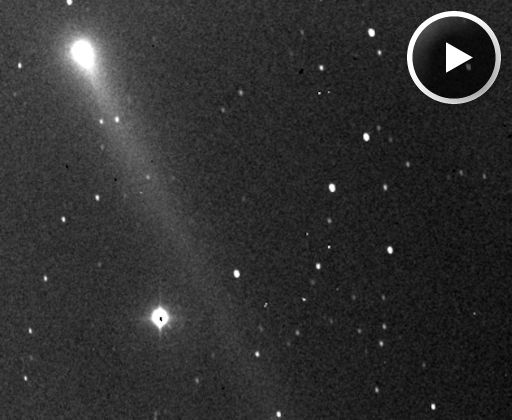
"The movie shows the comet's motion over 27 minutes," says Vodniza. Watch it again. "We also caught a satellite."
On Nov. 28th, Comet ISON will fly through the sun's atmosphere little more than a million kilometers above the sun's fiery surface. This raises a question: Is Comet ISON racing toward its doom? Astronomer Matthew Knight of the Lowell Observatory thinks the comet might withstand the heat:
"At its closest point to the Sun, the equilibrium temperature approaches 5000 degrees Fahrenheit, hot enough to cause much of the dust and rock on ISON’s surface to vaporize," says Knight. "While it may seem incredible that anything can survive this inferno, the rate at which ISON will likely lose mass is relatively small compared to how big it likely is. Assuming that the comet's nucleus is bigger than about 200 meters in radius (current estimates suggest it is 500-2000 m in radius), it will likely survive. It helps that the comet is moving very fast, about 400 km/s at perihelion, so it will not remain long at such extreme temperatures."
If Comet ISON does survive its encounter with the sun, it could put on a good show for backyard astronomers in the northern hemisphere in December. The next few weeks will tell the tale. Stay tuned!
Realtime Comet ISON Photo Gallery
Realtime Comet ISON Photo Gallery