CHANCE OF FLARES: NOAA forecasters estimate a 60% chance of M-class flares and a 30% chance of X-flares on Nov. 11th. The most likely source is active sunspot AR1890, which has already produced three X-flares since Nov. 5th. In addition, a new flare threat is emerging over the sun's southeastern limb: Sunspot group AR1895 appears to be big and potent enough to produce some explosions of its own in the days ahead. Solar flare alerts: text, voice.

COMET ISON SPROUTS A DOUBLE TAIL: Amateur astronomers are getting a better look at Comet ISON as it dives toward the sun for a Nov. 28th close encounter with solar fire. As the heat rises, the comet brightens, revealing new details every day. This photo, taken Nov. 10th by Michael Jäger of Jauerling Austria, shows a beautiful double tail:
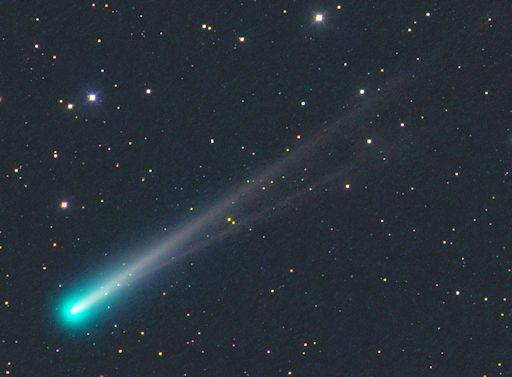
One tail is the ion tail. It is a thin streamer of ionized gas pushed away from the comet by solar wind. The filamentary ion tail points almost directly away from the sun.
The other tail is the dust tail. Like Hansel and Gretel leaving bread crumbs to mark their way through the forest, ISON is leaving a trail of comet dust as it moves through the solar system. Compared to the lightweight molecules in the ion tail, grains of comet dust are heavier and harder for solar wind to push around. The dust tends to stay where it is dropped. The dust tail, therefore, traces the comet's orbit and does not point directly away from the sun as the ion tail does.
Comet ISON is currently moving through the constellation Virgo low in the eastern sky before dawn. Shining like an 8th magnitude star, it is still too dim for naked eye viewing, but an increasingly easy target for backyard optics. Amateur astronomers, if you have a GOTO telescope, enter these coordinates. Special dates of interest are Nov. 17th and 18th when the comet will pass the bright star Spica. Sky maps: Nov. 10, 11, 12, 13, 14, 15, 16, 17, 18, 19.


Realtime Comet ISON Photo Gallery
BRIGHTER THAN ISON: Comet ISON is getting all the press, but it's not even the brightest comet in its own patch of sky. That would be Comet Lovejoy (C/2013 R1), one of four comets now rising in the east before dawn:

Image credits: Sormano Astronomical Observatory (Nov. 7, 2013)
Pictured from left to right are exploding Comet LINEAR X1, sungrazing Comet ISON, short-period Comet Encke, and the brightest of them all, Comet Lovejoy. All four are visible in binoculars or backyard telescopes, and Comet Lovejoy (mag. +6.0) is visible to the naked eye from dark-sky sites. Comet ISON is actually one of the faintest of the group; only expanding Comet LINEAR X1 (mag. +8) is more difficult to see.
An apparition of so many comets at once is a rare thing, and amateur astronomers are encouraged to wake up early for a tour of the pre-dawn sky. Dates of special interest include Nov. 15-18 when Comet LINEAR X1 passes by the bright star Arcturus, Nov 17-18 when Comet ISON has a close encounter with Spica, and Nov. 18-20 when Comet Encke buzzes Mercury. These stars and planets make excellent naked-eye guideposts for finding the comets. Meanwhile, bright Comet Lovejoy is approaching the Big Dipper; if you can't see it with your unaided eye, a quick scan with binoculars will reveal it. Sky maps: Nov. 10, 11, 12, 13, 14, 15, 16, 17, 18, 19.
Comet ephemerides: Comet ISON, Comet Lovejoy, Comet Encke, Comet LINEAR X1
YET ANOTHER X-FLARE: Solar activity is high as sunspot AR1890 continues to produce X-class solar flares. The latest, which registered X1 on the Richter Scale of Flares, occured on Nov. 10th at 05:15 UT. NASA's Solar Dynamics Observatory recorded a bright flash of extreme ultraviolet radiation from the blast site:

The flare also produced a strong burst of ~300 MHz radio waves, recorded at the Mauritius Radio Telescope on the island of Mauritius in the Indian Ocean: data.
This is the third X-flare from AR1890 since Nov. 5th, and all three have something in common: brevity. AR1890 tends to produce impulsive flares, peaking sharply in a matter of minutes or less. Brief flares usually do not produce coronal mass ejections (CMEs), but this one was an exception. A movie of the flare shows a plume of material lifting off the sun shortly after the UV flash. Update: A faint CME associated with that plume will probably sail south of our planet without hitting on Nov. 12th or 13th. Solar flare alerts: text, voice.
Realtime Space Weather Photo Gallery