MINOR STORM WARNING: A 'cannibal CME' might be en route to Earth. NOAA analysts suspect that two CMEs propelled into space by the X-class flares of Nov. 8th and 10th have merged into a single cannibalized cloud. It could deliver a glancing blow to Earth's magnetic field on Nov. 13th, producing minor geomagnetic storms. High-latitude sky watchers should be alert for auroras. Aurora alerts: text, voice.
SUNSPOTS OF INTEREST: Solar activity today is low, but there is reason to believe the quiet won't last. At least three sunspots pose a latent threat for strong flares. They are circled in this image from NASA's Solar Dynamics Observatory:

Just returning from a transit of the sun's farside, old sunspot AR1875 is back on the Earthside where it unleashed several strong flares in October. A second round of eruptions from this active region could be in the offing. Complex sunspots AR1890 and AR1897 also pose a threat for flares. NOAA forecasters estimate a 65% chance of M-class flares and a 35% chance of X-flares during the next 24 hours. Solar flare alerts: text, voice
COMET ISON SPROUTS A DOUBLE TAIL: Amateur astronomers are getting a better look at Comet ISON as it dives toward the sun for a Nov. 28th close encounter with solar fire. As the heat rises, the comet brightens, revealing new details every day. This photo, taken Nov. 10th by Michael Jäger of Jauerling Austria, shows a beautiful double tail:
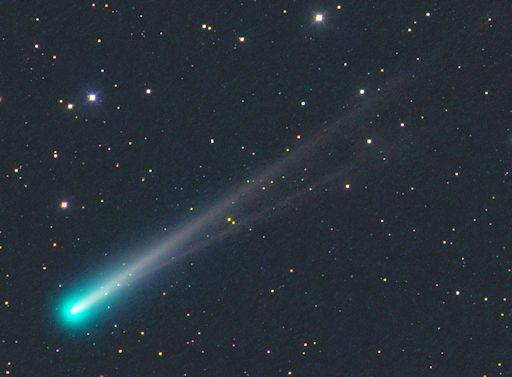
One tail is the ion tail. It is a thin streamer of ionized gas pushed away from the comet by solar wind. The filamentary ion tail points almost directly away from the sun.
The other tail is the dust tail. Like Hansel and Gretel leaving bread crumbs to mark their way through the forest, ISON is leaving a trail of comet dust as it moves through the solar system. Compared to the lightweight molecules in the ion tail, grains of comet dust are heavier and harder for solar wind to push around. The dust tends to stay where it is dropped. The dust tail, therefore, traces the comet's orbit and does not point directly away from the sun as the ion tail does.
Comet ISON is currently moving through the constellation Virgo low in the eastern sky before dawn. Shining like an 8th magnitude star, it is still too dim for naked eye viewing, but an increasingly easy target for backyard optics. Amateur astronomers, if you have a GOTO telescope, enter these coordinates. Special dates of interest are Nov. 17th and 18th when the comet will pass the bright star Spica. Sky maps: Nov. 10, 11, 12, 13, 14, 15, 16, 17, 18, 19.


Realtime Comet ISON Photo Gallery
BRIGHTER THAN ISON: Comet ISON is getting all the press, but it's not even the brightest comet in its own patch of sky. That would be Comet Lovejoy (C/2013 R1), one of four comets now rising in the east before dawn:

Image credits: Sormano Astronomical Observatory (Nov. 7, 2013)
Pictured from left to right are exploding Comet LINEAR X1, sungrazing Comet ISON, short-period Comet Encke, and the brightest of them all, Comet Lovejoy. All four are visible in binoculars or backyard telescopes, and Comet Lovejoy (mag. +6.0) is visible to the naked eye from dark-sky sites. Comet ISON is actually one of the faintest of the group; only expanding Comet LINEAR X1 (mag. +8) is more difficult to see.
An apparition of so many comets at once is a rare thing, and amateur astronomers are encouraged to wake up early for a tour of the pre-dawn sky. Dates of special interest include Nov. 15-18 when Comet LINEAR X1 passes by the bright star Arcturus, Nov 17-18 when Comet ISON has a close encounter with Spica, and Nov. 18-20 when Comet Encke buzzes Mercury. These stars and planets make excellent naked-eye guideposts for finding the comets. Meanwhile, bright Comet Lovejoy is approaching the Big Dipper; if you can't see it with your unaided eye, a quick scan with binoculars will reveal it. Sky maps: Nov. 10, 11, 12, 13, 14, 15, 16, 17, 18, 19.
Comet ephemerides: Comet ISON, Comet Lovejoy, Comet Encke, Comet LINEAR X1
Realtime Space Weather Photo Gallery