LEONID METEOR SHOWER: Today, Nov. 19th, Earth is passing through a narrow stream of debris from Comet Tempel-Tuttle, source of the annual Leonid meteor shower. "The Leonids are showing up nicely in our data from the Canadian Meteor Orbit Radar (CMOR)," reports Peter Brown of the University of Western Ontario. "Rates are only about 10 per hour, but the shower is definitely active, if muted due to moonlight this year!" Listen to Space Weather Radio for live Leonid echoes.
X-CLASS SOLAR FLARE (UPDATED): Departing sunspot AR1893 (not AR1897 as previously reported) erupted on Nov. 19th (10:26 UT), producing an X1-class solar flare. NASA's Solar Dynamics Observatory recorded the explosion's extreme ultraviolet flash:

Although the sunspot is not directly facing Earth, the flare did affect our planet. Mainly, the UV flash produced a wave of ionization in the upper atmosphere over Europe, Africa and parts of Asia. A brief blackout of HF radio transmissions around the poles might have also occurred. UPDATE: The explosion hurled a CME into space: movie. But the cloud is not heading toward Earth. Solar flare alerts: text, voice

Realtime Space Weather Photo Gallery
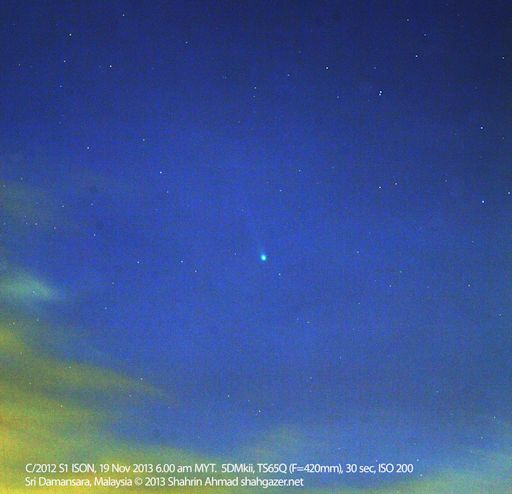
COMET ISON--ANOTHER OUTBURST? Astronomers working with the TRAPPIST telescope at ESO's La Silla Observatory report that Comet ISON's production of gas and dust surged another six-fold during the early hours of Nov. 19th. This marks the second outburst since Nov. 13th. Experienced observers put the comet's rising magnitude near +4.0, well above the threshold of naked-eye visibility. The problem is, ISON is approaching the sun and becoming increasingly difficult to observe. Shahrin Ahmad of Kuala Lumpur, Malaysia, photographed the comet's green core framed by twilight blue on the morning of Nov. 19th:
Amateur photography of the comet will be possible for a few more days. Soon, however, only NASA's fleet of solar observatories will be able to track the sundiver.
At closest approach (perihelion) on Nov. 28th, ISON will be little more than a million kilometers from the sun's fiery surface. Despite the recent outbursts, which could have been caused by a break up of ISON's nucleus, astronomers with NASA's Comet ISON Observing Campaign believe that the comet is still intact. It will need to be to survive next week's hellish plunge through the sun's atmosphere.
Observationally speaking, the next big event in the timeline of Comet ISON's journey comes on Nov. 21st when the comet enters the field of view of STEREO-A. The spacecraft's Heliospheric Imager will pick up the comet just as Earth-bound telescopes begin to lose it. In the days that follow, STEREO-B, SOHO and the Solar Dynamics Observatory will join the hunt, providing continuous views of Comet ISON all the way to perihelion. Stay tuned for some marvelous images.
Realtime Comet ISON Photo Gallery
Ephemerides: Comet ISON, Comet Lovejoy, Comet Encke, Comet LINEAR X1
VENUS AND NUNKI: When the sun goes down tonight, step outside and look southwest. You can't miss Venus shining brightly through the twilight. Got patience? Keep watching until the sky darkens. Venus is not alone:
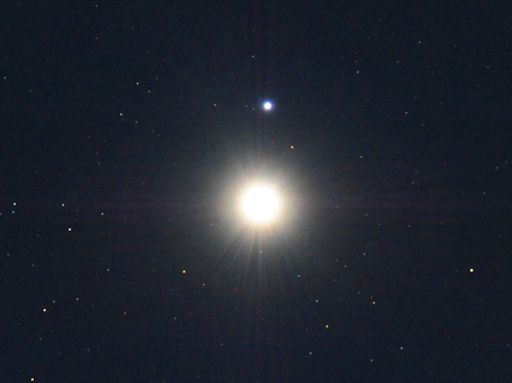
"Last night, Venus slid past the star Nunki (Sigma Sagittarii) in the Milk Dipper asterism in Sagittarius," says astronomy professor Jimmy Westlake, who took the picture on November 18th from Stagecoach, Colorado. "The two missed each other by a scant 12.75 arc minutes. Venus (magnitude -4.56) shines a whopping 420 times brighter than Nunki (magnitude +2)." The mismatched pair is separating now, but Venus and Nunki are still only a fraction of a degree apart on Nov. 19th. Take a look!
Realtime Space Weather Photo Gallery