COMET ISON--UPDATE: New images from SOHO show something emerging from behind the sun. It could be a small fragment of Comet ISON's nucleus or perhaps a "headless comet"--a stream of debris marking the remains of the comet's disintegrated core. Watch the movie and stay tuned for updates.

COMET ISON, R.I.P? Evidence is mounting that comet ISON did not survive its brush with the sun earlier today. At 01:45 EST on Nov. 28th, Thanksgiving Day in the USA, the comet was supposed to pass a little more than a million miles above the surface of the sun. As a new movie from SOHO shows, the comet had already disintegrated. Click to set the scene in motion, and pay careful attention to the head of the comet:


In the movie, Comet ISON is clearly falling apart as it approaches the sun. Researchers working with the Solar Dynamics Observatory report that they are saw nothing along the track that ISON was expected to follow through the sun's atmosphere. Update: Nevertheless, something has emerged from the sun's atmosphere. Watch this movie all the way to the end. Whether this is a small fragment of Comet ISON's nucleus or perhaps a "headless comet"--a stream of debris marking the remains of the comet's disintegrated core--remains to be seen.
An earlier movie from SOHO shows more of the comet's approach:

The movie spans a day and a half period from Nov. 27th (01:41 UT) to 28th (15:22 UT). We see that Comet ISON brightened dramatically on Nov. 27th before fading on Nov. 28th. That brightening might have been the disintegration event, in which the comet cracked open and spilled its vaporizing contents into space.
There is still a chance that some fraction of Comet ISON has survived. (That would make ISON a headless comet--more appropriate for Halloween than Thanksgiving.) Stay tuned for more movies as we watch for debris emerging behind the occulting disk of SOHO coronagraphs. Solar flare alerts: text, voice
Realtime Comet ISON Photo Gallery
WHICH SIDE OF THE SUN IS FACING COMET ISON? When Comet ISON sweeps through the sun's atmosphere on Nov. 28th, it will be in the 'hot zone' for CMEs. A strike by one of the massive storm clouds probably wouldn't destroy the comet, but it could have a dramatic effect on the comet's fragile tail. The odds of a strike depend on which side of the sun is facing the comet at the time of the flyby. This is something you can monitor using a NASA iPhone app called the Interplanetary 3D Sun:
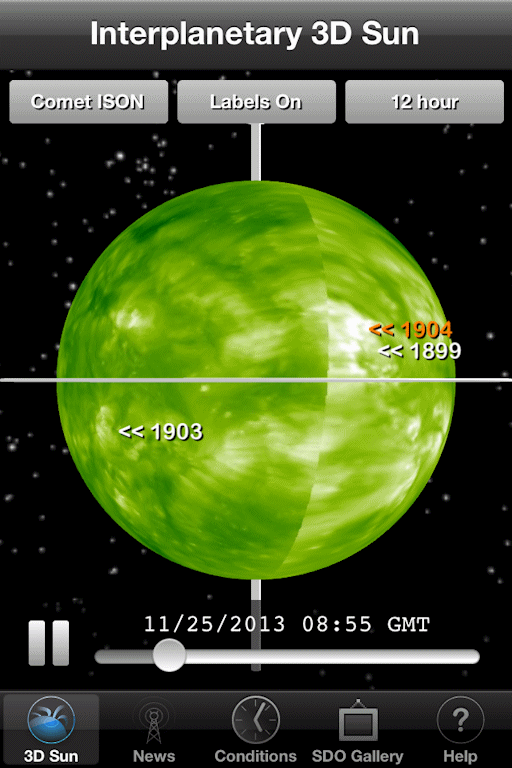
The app displays an interactive 3D model of the entire sun photographed by extreme UV cameras onboard NASA's twin STEREO probes. The data are realtime and fully interactive (pinch, spin and zoom). As shown in this target list, you can view the sun from many locations around the solar system--including Comet ISON.

Active regions are color-coded by their potential for flares: Orange means "expect M-class solar flares," while red denotes sunspots capable of X-flares. In the screen shot above we see that, on Nov. 25th, Comet ISON was bearing down on an active region, AR1904, that posed a threat for M-class eruptions. What is targeting the comet today? Download the app and find out. Solar flare alerts: text, voice
Realtime Space Weather Photo Gallery